10 Best Large Statement Houseplants
Big indoor plants that transform a space. 10 large statement houseplants - from the kentia palm and rubber plant to the fiddle-leaf fig - with indoor heights, light and care from NC State and University of Illinois Extension.
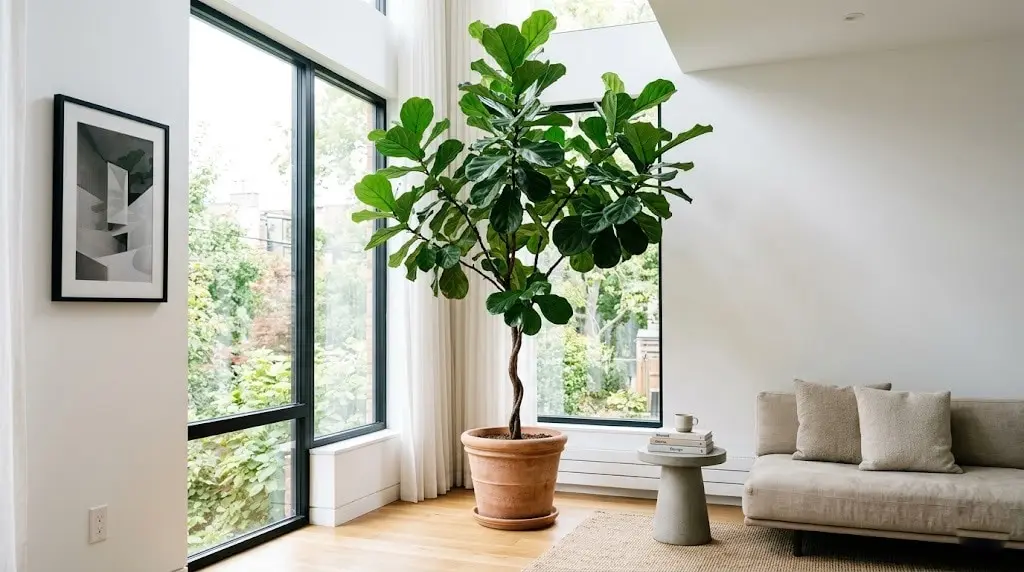
One big, healthy plant in an empty corner fills vertical space and gives the eye somewhere to rest. Big plants are also a bigger commitment: they cost more, are harder to move, and a struggling one is hard to hide. The heights, light and care notes below come from NC State Extension’s Gardener Plant Toolbox and the University of Illinois Extension’s light ratings for houseplants.
At a glance: 10 statement plants
| Plant | Indoor size (NC State) | Light |
|---|---|---|
| Kentia palm | Room-filling palm | Little light needed; no direct sun (NC State) |
| Rubber plant | Usually kept to 2-10 ft | Medium (Illinois); bright indirect or partial shade (NC State) |
| Dracaena marginata | Up to 6 ft as a houseplant | Bright indirect (NC State) |
| Corn plant (Dracaena fragrans) | 3-14.5 ft | Medium (Illinois, dracaena) |
| Snake plant | Upright clumps | Low (Illinois); tolerates very low light (NC State) |
| Giant yucca | Large upright shrub or small tree | Full sun (NC State) |
| Bird of paradise | 3-4 ft | Well-lit, sunny spot (NC State) |
| Monstera | Usually 6-8 ft in homes | See its profile |
| Heartleaf philodendron on a pole | Climbs up to 13 ft | Low (Illinois) |
| Bird’s nest fern | 3-5 ft | Medium (Illinois) |
| Fiddle-leaf fig | 2-10 ft as a houseplant | Medium (Illinois); bright indirect or partial shade (NC State) |
If you share the house with a cat or a dog, check before you buy a floor plant they can reach: the ASPCA lists the kentia palm as non-toxic, and dracaena, snake plant and monstera are on its toxic list. NC State also notes that bird of paradise is toxic to cats, dogs and horses. The links to each ASPCA entry are in our pet-safe houseplants guide.
The forgiving statement plants
Kentia palm (Howea forsteriana)
NC State calls the kentia palm a popular houseplant that needs little light, though it adapts to sunny spots as long as direct sun is avoided. It was hugely popular in Victorian times, suits containers, and has a track record of surviving low light, dust, central heating, rough handling, drought and general neglect. NC State lists it as non-toxic to cats and dogs.
Rubber plant (Ficus elastica)
NC State says the rubber plant can reach 100 feet in the wild but is usually kept to 2-10 feet indoors. Grow it in a soil-based mix in bright indirect light or partial shade, out of afternoon sun; water regularly but don’t overwater, and water less from autumn to late winter. It prefers to stay in one place, dislikes draughts and cold, and can become heavy, so it suits large spaces. Wipe the leaves with a damp cloth.
Dracaena
NC State says Dracaena marginata grows to about 6 feet as a houseplant and can be pruned smaller; give it a well-draining mix, let it dry between waterings (but not severely), and bright indirect light. Like most dracaenas it is sensitive to fluoride, which discolours the leaves. The corn plant (Dracaena fragrans) is a slow-growing shrub widely grown indoors. The University of Illinois rates dracaenas for medium light.
Snake plant
NC State says the snake plant tolerates very low light and suits a spot with 2 to 6 hours of direct sun. Don’t overwater, or the roots rot: let the mix dry between waterings from spring to autumn, and water only every one to two months in winter. The University of Illinois rates it for low light.
Giant yucca (Yucca gigantea)
NC State calls the giant (spineless) yucca a popular, low-maintenance indoor and outdoor plant that grows as a large upright succulent shrub or small tree. It prefers full sun, is drought tolerant, and suffers from overwatering; for houseplants NC State suggests one part potting mix to three parts perlite or sand. Keep it away from cold draughts and sudden temperature changes.
Bird of paradise (Strelitzia reginae)
NC State gives the bird of paradise a height of 3-4 feet. Indoors, grow it in a well-lit, sunny spot in fertile, well-drained soil; water freely and feed regularly in spring and summer, and keep it drier in winter. It likes night temperatures of 55-65°F.
The climbers
Monstera deliciosa
NC State says Monstera deliciosa can reach 70 feet in the wild but stays between 6 and 8 feet in most homes, and rates its growth as rapid.
Heartleaf philodendron on a pole
NC State describes the heartleaf philodendron as a trailing or climbing plant that can grow up to 13 feet. Given something to climb, it becomes a tall green column; the University of Illinois rates it for low light.
Ferns and figs
Bird’s nest fern (Asplenium nidus)
NC State gives the bird’s nest fern a height of 3-5 feet, says it does best in a rich, moist, porous mix such as a fern potting mix, and that it will not survive below 40°F. A pebble tray of water helps with humidity. The University of Illinois rates it for medium light.
Fiddle-leaf fig (Ficus lyrata)
NC State says the fiddle-leaf fig grows 2-10 feet tall as a houseplant, with leaves up to 18 inches long. It prefers bright indirect light or partial shade, protection from afternoon sun, medium humidity and temperatures above 55°F, and it is sensitive to overwatering. Its stems have a milky sap that can irritate the skin. The University of Illinois rates it for medium light.
How to care for a large plant
- Place it before you buy it. Choose the spot first; NC State notes the rubber plant, for one, prefers to stay in one location.
- Match the light. Use the University of Illinois ratings above; our light checker helps you judge a spot.
- Use a heavy pot for top-heavy plants. The Royal Horticultural Society suggests a peat-free, loam-based compost for top-heavy plants, because it is heavier and more stable. Always use a pot with drainage.
- Don’t overwater. NC State warns about overwatering for the snake plant, yucca, rubber plant and fiddle-leaf fig.
- Keep the leaves clean. Wipe big leaves with a damp cloth (NC State, for the rubber plant).
Frequently asked questions
What is the easiest large houseplant?
NC State says the kentia palm has a track record of surviving low light, dust, central heating, drought and general neglect; the snake plant also tolerates very low light.
Is the fiddle-leaf fig good for beginners?
NC State calls it relatively low-maintenance, but it needs bright indirect light, protection from afternoon sun and careful watering, because it is sensitive to overwatering.
How much light does a large statement plant need?
It varies: the University of Illinois rates the snake plant for low light; dracaenas, the rubber plant, the fiddle-leaf fig and the bird’s nest fern for medium; and NC State says the bird of paradise and giant yucca want sun.
Which large houseplants are safe for pets?
The ASPCA lists the kentia palm as non-toxic; dracaena, snake plant and monstera are on its toxic list, and NC State notes bird of paradise is toxic to cats, dogs and horses.
Sources
- NC State Extension Gardener Plant Toolbox: Howea forsteriana, Ficus elastica, Dracaena marginata, Dracaena fragrans, Dracaena trifasciata, Yucca gigantea, Strelitzia reginae, Monstera deliciosa, Philodendron hederaceum, Asplenium nidus, Ficus lyrata. Read 28 October 2026.
- University of Illinois Extension, Houseplants: lighting. Read 28 October 2026.
- Royal Horticultural Society, How to grow houseplants. Read 28 October 2026.
- ASPCA, plant lists for cats and dogs, via our pet-safe guide.
Recommended Gear on Amazon
- Fiddle leaf fig (live) - browse current options and reviews on Amazon.
- Monstera deliciosa (live) - browse current options and reviews on Amazon.
- Large indoor planter with drainage - browse current options and reviews on Amazon.
As an Amazon Associate, we earn from qualifying purchases - at no extra cost to you. This helps us keep producing free, in-depth guides.