Snake Plant (Sansevieria / Dracaena trifasciata)
The Snake Plant is the plant for people who think they cannot keep plants alive.
🗓️ Last reviewed: June 2026
Overview
The Snake Plant is the plant for people who think they cannot keep plants alive. Tall, sculptural, architectural, and almost indestructible, it thrives on neglect, survives in low light, and asks for water roughly once a month. It is the number-one recommendation for beginners, offices, dark hallways, and frequent travelers. Botanically it was reclassified from Sansevieria into the genus Dracaena a few years ago, but the plant world still mostly calls it Sansevieria - and almost everyone calls it the Snake Plant or "mother-in-law's tongue."
Origin & Natural Habitat
The Snake Plant is native to the dry, rocky regions of West Africa, particularly Nigeria and the Congo. It evolved in hot, arid conditions with poor soil and long dry spells - which is exactly why it is so tough indoors. It stores water in its thick, fleshy leaves and rhizomes, so it can coast through weeks of drought without complaint.
Because it comes from harsh environments, its survival strategy is patience and toughness rather than fast growth. Understanding that origin is the whole secret to its care: treat it like the desert-edge survivor it is, and it will outlive most of your furniture.
Appearance
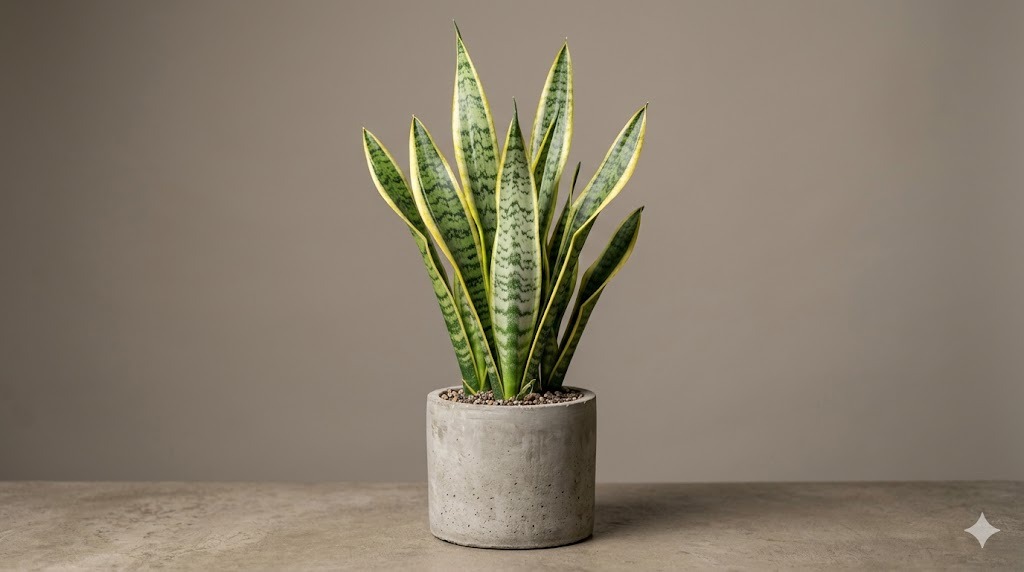
The classic Snake Plant has stiff, upright, sword-shaped leaves growing straight up from the soil in a tight clump. Leaves are dark green with paler grey-green horizontal banding, and many varieties have a bright yellow margin.
Popular varieties:
- 'Laurentii' - the classic tall form with golden-yellow leaf edges.
- 'Zeylanica' - dark green with wavy banding, no yellow edge.
- 'Moonshine' - pale silvery-green leaves.
- 'Cylindrica' - round, spear-like leaves, sometimes braided.
- 'Hahnii' (Bird's Nest) - a compact rosette form, only 15-20 cm tall, great for desks.
Indoors, the tall types reach 60-120 cm; some old plants exceed 1.5 m. Growth is slow - expect a few new leaves a year.
Why People Love It - Qualities & Benefits
- Nearly impossible to kill: it survives low light, dry air, irregular watering, and long absences. The ultimate beginner and traveler plant.
- Architectural shape: the strong vertical lines suit modern, minimal interiors and fill an empty corner without sprawling.
- Thrives in low light: one of the very few striking plants that genuinely tolerate dark rooms, hallways, and windowless offices.
- Night-time oxygen: unlike most plants, the Snake Plant uses CAM photosynthesis and releases oxygen at night, which is why it is often recommended as a bedroom plant. The effect on real room air is small, but it is a genuine quirk.
- Air quality: it featured in NASA's famous Clean Air Study; in a normal home the purifying effect is modest, but it is a healthy, low-maintenance way to add greenery.
- Slow and tidy: it does not outgrow its space or need constant pruning.
Care
Light
Extremely adaptable. It does best in moderate to bright indirect light, where it grows fastest and shows the strongest leaf color. But its superpower is tolerating low light - it will survive in a dim corner where almost nothing else would. It also handles some direct sun once acclimated. In short: it grows anywhere, just faster in brighter spots.
Watering
This is the only way to kill a Snake Plant - overwatering. Water only when the soil is completely dry all the way through, then water thoroughly and drain. In practice that means roughly every 2-4 weeks in summer and every 6-8 weeks in winter. When unsure, do not water. The leaves store plenty of reserve. Soft, mushy, or yellowing leaves at the base mean rot from too much water.
Soil & Potting
Use a free-draining mix - a cactus/succulent mix, or regular potting soil cut heavily with perlite and sand. A pot with drainage holes is essential. Terracotta is ideal because it wicks away excess moisture.
Humidity & Temperature
Indifferent to humidity - normal dry room air is fine. Comfortable at 18-27 °C. It dislikes cold; keep it above about 10 °C and away from cold drafts and frosty windows in winter.
Feeding
Barely needs feeding. A diluted balanced fertilizer once or twice during spring and summer is plenty. It grows happily with none at all.
Repotting
Repot rarely - every 3-5 years. Snake Plants actually like being root-bound and may flower when crowded. They can even crack a thin plastic pot with their rhizomes; that is a sign to move up one size, in spring.
Propagation
Two easy methods:
- Division: at repotting time, separate the rhizome clump into sections, each with leaves and roots, and pot them up. This is the fastest method and keeps leaf variegation.
- Leaf cuttings: cut a healthy leaf into 5-8 cm segments, let them callous for a day or two, then stand them upright in soil or water. They root slowly over weeks to months. Note: leaf cuttings of variegated varieties usually lose the yellow edge and grow back plain green - use division to keep variegation.
Common Problems & Pests
- Mushy, soft, yellow base: root and rhizome rot from overwatering - the classic mistake. Cut away all rot, let the plant dry, and repot in dry, gritty mix.
- Wrinkled, curling leaves: extreme underwatering (rare, but possible after many months).
- Brown leaf tips: usually inconsistent watering or, occasionally, fluoride/chlorine sensitivity.
- Drooping, splaying leaves: too little light, or overwatering weakening the base.
- Pests: rarely troubled, but mealybugs and spider mites can appear. Wipe off and treat with insecticidal soap.
Toxicity & Safety
Mildly toxic to cats and dogs. The leaves contain saponins; if chewed they cause drooling, nausea, vomiting, and diarrhea. It is not life-threatening but unpleasant, so keep it away from pets that chew plants. Mildly irritating to humans if eaten.
Pros & Cons
Pros
- Almost impossible to kill - perfect for beginners.
- Survives low light and dark rooms.
- Needs water only every few weeks - ideal for travelers.
- Strong, modern, architectural shape.
- Slow, tidy, and long-lived.
Cons
- Slow grower - little visible change month to month.
- Will rot quickly if overwatered.
- Mildly toxic to pets.
- Stiff, formal look is not for everyone.
Best Suited For
- Absolute beginners and "plant killers."
- Offices, hallways, bedrooms, and low-light corners.
- Frequent travelers and busy people.
- Anyone wanting a clean, modern, low-maintenance statement plant.
Not ideal for people who want fast growth and constant new leaves, or pet owners with determined leaf-chewers.
FAQ
How often do I water a Snake Plant? Only when the soil is bone dry - roughly every 2-4 weeks in summer, every 6-8 weeks in winter. If you are unsure, wait. Overwatering is the only common way to kill it.
Can a Snake Plant survive in a room with no window? It will survive low light better than almost any other striking plant, but a truly windowless room with no light at all will eventually weaken it. Some daylight, even indirect, keeps it healthy.
Is it true it cleans the air and releases oxygen at night? It does release oxygen at night, a genuine quirk of its CAM photosynthesis, and it appeared in NASA's Clean Air Study. In a normal-sized room the measurable effect is small - enjoy it as a tough, attractive plant rather than an air purifier.
Why are the leaves falling over? Splaying, drooping leaves usually mean too little light or overwatering softening the base. Move it brighter and water less.
Is it called Sansevieria or Dracaena? Both. Botanists reclassified it from Sansevieria to Dracaena trifasciata, but the plant trade still widely uses Sansevieria. They are the same plant.