Peace Lily (Spathiphyllum)
The Peace Lily is one of the few easy houseplants that flowers reliably indoors.
🗓️ Last reviewed: June 2026
Overview
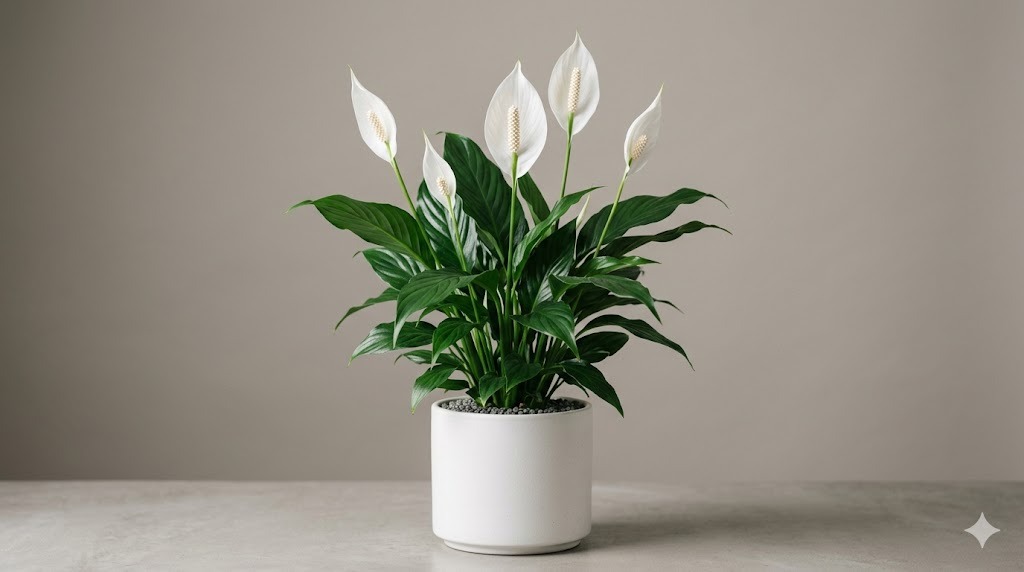
The Peace Lily is one of the few easy houseplants that flowers reliably indoors. With glossy dark-green leaves and elegant white blooms, it brings a soft, calming presence to a room - and unlike most flowering plants, it does it in low to moderate light. Its single most beloved trait is honesty: when it needs water, it dramatically droops, and within an hour of a drink it bounces back. That built-in feedback makes it one of the most beginner-friendly plants you can own. Despite the name, it is not a true lily.
Origin & Natural Habitat
Peace Lilies are native to the tropical rainforests of Central and South America, with some species from Southeast Asia. They grow on the shaded forest floor, beneath the canopy, in warm, humid, consistently moist conditions. That habitat explains their care perfectly: they are adapted to dappled, low light rather than bright sun, and to soil that stays evenly moist rather than drying out hard.
Appearance
The Peace Lily forms a clump of glossy, lance-shaped dark-green leaves rising directly from the soil. The "flower" is its signature feature: a white, hood-like leaf called a spathe, wrapped around a central spike called a spadix. Technically the spathe is a modified leaf, not a petal - but the effect is a clean, sculptural white bloom. Blooms last for weeks, slowly fading to pale green before withering.
Indoors, common types range from compact 30-40 cm plants to large floor specimens over 1 m. Popular cultivars include 'Sensation' (very large), 'Domino' (variegated white-speckled leaves), and many compact hybrids sold simply as "Peace Lily."
Why People Love It - Qualities & Benefits
- Flowers in low light: one of the very few houseplants that produces real blooms in modest light.
- Tells you when it's thirsty: the dramatic droop-and-recover makes watering almost foolproof - perfect for beginners.
- Elegant and calming: the dark leaves and white blooms suit any interior and create a soft, peaceful look.
- Air quality: a star of NASA's Clean Air Study; while real-home purification is modest, it is a healthy way to add humidity and greenery, and it does well in bathrooms.
- Affordable and widely available: inexpensive, easy to find, and easy to replace or divide.
- Forgiving: recovers well from the occasional missed watering.
Care
Light
Low to moderate, indirect light is ideal - it thrives away from windows where many plants would sulk. However, a Peace Lily that never blooms usually needs a bit more (still indirect) light. Avoid direct sun, which scorches the leaves and causes brown patches. It is one of the best true low-light flowering plants.
Watering
Keep the soil lightly and evenly moist - not soggy, not bone dry. The plant makes this easy: when it dries out too much, the whole plant wilts dramatically, and it recovers within an hour or two of watering. Use this as a guide, but try not to let it fully collapse repeatedly, as constant extreme wilting stresses it over time. Water thoroughly and drain. Peace Lilies are sensitive to chemicals in tap water - brown leaf tips are often caused by chlorine, fluoride, or salts; using filtered, distilled, or left-out (dechlorinated) water helps.
Soil & Potting
Use a standard, good-quality potting mix that holds some moisture but still drains. Drainage holes are essential.
Humidity & Temperature
Loves higher humidity (50%+) - ideal for bathrooms and kitchens. Mist it, group it with other plants, or use a pebble tray if your air is dry. Comfortable at 18-27 °C; keep above about 13 °C and away from cold drafts.
Feeding
Feed every 6-8 weeks in spring and summer with a balanced liquid fertilizer at half strength. Over-feeding causes brown tips, so go light.
Repotting
Repot every 1-2 years in spring when roots fill the pot. A Peace Lily that wilts again within a day or two of watering is often badly root-bound and needs a bigger pot.
Propagation
Peace Lilies propagate easily by division. At repotting time, gently separate the clump into sections, each with several leaves and a healthy portion of roots, and pot them up individually. They cannot be propagated from a single leaf cutting. Division is best done in spring.
Common Problems & Pests
- Brown leaf tips: the most common complaint - usually tap-water chemicals, over-fertilizing, or low humidity. Switch to filtered water, feed less, raise humidity.
- Yellow leaves: overwatering, or simply old leaves aging out (occasional yellowing of the oldest leaves is normal).
- No flowers: too little light, or the plant is too young; move it to brighter (still indirect) light.
- Green flowers / blooms turning green: natural aging of the spathe, or too much fertilizer.
- Drooping that doesn't recover after watering: root rot from overwatering, or severely root-bound - check the roots.
- Pests: mealybugs and spider mites occasionally; wipe off and treat with insecticidal soap.
Toxicity & Safety
Toxic to cats, dogs, and humans if chewed. All parts contain insoluble calcium oxalate crystals; chewing causes intense burning of the mouth and throat, drooling, and vomiting. It is not usually life-threatening, but it is genuinely painful - keep it well away from pets and small children.
Pros & Cons
Pros
- Flowers reliably even in low light.
- Tells you clearly when it needs water.
- Elegant, calming, suits any room.
- Inexpensive and easy to find.
- Easy to divide into more plants.
Cons
- Toxic to pets and kids if chewed.
- Brown tips are common with hard tap water.
- Needs fairly consistent moisture - not drought-tolerant.
- Dislikes cold and dry air.
Best Suited For
- Beginners who want a flowering plant.
- Low-light rooms, bathrooms, and offices.
- Anyone who wants an elegant, calming, affordable plant.
- People who like a plant that visibly communicates its needs.
Not ideal for very bright sunny windowsills, homes with leaf-chewing pets or toddlers, or people who travel for long stretches and cannot keep the soil moist.
FAQ
Why does my Peace Lily droop? It is thirsty. The Peace Lily wilts dramatically when the soil gets too dry, then recovers within an hour or two of watering. If it droops and does not recover after a good watering, suspect root rot or a severely root-bound pot.
Why are the leaf tips turning brown? Most often chemicals in tap water - chlorine, fluoride, or salts. Try filtered, distilled, or water left out overnight. Over-fertilizing and dry air also cause brown tips.
Why won't my Peace Lily flower? Usually not enough light. It survives in low light, but to bloom it needs brighter (still indirect) light. A very young or recently divided plant may also simply need time.
Is the Peace Lily safe for pets? No. It is toxic to cats and dogs - chewing causes painful mouth irritation, drooling, and vomiting. Keep it out of their reach.
Do I need to cut off old flowers? Yes - once a bloom fades and turns brown or green and shrivels, snip its stalk down at the base. It tidies the plant and directs energy into new growth.