Pothos (Epipremnum aureum / Devil's Ivy)
Pothos is the friendliest trailing vine in the houseplant world - fast, forgiving, beautiful, and almost unkillable.
🗓️ Last reviewed: June 2026
Overview
Pothos is the friendliest trailing vine in the houseplant world - fast, forgiving, beautiful, and almost unkillable. Its heart-shaped leaves cascade from shelves, climb up poles, and trail across whole walls. It tolerates low light, irregular watering, and beginner mistakes, then rewards you with rapid, visible growth. Its nickname, "Devil's Ivy," comes from the fact that it stays green and keeps growing even in conditions that should kill it. If the Snake Plant is the toughest upright plant, Pothos is the toughest vine.
Origin & Natural Habitat
Pothos originates from the tropical forests of French Polynesia and Southeast Asia, and has since naturalized across tropical regions worldwide - so successfully that in some places it is considered an invasive weed. In the wild it grows as a climbing vine, scrambling up tree trunks with aerial roots, where its leaves can become enormous and develop dramatic splits, much like a Monstera. Indoors it almost always stays in its juvenile, smaller-leaved trailing form.
Appearance
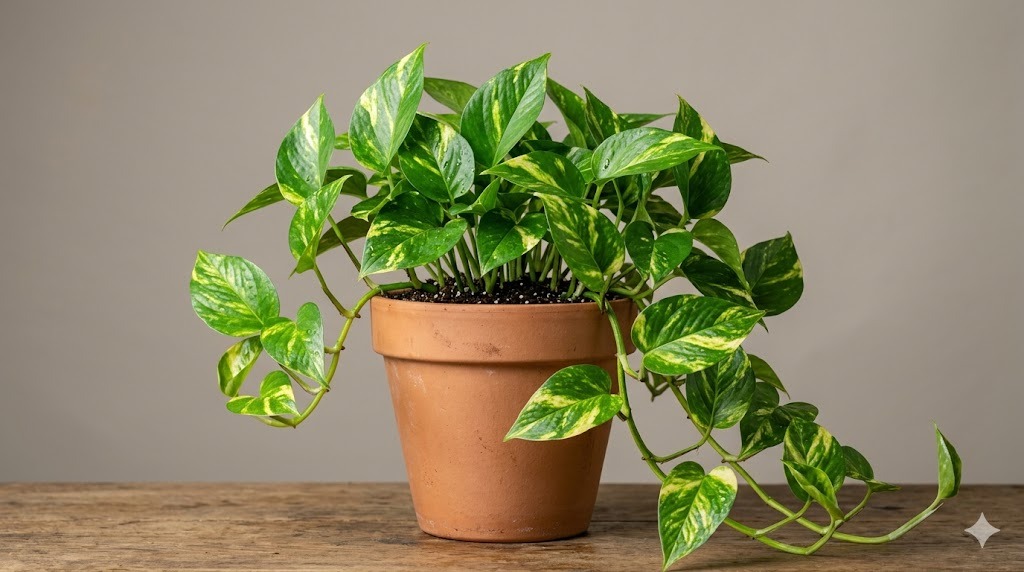
Pothos has glossy, heart-shaped leaves on long, flexible trailing stems. Indoor vines commonly reach 1.5-3 m and can be trained much longer. Left to climb a moss pole, the leaves grow noticeably larger.
Popular varieties:
- 'Golden Pothos' - the classic, green leaves splashed with yellow.
- 'Marble Queen' - heavily marbled cream-and-green.
- 'Neon' - bright chartreuse-lime, glowing.
- 'Jade' - solid deep green, the most low-light tolerant.
- 'Pearls and Jade' / 'N'Joy' - compact, white-and-green variegation.
- 'Manjula' / 'Cebu Blue' - collector favorites with unique patterning.
Why People Love It - Qualities & Benefits
- Beginner-proof: tolerates low light, missed waterings, and dry air. Hard to kill.
- Fast and rewarding: grows visibly week to week in the growing season - very satisfying.
- Versatile styling: trails from a shelf, drapes from a hanging pot, climbs a pole, or frames a window or doorway.
- Tells you what it needs: the leaves droop clearly when thirsty and perk back up within hours of watering - an easy plant to "read."
- Endlessly propagatable: one vine becomes dozens of free plants.
- Greenery and calm: like all leafy plants it adds humidity and a measurable mood lift; it appeared in NASA's Clean Air Study, though real-home purification is modest.
Care
Light
Extremely flexible. Bright, indirect light gives the fastest growth and the boldest variegation. It also tolerates low and medium light better than almost any other variegated plant - though in deep shade, variegated types fade toward plain green. Avoid harsh direct sun, which scorches leaves. If a variegated Pothos is losing its pattern, give it more light.
Watering
Water when the top 3-5 cm of soil is dry - typically weekly in summer, every 10-14 days in winter. Pothos is dramatic and helpful about thirst: the whole plant wilts and the leaves go limp, then recover within hours of a drink. Do not let it sit fully wilted often, but the occasional clear "I'm thirsty" signal makes it easy. As always, overwatering and soggy soil cause root rot.
Soil & Potting
Ordinary well-draining potting mix is fine; a little perlite improves it. A pot with drainage holes is important. Pothos also grows happily in plain water indefinitely as a no-soil display.
Humidity & Temperature
Tolerates normal dry room air; appreciates but does not require higher humidity. Comfortable at 18-29 °C; keep above about 10 °C and away from cold drafts.
Feeding
Feed monthly in spring and summer with a balanced liquid houseplant fertilizer at half strength. None needed in winter.
Repotting & Training
Repot every 1-2 years when roots fill the pot. To keep it full rather than leggy, prune regularly - and every cutting can be replanted into the same pot to thicken it up. Train it on a moss pole for bigger leaves, or let it trail.
Propagation
The easiest propagation of any houseplant. Cut a stem just below a node (the bump where a leaf and a small aerial root meet). Put the node in a glass of water. Roots appear within 1-2 weeks. Pot up the rooted cutting, or leave it growing in water. You can take a dozen cuttings from one plant in five minutes.
Common Problems & Pests
- Yellow leaves: usually overwatering; occasionally natural aging of the oldest leaves.
- Brown crispy tips/edges: underwatering or very dry air.
- Leggy, sparse vines with leaves only at the ends: too little light - move it brighter and prune to encourage bushiness.
- Loss of variegation (going all-green): not enough light.
- Black mushy stems: root rot from soggy soil.
- Pests: generally pest-resistant, but mealybugs and spider mites occasionally appear; wipe off and treat with insecticidal soap.
Toxicity & Safety
Toxic to cats and dogs, and irritating to humans, if chewed. Pothos contains insoluble calcium oxalate crystals; chewing causes intense mouth and throat irritation, drooling, and vomiting. Not usually fatal but genuinely unpleasant. Because Pothos trails and dangles, keep hanging pots well out of reach of cats especially.
Pros & Cons
Pros
- One of the easiest plants to grow and propagate.
- Tolerates low light and irregular watering.
- Fast, visible, rewarding growth.
- Extremely versatile - trail, climb, or grow in water.
- Many beautiful varieties.
Cons
- Toxic to pets and kids if chewed.
- Can get leggy in low light without pruning.
- Vigorous - needs occasional trimming to stay tidy.
- Variegation fades in dim spots.
Best Suited For
- Complete beginners and first plant ever.
- Shelves, hanging pots, and high spots where a vine can trail.
- Lower-light rooms (use the Jade or Golden types).
- Anyone who wants to build a collection cheaply through propagation.
Not ideal for homes with cats that chew dangling leaves, unless hung truly out of reach.
FAQ
Why is my Pothos getting leggy with bare stems? Too little light. The plant stretches toward the light and drops lower leaves. Move it brighter and prune the long bare vines - it will branch and fill out.
Can Pothos grow in just water? Yes - permanently. It grows happily in a vase of water; just change the water every week or two and add a drop of liquid fertilizer occasionally.
Why is my variegated Pothos turning all green? Not enough light. Variegated parts have less chlorophyll, so in low light the plant favors green growth. More bright indirect light restores the pattern.
How do I make my Pothos bushier? Prune it regularly and replant the cuttings back into the same pot. More stems in one pot equals a fuller plant. Brighter light helps too.
Is Pothos safe around pets? No - it is toxic to cats and dogs if chewed, causing mouth irritation and vomiting. Hang it high or keep it in a pet-free room.