Monstera Deliciosa (Swiss Cheese Plant)
The Monstera Deliciosa - the "Swiss Cheese Plant" - is the single most recognizable houseplant of the modern era.
🗓️ Last reviewed: June 2026
Overview
The Monstera Deliciosa - the "Swiss Cheese Plant" - is the single most recognizable houseplant of the modern era. Its huge, glossy, deeply split leaves have appeared on wallpaper, cushions, phone cases, and café walls all over the world. But behind the Instagram fame is a genuinely rewarding plant: a fast-growing tropical climber that is dramatic, forgiving, and easy enough for a confident beginner. Give it light and a pole to climb and it will reward you with leaf after leaf, each one bigger and more fenestrated than the last.
Origin & Natural Habitat
Monstera Deliciosa is native to the tropical rainforests of southern Mexico and Central America, where it grows as a hemiepiphyte - it starts life on the forest floor, then climbs up tree trunks toward the light using thick aerial roots. In the wild a mature plant can climb 20 meters and produce leaves nearly a meter across.
The name tells its story. Monstera comes from the Latin for "monstrous," a nod to the enormous size of a mature plant. Deliciosa refers to its fruit - in habitat the plant produces an edible, ripening cob that tastes like a blend of pineapple and banana. (Indoors it almost never fruits, and the unripe fruit is irritating to eat, so this is trivia, not a feeding tip.)
Appearance
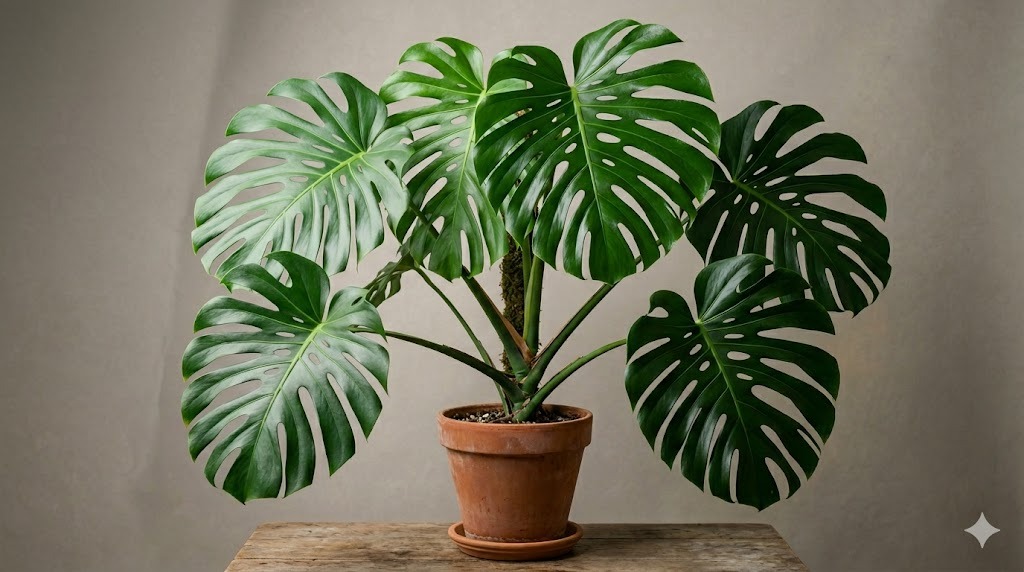
A young Monstera has small, solid, heart-shaped leaves with no holes at all - which is why new owners sometimes think they bought the wrong plant. As the plant matures and especially as it climbs, leaves grow larger and develop the signature features:
- Fenestration: the splits and holes along and inside the leaf. Scientists believe these let wind pass through and help light reach lower leaves in the wild.
- Leaf size: indoors, mature leaves commonly reach 30-60 cm; on a climbing, well-lit plant they get far larger.
- Aerial roots: thick brown roots that emerge from the stem, used to grip and to absorb moisture.
- Growth habit: a vining climber, not a tidy upright - it wants to lean, sprawl, and ascend.
Indoors a Monstera typically reaches 2-3 meters tall over several years. There is also a popular variegated form (Monstera Deliciosa 'Albo' and 'Thai Constellation') with white or cream marbling - beautiful, much slower-growing, and far more expensive.
Why People Love It - Qualities & Benefits
- Statement decor: one mature Monstera fills a corner and transforms a room. It is the definitive "designer" houseplant.
- Fast, visible progress: in good conditions it pushes a new leaf every 4-6 weeks in the growing season, and each leaf is more impressive than the last - deeply satisfying for the owner.
- Forgiving: it tolerates a missed watering and a range of light levels far better than its diva reputation suggests.
- Air and atmosphere: like most large-leaved tropicals it adds humidity to a room through transpiration and contributes to a calmer, greener living space. (The famous "air-purifying" claims are real but modest in a normal home - the main benefit is psychological: greenery measurably lowers stress and lifts mood.)
- Easy to share: it propagates readily, so one plant becomes gifts for friends.
Care
Light
Bright, indirect light is ideal - a spot near an east or north window, or a couple of meters back from a bright south/west window. It tolerates medium light but grows slowly and produces smaller, less-split leaves. Avoid harsh direct midday sun, which scorches the leaves. If new leaves come out small and solid, the plant wants more light.
Watering
Water thoroughly when the top 3-5 cm of soil has dried out, then let excess drain away completely. In a bright spot in summer that is often once a week; in winter every 10-14 days. Monstera hates sitting in water - soggy soil causes root rot, the number-one killer. When in doubt, wait. Drooping, limp leaves usually mean thirst; yellowing lower leaves usually mean overwatering.
Soil & Potting
Use a chunky, well-draining aroid mix: regular potting soil loosened with orchid bark, perlite, and a little coco coir or charcoal. The roots need air. Always use a pot with drainage holes.
Humidity & Temperature
Comfortable at normal room humidity (40-50%) but happiest above 60% - higher humidity means bigger leaves and better fenestration. It enjoys 18-27 °C and dislikes cold drafts and anything below about 12 °C.
Feeding
Feed monthly through spring and summer with a balanced liquid houseplant fertilizer at half strength. Stop feeding in late autumn and winter when growth slows.
Repotting
Repot every 1-2 years in spring, moving up one pot size when roots circle the bottom or push out the drainage holes. A slightly snug pot is fine; an enormous pot holds too much wet soil.
Support - the key to a beautiful Monstera
This is the single most important tip. A Monstera is a climber. Give it a moss pole, coir pole, or trellis and tie new growth to it. A supported, climbing Monstera produces dramatically larger, more fenestrated leaves; an unsupported one sprawls and stays juvenile-looking.
Propagation
Monstera is one of the easiest plants to propagate. Cut a stem section just below a node (the bump where a leaf and aerial root emerge) - the cutting must include at least one node. Place the node in water or directly into moist sphagnum moss or soil. Roots appear in 3-6 weeks. Once roots are several centimeters long, pot it up. A leaf with no node will never grow into a plant.
Common Problems & Pests
- Yellow leaves: usually overwatering or poor drainage. Check the roots and let the soil dry more between waterings.
- Brown crispy edges: low humidity or underwatering.
- No splits / small leaves: not enough light, or no support to climb.
- Brown spots, mushy stem: root rot from soggy soil - repot into fresh dry mix and remove rotten roots.
- Pests: spider mites (fine webbing, stippled leaves), mealybugs (white fluff in leaf joints), and scale. Wipe leaves, isolate the plant, and treat with insecticidal soap or neem oil.
- Weeping / dripping leaves: harmless guttation - the plant is releasing excess water, usually after a generous watering.
Toxicity & Safety
Mildly toxic to cats, dogs, and humans if chewed. All parts contain insoluble calcium oxalate crystals, which cause mouth and throat irritation, drooling, and vomiting if eaten. It is not deadly, but keep it out of reach of pets and small children who chew leaves. The unripe fruit is also irritating.
Pros & Cons
Pros
- Iconic, dramatic, room-transforming foliage.
- Fast and rewarding - visible new growth.
- Forgiving and beginner-friendly.
- Very easy to propagate and share.
- Tolerates a range of light conditions.
Cons
- Gets large - needs floor space and a support pole.
- Sprawls without support; can look messy if neglected.
- Mildly toxic to pets and kids.
- Variegated forms are expensive and slow.
- Aerial roots and climbing habit are not to everyone's taste.
Best Suited For
- Anyone who wants one big, impressive statement plant.
- Confident beginners who can keep a basic watering routine.
- Bright rooms with floor space to spare.
- Plant owners who enjoy training and propagating.
Not ideal for tiny apartments with no floor space, very dark rooms, or homes with pets and toddlers who chew everything.
FAQ
Why doesn't my Monstera have holes? It is either young or not getting enough light. Splits develop with maturity and bright light - and a moss pole to climb dramatically speeds it up.
Is Monstera the same as a "split-leaf philodendron"? No, though it is often sold under that name. Monstera Deliciosa is not a philodendron; it is its own genus. The mislabeling is a long-standing nursery habit.
How often should I water it? When the top 3-5 cm of soil is dry - roughly weekly in summer, every 10-14 days in winter. Light and pot size change everything, so always check the soil rather than following a fixed schedule.
Can I cut the aerial roots? Yes, you can trim them for tidiness without harming the plant, or tuck them into the pot or moss pole where they help with support and moisture.
Why are the new leaves smaller than the old ones? Usually not enough light, or the plant has nothing to climb. Move it brighter and add a support pole.