Keep Plants Alive While on Vacation
Going away? How to keep houseplants and garden plants going while you're on vacation, from a weekend to a month, following RHS and university extension advice.
A holiday should be relaxing, not spoiled by worry about thirsty plants. The Royal Horticultural Society notes that most houseplants tolerate a few days’ absence without suffering, while absences of more than a week call for some measures to give them water in the right amount. Cacti and succulents, which store water in their fleshy leaves and stems, tolerate longer without water than other houseplants.
This guide covers each length of trip, indoors and out, following the RHS, the University of Illinois Extension and Penn State Extension.
First: prepare before every trip
Whatever the length of your trip:
- Water thoroughly before you leave. For short summer absences, the RHS says a thorough watering before going away may be enough. If you are unsure how much each plant needs, our watering calculator can help you gauge it.
- Move houseplants out of direct sun. The RHS advises moving them away from bright, hot windowsills into a cooler, central room: leaving plants in direct sun while you are away increases water loss dramatically.
- In winter, watch the cold. The RHS notes that in winter houseplants can often be left for a week or two, as long as the temperature does not fall below the minimum they tolerate, so move them away from cold windows.
For a few days
A thorough watering before you leave and a move away from the bright window is usually enough (RHS). Cacti and succulents need no special measures. Don’t overdo it: plants that stand in waterlogged compost can rot.
For a week or two
For longer absences, the RHS suggests giving the plant a reservoir of water to draw on:
The wick method
Useful for a large single pot. Fill a large container with water and use a strip of capillary matting as a wick: put one end in the reservoir and tuck the other end into the pot, so the plant can draw water as it needs it (RHS).
Capillary matting in the sink or bath
Useful for a collection of smaller pots. Lay capillary matting on the draining board or next to the bath, drape one end into the sink or bath filled with water, and stand the plants on the wet matting, pressing them down slightly so they make good contact. The RHS notes that clay pots need a thorough watering first to start drawing water from the mat, and the method may not work with pots that have broken crocks in the bottom. Wet towels can stand in for the matting.
A clear cover
For short absences, the RHS suggests a reusable clear cover or a propagator lid over the plant to keep moisture in, or a plastic bag you already have, held off the leaves with canes. The University of Illinois describes a version for about a week: cover each plant with a clear plastic bag large enough for it, and stand it in a shallow pan with pebbles and some water; it says this set-up should last 7-8 days.
Watering globes
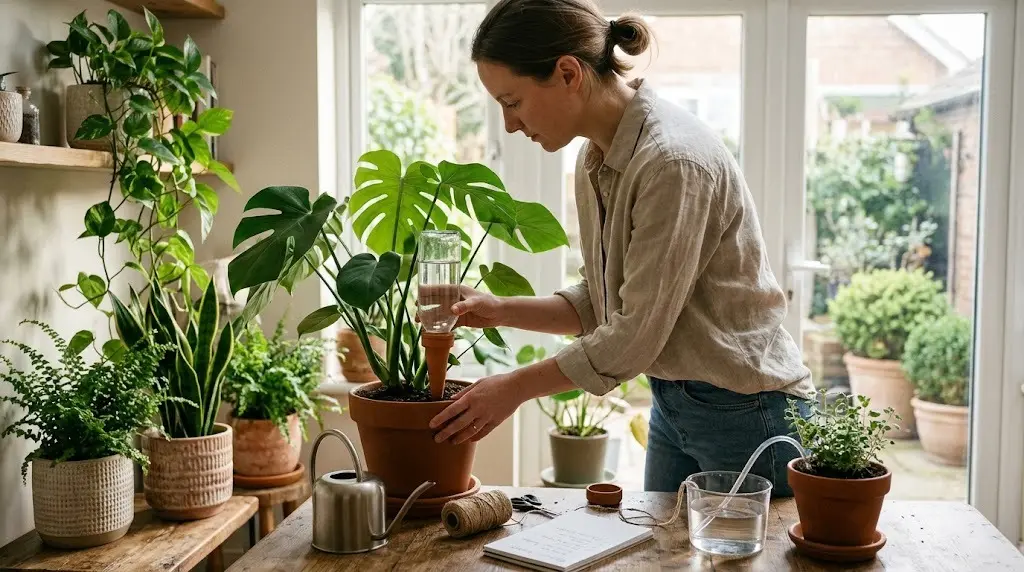
Penn State Extension’s Master Gardeners note that glass watering globes pushed into the soil may supply a trickle of moisture for one to two weeks, but suit only plants whose soil should stay constantly moist, and that in loosely packed soil all the water may run out at once.
Self-watering pots
The RHS sees self-watering containers as a long-term way of growing rather than a quick holiday fix, best for plants that like moisture all year, and advises against repotting just for a short absence unless you already use them.
For longer than a couple of weeks
The RHS suggests that for absences longer than a couple of weeks it may be better to have a trusted neighbour, friend or relative water the houseplants. Penn State Extension gives the same two options for several weeks away: clear plastic bags as a mini greenhouse, or a friend who waters. The University of Illinois also advises asking someone to check on the plants regularly during a longer trip.
Leave the person clear, simple notes per plant (“water these three when the compost feels dry; leave the rest alone”) so a well-meaning helper does not overwater.
For the outdoor garden
The RHS calls asking someone you trust to water the most reliable solution if you are away for more than a few days, focusing on containers, hanging baskets, vegetables and newly planted trees and shrubs, which dry out faster than established plants. Its other tips:
- Containers dry out first. Move portable pots into a shaded, sheltered spot out of the afternoon sun, group them tightly, water deeply before you leave and stand them on shallow saucers as a small reserve. Shade pots that are too heavy to move with prunings or taller potted plants.
- Hanging baskets dry out fastest of all because of the wind. If you are leaving for more than a few days, take them down and stand them in buckets or large saucers of water.
- Tomatoes: pick all ripe and ripening fruit and give the roots a long, deep soak just before you leave.
- Deadhead and trim. Remove faded flowers, and if suitable, cut back the top third of leafy, vigorous perennials to reduce their water needs (not plants at their peak or just coming into flower).
- Drip irrigation on a timer suits frequent travellers. Set it to run late at night or early in the morning, give survival rations only so plants do not rot if it rains a lot, and check your water provider’s rules on hosepipe bans and automatic watering first.
What not to do
- Don’t drown plants “to compensate.” The RHS warns that overestimating water needs can leave compost waterlogged and lead to rots such as grey mould.
- Don’t leave plants in direct sun. It increases water loss dramatically (RHS).
- Don’t rely on an untested setup. The RHS notes that small reservoirs can run dry and wicks can slip out of pots if not tucked in well. Try it for a few days before you leave.
- Don’t give vague sitter instructions. “Look after my plants” invites overwatering. Be specific, per plant.
Quick reference
| Trip length | Plan |
|---|---|
| A few days | Water well and move out of direct sun (RHS) |
| A week or two | Wick, capillary matting in the sink or bath, or a clear cover (RHS; bag over pebbles about 7-8 days, University of Illinois) |
| More than a couple of weeks | A trusted person to water (RHS, Penn State, University of Illinois) |
| Outdoor garden | Pots in shade and grouped, baskets down into water, ripe fruit picked, drip timer or a neighbour (RHS) |
Frequently asked questions
How long can houseplants go without water?
It varies. The RHS says most houseplants tolerate a few days, that cacti and succulents tolerate longer, and that in winter houseplants can often be left for a week or two if the room stays cool enough for them.
Can I leave my plants for 2 weeks?
Usually yes, with a water reservoir: a wick, capillary matting in the sink or bath, or a clear cover (RHS). Move them out of direct sun first. For longer than a couple of weeks, the RHS suggests a trusted person to water.
Should I water my plants extra before leaving?
Water them thoroughly once, but don’t leave them waterlogged: the RHS warns that overestimating water needs can lead to rots.
What about my outdoor garden while I’m away?
Group containers in shade, water deeply, take hanging baskets down into buckets of water, pick ripe fruit, and ask someone to water if you are away for more than a few days (RHS).
Sources
- Royal Horticultural Society, Houseplants: holiday care tips and How to look after your garden on holiday. Read 28 October 2026.
- University of Illinois Extension, Houseplants: care. Read 28 October 2026.
- Penn State Extension, Master Gardener advice on the gear houseplants really need (extension.psu.edu). Read 28 October 2026.
Recommended Gear on Amazon
- Capillary matting - browse current options and reviews on Amazon.
- Self-watering wicks - browse current options and reviews on Amazon.
- Drip irrigation kit with timer - browse current options and reviews on Amazon.
As an Amazon Associate, we earn from qualifying purchases - at no extra cost to you. This helps us keep producing free, in-depth guides.