Butterfly Bush (Buddleja)
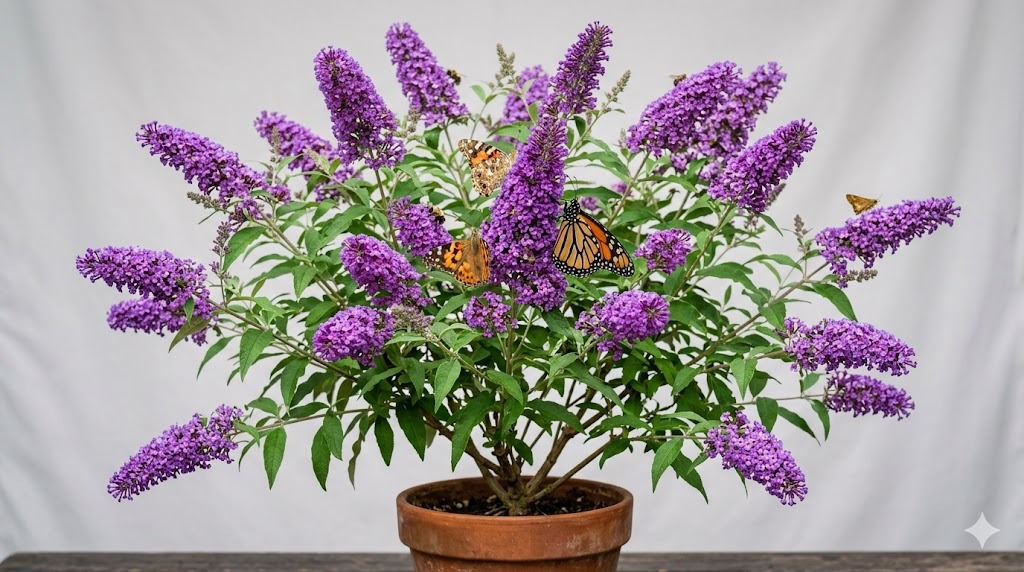
The butterfly bush earns its name in the most literal way - in summer, its long arching plumes of nectar-rich flowers become a magnet, alive with butterflies, bees, and hoverflies.
🗓️ Last reviewed: June 2026
Overview
The butterfly bush earns its name in the most literal way - in summer, its long arching plumes of nectar-rich flowers become a magnet, alive with butterflies, bees, and hoverflies. It is one of the fastest, easiest, toughest flowering shrubs you can grow: it shrugs off poor soil, drought, and neglect, and rewards you with months of bloom in purple, blue, pink, white, and yellow. That toughness is also its dark side - in many regions Buddleja self-seeds aggressively and is classed as invasive. Grown responsibly, with deadheading or sterile varieties, it is a brilliant pollinator plant.
Origin & Natural Habitat
The most common species, Buddleja davidii, comes from China. In the wild, and as a colonizer, it grows on disturbed, stony, free-draining ground - riverbanks, rocky slopes, gravel, and (famously) old walls, railway lines, and urban wasteland. This pioneer nature explains both its toughness and its weediness: it thrives on poor dry ground and produces enormous quantities of wind-blown seed.
Appearance
Buddleja davidii is a fast-growing deciduous shrub, typically 2-3 m tall and wide (dwarf varieties stay around 1 m). It has an arching, somewhat loose habit, with long lance-shaped grey-green leaves. From midsummer to autumn it produces long, tapering, cone-shaped flower panicles - packed with tiny, honey-scented flowers - at the tips of the current year's growth. Colors include deep purple, violet-blue, magenta, pink, white, and (in the species B. globosa) orange-yellow balls.
Why People Grow It - Qualities & Benefits
- Butterfly and pollinator magnet: one of the very best nectar plants for butterflies, bees, and moths.
- Long bloom: months of flower through summer into autumn.
- Fast and easy: rapid growth, quick to fill a space, almost unkillable.
- Drought- and poverty-tolerant: thrives in poor, dry, free-draining soil.
- Fragrance: the flowers carry a sweet honey scent.
- Cheap and forgiving: easy to propagate; recovers from hard pruning.
Care
Light & Position
Full sun. Buddleja flowers best, and attracts the most insects, in a hot, open, sunny position. It tolerates some shade but grows leggier and flowers less.
Soil
Almost any well-drained soil, including poor, stony, and dry ground. It dislikes only heavy, wet, waterlogged soil. Rich soil simply produces lush growth and is not needed.
Watering
Drought-tolerant once established. Water new plants through their first season; after that, watering is rarely necessary except in extended drought or in containers.
Feeding
Generally needs no feeding - it grows vigorously without it, and rich feeding only produces more leaf. A light mulch is ample.
Pruning - the key to good flowering
Buddleja davidii flowers on new wood (the current year's growth). Prune hard every spring - cut the whole plant back to a low framework, roughly 30-60 cm from the ground, as growth begins. Hard pruning produces a compact, shapely shrub with bigger, better flower plumes; left unpruned it becomes a tall, woody, sparse, top-heavy tangle. Deadhead spent flower spikes through summer to prolong bloom - and, importantly, to reduce self-seeding.
Hardiness & Winter Care
Buddleja davidii is hardy to around USDA zone 5. In cold areas the top growth may die back in winter; since it is pruned hard each spring anyway, this is rarely a problem - it regrows from the base. No special winter protection is needed.
Planting & Propagation
Plant in spring or autumn in a sunny, well-drained spot. Propagation is extremely easy from hardwood or softwood cuttings - it roots readily. It also self-seeds abundantly (the source of its invasiveness). To grow it responsibly, choose modern seedless or sterile varieties, and deadhead before seed sets.
Common Problems & Pests
- Leggy, sparse, woody shrub: caused by not pruning hard each spring; the cure is hard annual pruning.
- Self-seeding / invasiveness: the major issue - seedlings spread into walls, pavements, and the wild. Deadhead diligently and prefer sterile cultivars; in some regions sale is restricted.
- Few flowers / few butterflies: too much shade.
- Pests/disease: remarkably trouble-free; capsid bugs, spider mites in hot dry spells, occasional die-back can occur but are minor.
Toxicity & Safety
Buddleja is generally regarded as non-toxic / low-toxicity to cats, dogs, horses, and humans - it is not considered a significant poisoning hazard, and as a pollinator plant it has high wildlife value. The genuine "safety" concern with butterfly bush is ecological, not medical: its invasive self-seeding can crowd out native plants, so responsible, deadheaded, or sterile-variety growing is the key.
Pros & Cons
Pros
- Outstanding butterfly and pollinator magnet.
- Long summer-to-autumn bloom, sweetly scented.
- Extremely fast, tough, and easy; drought-tolerant.
- Pet-friendly; very easy to propagate.
Cons
- Invasive self-seeder in many regions - needs responsible management.
- Becomes leggy and ugly without hard annual pruning.
- The species can be coarse and large for small gardens.
- Short-lived and somewhat untidy compared to refined shrubs.
Best Suited For
- Wildlife and pollinator gardens; butterfly borders.
- Hot, dry, sunny spots and poor soil where little else thrives.
- Fast screening or quick color in a new garden.
- Gardeners willing to prune hard each spring and deadhead.
Not ideal for small tidy gardens (the species), wet heavy soil, deep shade, or regions where it is invasive - unless a sterile variety is used.
FAQ
Why is my butterfly bush tall, woody, and bare at the bottom? Because it was not pruned hard. Buddleja davidii flowers on new growth and must be cut back hard - to a low framework about 30-60 cm tall - every spring. Hard pruning keeps it compact and improves flowering dramatically.
Is butterfly bush invasive? It can be. In many regions Buddleja davidii self-seeds aggressively and is classed as invasive, colonizing walls, pavements, and wild areas. Deadhead spent flowers before they set seed, and choose modern sterile or seedless varieties.
When should I prune a butterfly bush? In spring, as new growth begins - cut the whole plant back hard. It flowers on the current year's wood, so spring pruning does not cost you flowers; it improves them.
Is butterfly bush safe for pets? Yes - it is generally considered non-toxic to cats, dogs, and horses. Its real downside is ecological invasiveness, not toxicity.
How do I attract more butterflies to it? Grow it in full sun, deadhead to keep new flowers coming, and avoid pesticides. A sunny, sheltered, undisturbed spot brings in the most butterflies.