Climbing Hydrangea
The climbing hydrangea is the answer to one of the trickiest questions in gardening: how do you bring real flowers to a cold, shady, north-facing wall?
🗓️ Last reviewed: June 2026
Overview
The climbing hydrangea is the answer to one of the trickiest questions in gardening: how do you bring real flowers to a cold, shady, north-facing wall? Most flowering climbers want sun; this one is genuinely happy in shade. It is a self-clinging, woody climber that, given time, covers a wall, fence, or tree trunk in handsome heart-shaped leaves and, in early summer, in broad, flat, white lacecap flower heads. It is hardy, long-lived, low-maintenance, and self-supporting. Its one demand of the gardener is the hardest of all - patience: the climbing hydrangea is famously slow to establish and slow to start flowering.
Origin & Natural Habitat
The climbing hydrangea (Hydrangea anomala subsp. petiolaris, often simply Hydrangea petiolaris) is native to the woodlands of East Asia - Japan, Korea, and parts of China and the Russian Far East. In the wild it climbs up the trunks of forest trees and over rocks, in cool, moist, shaded, humus-rich conditions. This woodland origin is the entire basis of its care: it is built for shade, cool moist roots, and rich soil, and it climbs tree trunks naturally - which is exactly how it behaves in the garden.
Appearance
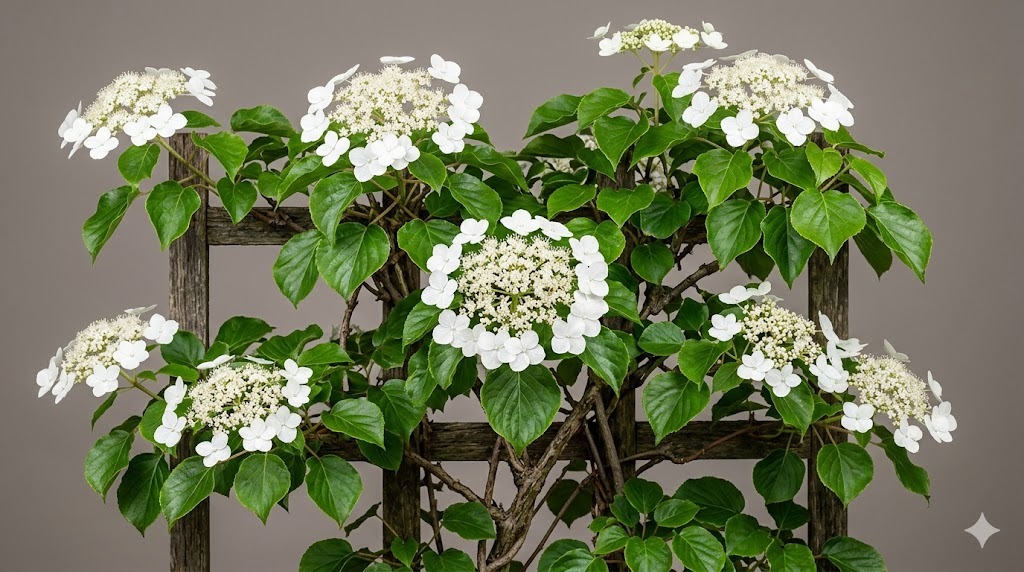
The climbing hydrangea is a vigorous, woody, deciduous climber that, once established, can reach 10-15 m and live for decades. It climbs by means of aerial rootlets that cling directly to walls, fences, and bark - it is self-supporting and needs no wires or ties. The leaves are rounded to heart-shaped, glossy mid-green, often turning soft yellow in autumn before falling. In early summer it produces broad, flattened lacecap flower heads - a central mass of tiny fertile flowers surrounded by a ring of showy white sterile florets - up to 20-25 cm across. The mature bark is attractive, peeling cinnamon-brown, giving winter interest.
Why People Grow It - Qualities & Benefits
- Flowers in shade: one of the very best flowering climbers for a shady, north-facing wall.
- Self-clinging: climbs unaided - no wires, trellis, or tying needed.
- Handsome all-rounder: glossy foliage, white lacecap flowers, autumn colour, and peeling winter bark.
- Hardy and long-lived: very cold-tolerant and durable once established.
- Low-maintenance: needs minimal pruning once settled.
- Versatile: walls, fences, large tree trunks, and can even sprawl as ground cover.
- Pollinator value: the lacecap flowers attract bees.
Care
Light & Position
Shade to part shade - its great strength. The climbing hydrangea thrives on cool, shaded, even north- and east-facing walls where flowering climbers are scarce. It also grows in part shade and tolerates some sun if the soil stays moist; it dislikes hot, dry, baking positions.
Soil
Cool, moist, fertile, humus-rich, well-drained soil - woodland soil. Improve generously with compost or leaf mould. It dislikes hot, dry, or thin soils.
Watering
Keep the soil moist, especially while establishing and in dry spells - this climber dislikes drying out. Mulch generously to retain moisture and keep the roots cool. Plants against walls need particular attention, as wall bases are often dry.
Feeding
Feed in spring with a balanced fertilizer and mulch with compost; this supports establishment and flowering.
Patience - the defining requirement
The single most important thing to know about the climbing hydrangea is that it is slow. It famously takes its time to establish - often two, three, even several years of putting on little visible growth while it builds its root system - and it may not flower at all for the first few years after planting. This slow start is completely normal and is not a sign of failure. The old gardening saying about establishing plants - "first they sleep, then they creep, then they leap" - fits the climbing hydrangea perfectly. Plant it, care for it, and wait.
Support & Pruning
No support is needed - the aerial rootlets cling directly. (On a young plant, a little initial help to direct it to the wall can be useful.) Pruning is minimal: once established, simply trim after flowering to keep it within bounds and remove any dead or wayward growth. It can be cut back harder to control size and generally tolerates it.
Hardiness & Winter Care
The climbing hydrangea is very hardy - commonly to around USDA zone 4-5 - and needs no winter protection. It is deciduous, dropping its leaves in winter, when the peeling bark provides interest.
Planting & Propagation
Plant in autumn or spring in cool, moist, improved soil, with the roots shaded. Propagate by layering (reliable) or from softwood/semi-ripe cuttings (slow). As with the plant itself, propagation rewards patience.
Common Problems & Pests
- Slow growth and no flowers for the first few years: the classic "problem" - and not really a problem at all, simply the plant's nature. Patience is the answer; do not assume failure.
- Poor flowering once established: usually too much deep shade for any flowering at all (it needs at least some light), too dry a position, or a plant still in its slow establishment phase.
- Drying out: wall bases are often dry - drought stress causes poor growth; water and mulch well.
- Pests/disease: generally robust and trouble-free; aphids or occasional leaf problems may occur but are rarely serious.
Toxicity & Safety
Like other hydrangeas, the climbing hydrangea is regarded as toxic if eaten - the leaves, buds, and flowers contain cyanogenic glycosides and can cause vomiting, diarrhea, and lethargy in cats, dogs, and horses, and stomach upset in humans, if eaten in quantity. Serious poisoning is uncommon, and hydrangeas are widely grown in family gardens, but pets and children should be discouraged from eating the plant.
Pros & Cons
Pros
- One of the best flowering climbers for shade and north-facing walls.
- Self-clinging - no wires, trellis, or tying needed.
- Hardy, long-lived, low-maintenance once established.
- Year-round interest: foliage, flowers, autumn colour, peeling bark.
Cons
- Very slow to establish and slow to start flowering - demands patience.
- Toxic if eaten.
- Vigorous in the long term - eventually needs space and some control.
- Self-clinging rootlets can mark or damage unsound walls and render.
Best Suited For
- Shady, cool, north- and east-facing walls and fences.
- Large tree trunks and as ground cover in shade.
- Woodland and shade gardens; covering difficult shaded structures.
- Patient gardeners who plant for the long term.
Not ideal for hot, dry, sunny spots, very small gardens (long-term size), old or rendered walls (clinging rootlets), or impatient gardeners wanting quick results.
FAQ
Why isn't my climbing hydrangea growing or flowering? This is almost always simply its nature, not a fault. The climbing hydrangea is famously slow to establish - it can spend two, three, or more years building its root system with little visible top growth, and it often does not flower at all for the first few years after planting. The pattern is "first it sleeps, then it creeps, then it leaps." Keep it watered, fed, and mulched, and be patient.
Can a climbing hydrangea really grow on a north-facing wall? Yes - this is exactly what it is best for. The climbing hydrangea is one of the very few flowering climbers that genuinely thrives in shade, including cool, north- and east-facing walls where most flowering climbers fail.
Does the climbing hydrangea need wires or a trellis? No - it is self-clinging, attaching directly to walls, fences, and bark with aerial rootlets. It needs no wires or ties, though a young plant may need a little initial guidance toward its support.
Is climbing hydrangea poisonous? Yes - like other hydrangeas, it is toxic if eaten, containing cyanogenic glycosides that can cause vomiting and lethargy in cats, dogs, and horses, and stomach upset in people. Discourage pets and children from eating it.
Will climbing hydrangea damage my wall? Its self-clinging aerial rootlets attach directly to the surface. On sound masonry this is generally not a structural problem, but the rootlets can mark surfaces and, as with ivy, may exploit cracks or damage loose render - so it is best avoided on old, unsound, or rendered walls.