Hardy Geranium / Cranesbill
The hardy geranium - properly called cranesbill - is one of the most genuinely useful perennials a gardener can plant.
🗓️ Last reviewed: June 2026
Overview
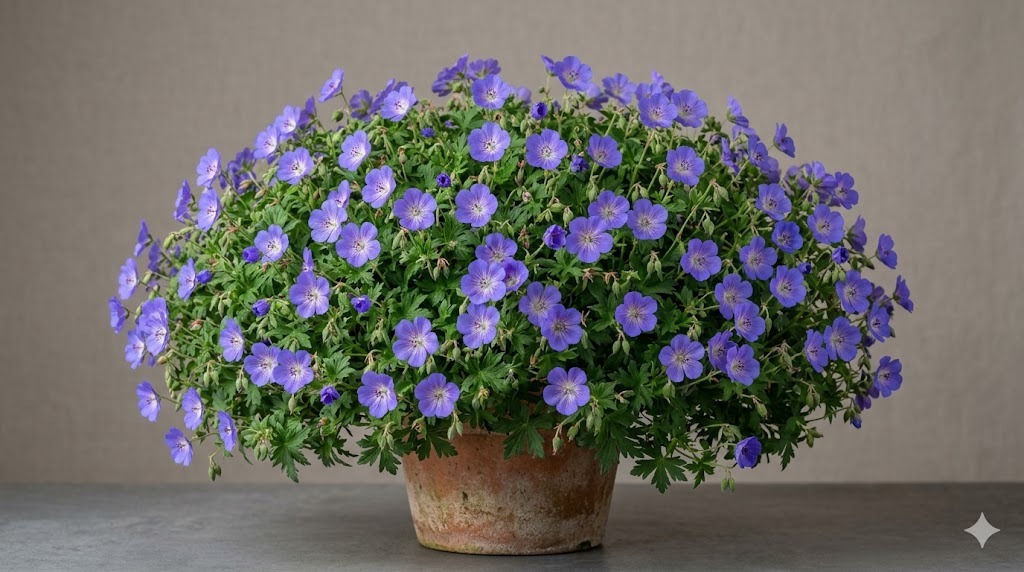
The hardy geranium - properly called cranesbill - is one of the most genuinely useful perennials a gardener can plant. It is not the bright bedding "geranium" of summer pots (that is Pelargonium); this is a tough, hardy, long-lived perennial that forms low, spreading mounds of attractive lobed foliage, smothered for months in saucer-shaped flowers of blue, purple, pink, magenta, or white. Hardy geraniums are famous for three things: they flower for an exceptionally long time, they smother weeds, and they grow almost anywhere - sun or shade, good soil or poor. For reliable, low-effort, weed-suppressing color, few plants come close.
Origin & Natural Habitat
True geraniums (Geranium) are a large genus of around 400 species found across temperate regions of the world - meadows, woodlands, hedgerows, mountain slopes, and grasslands. This wide natural range is exactly why hardy geraniums are so adaptable: there is a species suited to almost every garden situation, from dry sun to damp shade. The common name "cranesbill" comes from the long, beak-like seed capsule that forms after flowering.
Appearance
Hardy geraniums are clump-forming or spreading herbaceous perennials, typically 15-75 cm tall. The foliage is a real asset - rounded, deeply lobed or divided leaves forming a dense weed-excluding carpet, in many varieties coloring well in autumn or aromatic when touched. The flowers are five-petalled saucers or stars, 2-5 cm across, in blue, violet, purple, magenta, pink, and white, often delicately veined. Bloom is generous and long, from late spring through summer, with many varieties reblooming after a trim.
Why People Grow It - Qualities & Benefits
- Very long bloom: months of flower, extendable by cutting back.
- Weed suppression: the dense mounds smother weeds - superb, low-maintenance ground cover.
- Extreme adaptability: species and varieties for sun or shade, dry or moist.
- Hardy, long-lived, and easy: dependable and undemanding.
- Attractive foliage: good ground-covering leaves, often with autumn color.
- Pollinator-friendly: the open flowers attract bees and other insects.
- Pest-resistant: largely untroubled, and often left alone by deer and rabbits.
Care
Light & Position
Highly adaptable - there is a hardy geranium for almost any light level. As a rough guide, most flower best in full sun to part shade; many woodland species are excellent in shade, where good flowering plants are scarce. Choose the species to suit the spot.
Soil
Undemanding. Most hardy geraniums grow in any reasonably fertile, well-drained soil, and many tolerate poor, dry, or heavy ground. They dislike only permanently waterlogged conditions.
Watering
Water while establishing and in dry spells in the first year. Established plants are fairly drought-tolerant; some species are notably so.
Feeding
Minimal - a spring compost mulch or light feed is plenty. Hardy geraniums flower well without much feeding.
The Mid-Season Cut-Back
The single most useful technique: when a hardy geranium finishes its first flush and starts to look tired, sprawling, or has flopped open, cut the whole plant back hard - almost to the ground. It looks brutal, but the plant responds within weeks with a fresh mound of clean foliage and, in many varieties, a strong second flush of flowers. This one cut keeps geraniums tidy and blooming for far longer.
Seasonal Care
Cut down old foliage in late autumn or early spring. Divide congested clumps every few years to maintain vigor.
Hardiness & Winter Care
Hardy geraniums are very hardy - most are reliable to around USDA zone 3-5 - and need no winter protection. Most are herbaceous, dying back over winter; a few are semi-evergreen.
Planting & Propagation
Plant in spring or autumn. Hardy geraniums establish quickly and are very forgiving. Propagate easily by division in spring or autumn; some species also grow from seed or self-seed gently. Division every few years keeps clumps healthy and provides free plants.
Common Problems & Pests
- Tired, sprawling, flopped-open plants after the first flush: entirely normal - cured by the mid-season hard cut-back.
- Few flowers: usually too much deep shade for a sun-loving species, or an old congested clump needing division.
- Self-seeding: some species (notably Geranium 'Claridge Druce' types and others) seed around freely; this can be welcome ground cover or a mild nuisance - deadhead if unwanted.
- Powdery mildew: can appear on stressed or crowded plants, especially in dry conditions; cutting back hard usually clears it.
- Pests: generally very trouble-free; occasional sawfly or vine weevil.
Toxicity & Safety
Hardy geranium / cranesbill (Geranium species) is generally regarded as non-toxic / low-toxicity and is considered safe for cats, dogs, horses, and humans - it is not a recognized poisoning hazard and is widely grown in family and wildlife gardens. (This is in contrast to Pelargonium, the "geranium" of summer bedding, which is listed as mildly toxic to pets - so the distinction matters.)
Pros & Cons
Pros
- Very long bloom, with a second flush after cutting back.
- Excellent weed-suppressing ground cover.
- Extremely adaptable - a variety for sun, shade, dry, or moist.
- Hardy, easy, pet-friendly, and pollinator-friendly.
Cons
- Sprawls and flops after the first flush without the mid-season cut-back.
- Some species self-seed and spread more than wanted.
- Individual flowers are modest; can be untidy if neglected.
- Sun-loving types flower poorly in deep shade.
Best Suited For
- Ground cover and weed suppression in borders.
- Underplanting roses, shrubs, and trees; filling gaps and edging.
- Sun or shade - choosing the right species for the spot.
- Low-maintenance, cottage, and wildlife gardens; beginner gardeners.
Not ideal for permanently waterlogged soil, crisp formal designs, or gardeners wanting a single dramatic specimen flower.
FAQ
What is the difference between a hardy geranium and a "geranium" in pots? The bright bedding "geraniums" sold for summer pots are actually Pelargonium - tender plants. A hardy geranium, or cranesbill, is a true Geranium: a hardy perennial that lives outdoors year-round. They are different plants with different care, and only the bedding Pelargonium is listed as mildly toxic to pets.
My hardy geranium looks tired and sprawling - what do I do? Cut it back hard, almost to the ground, after its first flush of flowers. This is normal, recommended practice - the plant regrows a fresh mound of foliage and often a second flush of flowers within weeks.
Can hardy geraniums grow in shade? Yes - many species are excellent in part or even full shade, where good flowering plants are hard to find. Choose a woodland or shade-tolerant species for those spots, and a sun-loving one for open positions.
Are hardy geraniums safe for pets? Yes - true hardy geraniums (cranesbills) are considered non-toxic to cats, dogs, and horses. (Note that the unrelated bedding Pelargonium is mildly toxic.)
How do I make more hardy geraniums? By division - lift a clump in spring or autumn and split it into pieces, each with roots and shoots. It is easy and reliable, and also keeps congested clumps vigorous.