Honeysuckle (Lonicera)
Honeysuckle is the climber of the warm summer evening - a cottage-garden classic whose tubular, two-lipped flowers pour out a sweet, heady fragrance that carries on the dusk air and draws in moths, bees, and butterflies.
🗓️ Last reviewed: June 2026
Overview
Honeysuckle is the climber of the warm summer evening - a cottage-garden classic whose tubular, two-lipped flowers pour out a sweet, heady fragrance that carries on the dusk air and draws in moths, bees, and butterflies. Twining freely over arches, fences, pergolas, and trees, the climbing honeysuckles clothe a structure in informal, romantic bloom, often followed by glistening berries. They are easy, hardy, vigorous, and much loved. This guide covers the climbing honeysuckles (Lonicera periclymenum, L. japonica, and similar); note that the genus also includes shrubby honeysuckles, and that one or two species - Japanese honeysuckle especially - can be seriously invasive.
Origin & Natural Habitat
Lonicera is a large genus native across the Northern Hemisphere. The climbing honeysuckles grow wild in woodlands, hedgerows, and scrub - twining up through shrubs and trees, with their roots in cool, shaded, leafy soil and their flowering tops reaching into the light. The common honeysuckle or woodbine, Lonicera periclymenum, is a familiar European hedgerow plant; Japanese honeysuckle, L. japonica, comes from East Asia and is vigorous to the point of invasiveness in many regions. This woodland-edge origin gives the same key as for clematis: cool, shaded roots and a sunny head.
Appearance
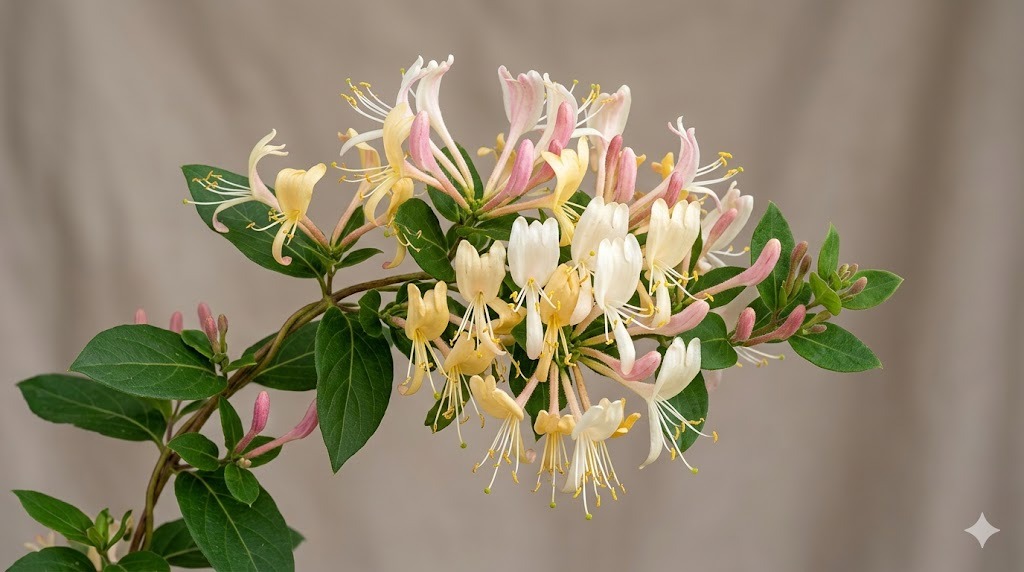
Climbing honeysuckles are vigorous, twining, woody climbers (mostly deciduous; some semi-evergreen or evergreen), reaching 3-8 m. They climb by twining their stems around supports. The leaves are simple and oval. The flowers are the signature feature - borne in clusters, each a long, slender tube flaring into two curving lips, often with prominent stamens; colors run through cream, yellow, gold, pink, red, and orange, and many flowers age from one color to another, giving two-tone clusters. Most are strongly, sweetly fragrant, especially in the evening. Clusters of red, orange, or black berries usually follow.
Why People Grow It - Qualities & Benefits
- Powerful evening fragrance: one of the great scents of the summer garden.
- Romantic, informal flowers in warm two-tone colors.
- Wildlife magnet: the scent and tubular flowers draw moths, bees, and butterflies; berries feed birds.
- Easy and vigorous: hardy, fast, and quick to cover a structure.
- Versatile: arches, pergolas, fences, walls, and scrambling through trees and hedges.
- Long-flowering over much of the summer; some types semi-evergreen.
- Cottage-garden charm: a traditional, much-loved plant.
Care
Light & Position
Roots in shade, head in the sun - the same principle as clematis. Climbing honeysuckles flower best with their top growth in good sun (some tolerate part shade), but the roots want cool, shaded soil. Shade the base with low planting or mulch. Plants in too much sun and dry soil are far more prone to mildew and aphids.
Soil
Fertile, humus-rich, moist but well-drained soil. Honeysuckle dislikes drying out; improve the soil with compost.
Watering
Keep the soil moist, especially while establishing and in dry spells - drought-stressed honeysuckle is much more prone to powdery mildew and aphid attack.
Feeding
Feed in spring with a balanced fertilizer and mulch with compost to retain moisture and keep the roots cool.
Pruning
Pruning depends on the type, broadly mirroring clematis logic:
- Early-flowering honeysuckles (flowering on the previous year's growth) - prune lightly after flowering, removing some old growth and tidying.
- Late-flowering honeysuckles (flowering on the current year's growth) - prune in late winter/early spring.
Overgrown, tangled, bare-based honeysuckles can be renovated by hard pruning, which they generally tolerate well. Provide a support for the twining stems to grip.
Hardiness & Winter Care
Most climbing honeysuckles are hardy (commonly to around USDA zone 4-5, varying by species) and need no winter protection.
Planting & Propagation
Plant in autumn or spring against a support, with the root area shaded. Propagate easily from softwood or semi-ripe cuttings, or by layering - honeysuckle roots readily. Be cautious propagating and planting Japanese honeysuckle where it is invasive.
Common Problems & Pests
- Powdery mildew: the most common problem - a white coating on leaves, much worse on plants that are drought-stressed, in hot dry positions, or with hot dry roots. The cure is largely cultural: cool, shaded, moist roots and a not-too-baking position.
- Aphids: honeysuckle is notably prone to aphids, which cluster on the soft shoot tips and buds, especially on stressed plants.
- Bare, tangled, top-heavy growth: vigorous honeysuckles left unpruned become a bare-based bird's nest of tangled stems - renovate by hard pruning.
- Few flowers: too much shade, or pruning at the wrong time for the type.
- Invasiveness: Japanese honeysuckle (L. japonica) in particular is highly invasive in many regions - check before planting and prefer well-behaved species.
Toxicity & Safety
Honeysuckle is generally regarded as mildly toxic - the berries especially can cause stomach upset (vomiting, diarrhea) if eaten in quantity by humans, cats, dogs, or horses, and are best considered not for eating. The plant is not regarded as a severe poisoning hazard, serious poisoning is uncommon, and honeysuckle is widely grown in family gardens - but children and pets should be discouraged from eating the berries. (The flowers of some species have a long folk tradition of having their nectar sucked, but the berries are the part to keep away from children.)
Pros & Cons
Pros
- Wonderful, powerful evening fragrance.
- Romantic two-tone flowers; long summer display.
- Easy, hardy, vigorous, and quick to cover a structure.
- Excellent for wildlife - moths, bees, butterflies, and berry-eating birds.
Cons
- Prone to powdery mildew and aphids, especially when stressed.
- Becomes a bare, tangled mess if not pruned.
- Berries are mildly toxic; some species (Japanese honeysuckle) are invasive.
- Vigorous - can outgrow small or flimsy supports.
Best Suited For
- Arches, pergolas, fences, and walls in cottage and informal gardens.
- Scrambling through trees, large shrubs, and hedges.
- Wildlife and pollinator gardens; near seating and doorways for the evening scent.
- Gardeners wanting an easy, fragrant, traditional climber.
Not ideal for hot, dry, baking positions (mildew), tiny gardens with flimsy supports, regions where Japanese honeysuckle is invasive (choose other species), or families wanting a berry-free plant around small children.
FAQ
Why does my honeysuckle get white powdery mildew? Powdery mildew is honeysuckle's most common problem, and it is closely linked to stress - especially hot, dry roots and drought. The fix is cultural: keep the roots cool and shaded, the soil moist, and avoid planting honeysuckle in a hot, baking, dry position. A well-watered, cool-rooted honeysuckle gets far less mildew.
Why is my honeysuckle bare at the bottom and tangled at the top? Vigorous honeysuckles left unpruned naturally become a top-heavy, tangled mass of bare stems. Renovate the plant by pruning it hard - honeysuckle generally tolerates this well and reshoots - and then prune regularly to keep it in shape.
When should I prune honeysuckle? It depends on the type. Early-flowering honeysuckles, which bloom on the previous year's growth, are pruned lightly after flowering. Late-flowering ones, blooming on the current year's growth, are pruned in late winter or early spring.
Are honeysuckle berries poisonous? Honeysuckle is considered mildly toxic, and the berries in particular can cause stomach upset if eaten in quantity by people or pets. They are not a severe hazard, but children and pets should be discouraged from eating them.
Is honeysuckle invasive? Some species are. Japanese honeysuckle (Lonicera japonica) in particular is highly invasive in many parts of the world. Check before planting, and where invasiveness is a concern, choose well-behaved species such as forms of the common honeysuckle.