Japanese Maple (Acer palmatum)
The Japanese maple is, for many gardeners, the most beautiful small tree it is possible to grow.
🗓️ Last reviewed: June 2026
Overview
The Japanese maple is, for many gardeners, the most beautiful small tree it is possible to grow. Slow-growing, elegant, and perfectly scaled for modern gardens and even containers, it is prized above all for its foliage: delicate, often deeply cut leaves that may be green, gold, red, purple, or variegated through the season - and that, in autumn, ignite into some of the most spectacular fiery colour in the plant world. Its graceful branching gives sculptural beauty even in winter. Japanese maples are not difficult, but they are particular: they dislike scorching sun, drying winds, and waterlogged soil, and protecting their delicate foliage from those things is the whole art of growing them.
Origin & Natural Habitat
Acer palmatum is native to Japan, Korea, and parts of China, where it grows as an understorey tree in cool, moist, sheltered woodland - beneath the canopy of larger trees, protected from harsh sun and wind, in humus-rich, well-drained soil. Centuries of cultivation, especially in Japan, have produced hundreds of named varieties. Every element of its care follows from that woodland-understorey origin: dappled light, shelter, cool moist (but well-drained) soil, and protection of its fine foliage.
Appearance
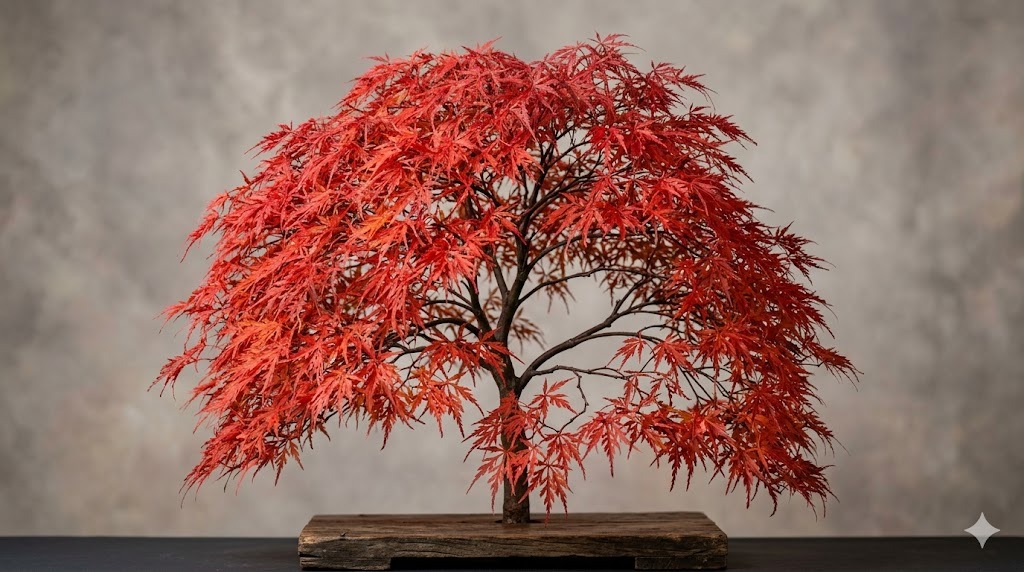
Japanese maples are deciduous trees or large shrubs, mostly slow-growing and small - many reach only 2-5 m over many years, and dwarf forms stay far smaller, ideal for pots. They have an elegant, often layered or weeping, branching habit. The leaves are typically palm-shaped ("palmatum") with five to many pointed lobes; in the dissectum (laceleaf) types the lobes are so finely cut the foliage looks lacy and feathery. Foliage colour varies enormously by variety and season - spring flush, summer colour, and a frequently brilliant autumn display of scarlet, crimson, orange, or gold. The bare winter silhouette, and the coral-red bark of some varieties, add further seasons of interest.
Why People Grow It - Qualities & Benefits
- Spectacular autumn colour: among the finest fiery foliage displays of any plant.
- Year-round beauty: spring flush, summer foliage, autumn fire, and a sculptural winter form.
- Elegant and refined: graceful branching and delicate leaves - a living work of art.
- Perfectly scaled: small and slow - ideal for small gardens and containers.
- Huge variety: hundreds of forms in different sizes, leaf shapes, and colours.
- Container- and courtyard-friendly: excellent in pots and small, sheltered spaces.
- A focal point: a single specimen anchors a garden, patio, or Japanese-style scheme.
Care
Light & Position
Dappled shade or part shade, sheltered from wind - this is the key. Japanese maples are understorey trees; their delicate leaves scorch in hot, direct afternoon sun and in drying or cold winds, browning and crisping at the edges. The finely cut laceleaf (dissectum) types are especially vulnerable and need the most shelter. Morning sun with afternoon shade, or bright dappled light, is ideal. (Some green-leaved types tolerate more sun in cooler climates; deep shade dulls the colour of red and purple varieties.)
Soil
Cool, moist, well-drained, humus-rich soil, ideally slightly acidic to neutral. Japanese maples dislike heavy, waterlogged ground (which rots the roots) and very alkaline or dry, poor soils. Improve with compost or leaf mould.
Watering
Keep the soil consistently moist, especially while establishing and in dry spells - drought stress causes leaf scorch. Container-grown maples need particular care, as pots dry out fast and the roots can also overheat; water regularly and mulch. Avoid waterlogging.
Feeding
Feed modestly in spring with a balanced or slow-release fertilizer; avoid heavy, high-nitrogen feeding, which produces soft, sappy growth more prone to scorch and dieback. A compost or leaf-mould mulch is beneficial - keeping it clear of the trunk.
Pruning
Japanese maples need very little pruning and are best left to develop their natural elegant form. If needed, prune only lightly - to remove dead, damaged, or crossing branches, or to refine the shape - and do so in late autumn or winter, when fully dormant. Avoid pruning in spring or early summer, when the sap is rising, as the cuts "bleed" heavily.
Containers
Japanese maples make superb container specimens - but pots demand attention: never let them dry out, protect the pot and roots from freezing solid in hard winters and from baking in summer, top-dress or repot periodically, and shelter the pot from wind.
Hardiness & Winter Care
Most Japanese maples are hardy (commonly to around USDA zone 5-6). The tree itself is cold-hardy, but the young spring growth is vulnerable to late frosts, which can scorch the new leaves - a sheltered position helps. Protect containerised maples' roots in severe winters.
Planting & Propagation
Plant in autumn or spring in a sheltered, dappled spot in improved, well-drained soil; do not plant too deeply. Named varieties are propagated by grafting (and are bought as grafted plants); species can be grown from seed, though seedlings vary. Most gardeners simply buy a named variety suited to their space and conditions.
Common Problems & Pests
- Leaf scorch (brown, crispy leaf edges): the most common problem - caused by too much hot direct sun, drying or cold winds, drought, or dry pots. The cure is positional: shelter, dappled light, and consistent moisture.
- Late-frost damage: frost scorches the tender spring flush; shelter helps.
- Wilting and dieback: can be caused by waterlogged soil and root rot, or by drought; also by verticillium wilt, a soil-borne fungal disease causing branch dieback - there is no cure, so prune out affected wood and avoid the disease through good soil and healthy plants.
- Container stress: drying out, root overheating, or roots freezing solid in pots.
- Aphids and scale: can occur but are rarely serious.
Toxicity & Safety
The Japanese maple (Acer palmatum) is generally regarded as non-toxic / low-toxicity and is considered safe for cats, dogs, and humans - it is not a recognised poisoning hazard and is widely grown in family gardens and courtyards. (One important caveat for horse owners: the leaves of some other maple species - notably wilted red maple and sycamore maple - are seriously toxic to horses; Acer palmatum itself is not generally implicated, but as a precaution, horse owners should be aware of maple toxicity in general and avoid letting horses access wilted maple leaves.)
Pros & Cons
Pros
- Spectacular autumn colour and year-round elegance.
- Small, slow-growing - perfect for small gardens and containers.
- Hundreds of varieties; a refined, sculptural focal point.
- Low-maintenance pruning; non-toxic to cats and dogs.
Cons
- Delicate foliage scorches in hot sun and drying wind - needs shelter.
- Slow-growing; named varieties can be expensive.
- Containers need careful, consistent attention.
- Vulnerable to late frosts and to verticillium wilt.
Best Suited For
- Sheltered, dappled-shade positions as a garden focal point.
- Small gardens, courtyards, and containers.
- Japanese-style, woodland-edge, and shade gardens.
- Patios and entrances where year-round elegance is wanted.
Not ideal for hot, exposed, sunny, or windy positions; heavy waterlogged or very alkaline soils; or gardeners wanting a fast-growing tree.
FAQ
Why are my Japanese maple's leaves brown and crispy at the edges? This is leaf scorch - the most common problem with Japanese maples. It is caused by too much hot, direct sun, by drying or cold winds, or by the soil (or pot) drying out. The remedy is positional: move or site the tree in dappled shade, sheltered from wind, and keep the soil consistently moist. The finely cut laceleaf types are especially prone and need the most shelter.
Can I grow a Japanese maple in a pot? Yes - Japanese maples are excellent container specimens, and dwarf forms are ideal for pots. But containers need consistent care: never let them dry out, protect the roots from freezing solid in hard winters and from overheating in summer, shelter the pot from wind, and top-dress or repot periodically.
When and how should I prune a Japanese maple? Japanese maples need very little pruning - they are best left to develop their natural form. If you must prune, do it lightly, only to remove dead, damaged, or crossing branches, and only in late autumn or winter when the tree is fully dormant. Pruning in spring or early summer causes heavy "bleeding" of sap.
Are Japanese maples safe for pets? Yes - the Japanese maple (Acer palmatum) is generally considered non-toxic to cats and dogs. (Note that some other maple species' wilted leaves are toxic to horses; horse owners should be aware of maple toxicity in general.)
Why is my Japanese maple's branch dying back? Branch dieback can result from drought or from waterlogged soil and root rot - check the growing conditions. It can also be caused by verticillium wilt, a soil-borne fungal disease for which there is no cure; prune out affected branches and maintain healthy growing conditions.