Snapdragon (Antirrhinum)
The snapdragon is one of the most charming and playful flowers in the garden - a tall, colorful spire whose individual blooms, when gently squeezed at the sides, open and close like a little dragon's mouth, a trick that has delighted children for generations.
🗓️ Last reviewed: June 2026
Overview
The snapdragon is one of the most charming and playful flowers in the garden - a tall, colorful spire whose individual blooms, when gently squeezed at the sides, open and close like a little dragon's mouth, a trick that has delighted children for generations. Beyond the fun, the snapdragon is a genuinely useful plant: it flowers over a long season in a rich range of colors, it is excellent for cutting, it is loved by bees, and it copes with cooler conditions that defeat many summer flowers. Usually grown as an annual (though it is really a short-lived perennial), the snapdragon brings vertical structure, color, and a touch of whimsy to beds, borders, and the vase.
Origin & Natural Habitat
The common snapdragon, Antirrhinum majus, is native to the Mediterranean region - rocky hillsides, walls, screes, and dry, sunny, well-drained ground in southern Europe. There it is actually a short-lived perennial; in colder climates it is grown as an annual. Its Mediterranean origin explains its love of sun and good drainage, its tolerance of poorer soil, and its surprising tolerance of cool weather (Mediterranean hillsides can be cold in the off-season), which makes it a fine early- and late-season performer.
Appearance
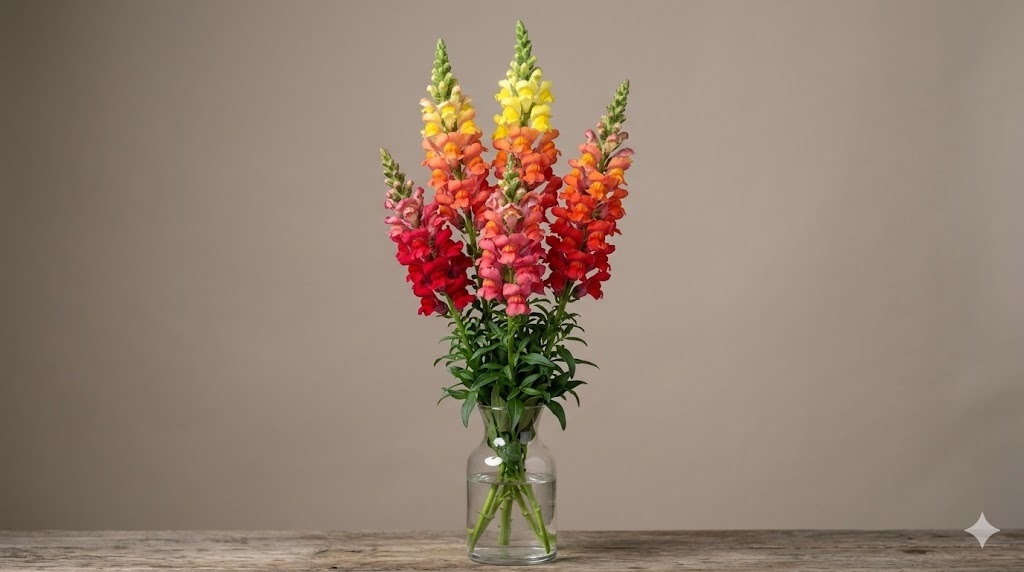
Snapdragons are upright plants with sturdy stems and narrow, lance-shaped green leaves. Heights vary enormously by variety: dwarf bedding types only 15-20 cm tall, mid-height types around 40-60 cm, and tall cutting varieties of 90 cm or more. The flowers are carried in dense vertical spikes, opening from the bottom up. Each flower is the classic two-lipped, pouched "dragon mouth" shape (modern "butterfly"/azalea-flowered and double types have open faces instead). Colors are rich and wide - red, pink, orange, yellow, white, purple, bronze, and bicolors - though true blue is absent.
Why People Grow It - Qualities & Benefits
- Long flowering season: blooms from late spring/early summer into autumn, often with a flush at each cooler end of summer.
- Vertical structure: the flower spikes add valuable height and rhythm to borders.
- Rich color range in a classic, much-loved cottage-garden flower.
- Playful "snap": the snapping flowers are a delight, especially for children.
- Excellent cut flower: long-lasting spikes, a cutting-garden favorite.
- Cool-tolerant: copes with cooler conditions better than many summer annuals.
- Pollinator value: bumblebees, strong enough to open the flowers, love them.
Care
Light & Position
Full sun for the best, sturdiest, most floriferous growth; snapdragons tolerate light shade but flower less well and may grow leggier there.
Soil
Fertile, well-drained soil. Snapdragons dislike heavy, wet ground; good drainage is important, particularly if they are to be overwintered.
Watering
Water to establish and during dry spells. Water at the base rather than over the foliage - wet leaves encourage rust disease, the snapdragon's main weakness. Avoid waterlogging.
Feeding
Feed moderately through the growing season, especially in containers or poorer soil, to support the long display of flower spikes.
Pinching, Deadheading & Cutting
- Pinch out the growing tip of young plants - this is important for snapdragons, producing bushy, well-branched plants with many flower spikes rather than a single stem.
- Deadhead spent spikes, or cut spikes for the vase - removing finished flowers prevents seed-setting and encourages further flushes of bloom.
- After the main flush, cutting plants back can prompt a fresh late-season display.
Hardiness & Winter Care
The snapdragon is technically a short-lived perennial but is frost-tender to only moderately hardy and is grown as an annual in most climates. In mild-winter areas, plants may survive the winter and flower again; in cold climates they are killed by frost and grown fresh each year. Their cool-tolerance makes them good for early spring and autumn planting in mild regions.
Planting & Propagation
Snapdragons are raised from very fine seed sown indoors in late winter/early spring, or bought as young plants; plant out around the last frost (they tolerate a little cool weather). They can also be grown from cuttings. Snapdragons sometimes self-seed, though seedlings of hybrids may not come true.
Common Problems & Pests
- Snapdragon rust: the classic and main problem - a fungal disease causing brown, powdery pustules, mostly on the leaf undersides, that can weaken and disfigure plants. Reduce it by watering at the base (not the leaves), spacing for air flow, choosing rust-resistant varieties, and not growing snapdragons in the same soil year after year.
- Leggy growth, few spikes: failing to pinch young plants, or too much shade.
- Downy mildew, root rots, and wilt: can affect plants, especially in wet or crowded conditions.
- Slugs, snails, and aphids: can damage young plants and growth.
Toxicity & Safety
Snapdragons (Antirrhinum) are generally regarded as non-toxic / low-toxicity and are considered safe for cats, dogs, horses, and humans - they are not a recognized poisoning hazard, the flowers are sometimes listed as edible, and the plant is widely grown in family gardens. A safe, child- and pet-friendly garden flower (and a fun one, thanks to the snapping blooms).
Pros & Cons
Pros
- Long flowering season; good vertical structure.
- Rich color range; classic, charming cottage-garden flower.
- Excellent cut flower; playful snapping blooms loved by children.
- Cool-tolerant; pet- and child-friendly; great for bumblebees.
Cons
- Prone to snapdragon rust, especially in damp conditions.
- Usually grown as an annual; frost-tender in cold climates.
- Needs pinching for a good bushy display.
- Tall types may need support; soft growth is slug-prone.
Best Suited For
- Sunny borders and cottage gardens wanting vertical color.
- Cutting gardens - a classic, long-lasting cut flower.
- Bedding and containers (dwarf and mid-height types).
- Children's gardens - for the fun of the snapping flowers.
Not ideal for deep shade, heavy waterlogged soil, gardens where rust is a persistent problem (without resistant varieties), or those wanting a reliably permanent perennial.
FAQ
Why do my snapdragon leaves have brown powdery spots underneath? That is snapdragon rust, a fungal disease and the snapdragon's main weakness. Reduce it by watering at the base rather than over the foliage, spacing plants for good air circulation, choosing rust-resistant varieties, and not planting snapdragons in the same soil every year.
Are snapdragons annuals or perennials? Technically the snapdragon is a short-lived perennial, but because it is frost-tender to only moderately hardy, it is grown as an annual in most climates. In mild-winter areas plants may survive and flower again the next year.
Why is my snapdragon tall and spindly with only one flower spike? It probably was not pinched. Pinching out the growing tip of young snapdragons is important - it makes them branch into bushy plants with many flower spikes instead of a single leggy stem.
Are snapdragons safe for pets and children? Yes - snapdragons are generally considered non-toxic and are a safe, child- and pet-friendly plant. The snapping flowers are a classic source of fun for children, and the flowers are sometimes even listed as edible.
How do I keep snapdragons flowering for a long time? Pinch young plants for bushy growth, deadhead spent spikes (or cut them for the vase), and feed through the season. Cutting plants back after the main flush can prompt a fresh late-season display, and their cool-tolerance often gives flushes at both ends of summer.