Aloe Vera
Aloe Vera is the houseplant that earns its keep.
🗓️ Last reviewed: June 2026
Overview
Aloe Vera is the houseplant that earns its keep. It is a tough, sun-loving succulent that asks for almost nothing - and inside its plump leaves it carries a clear, soothing gel used for thousands of years to calm minor burns, sunburn, and skin irritation. Easy, useful, sculptural, and long-lived, Aloe Vera is part windowsill plant, part home first-aid kit. For anyone who wants a low-effort plant that does something practical, it is the obvious pick.
Origin & Natural Habitat
Aloe Vera's exact wild origin is debated - it has been cultivated and spread by humans for so long that it now grows around the world - but it is believed to originate from the Arabian Peninsula. It evolved in hot, dry, sun-baked, rocky environments with sparse rainfall. Like all succulents, it survives there by storing water in its thick fleshy leaves. That single adaptation explains its entire care routine: it wants strong light, very little water, and gritty, fast-draining soil.
Humans have used Aloe Vera medicinally for at least 6,000 years; it appears in ancient Egyptian, Greek, and Chinese records.
Appearance
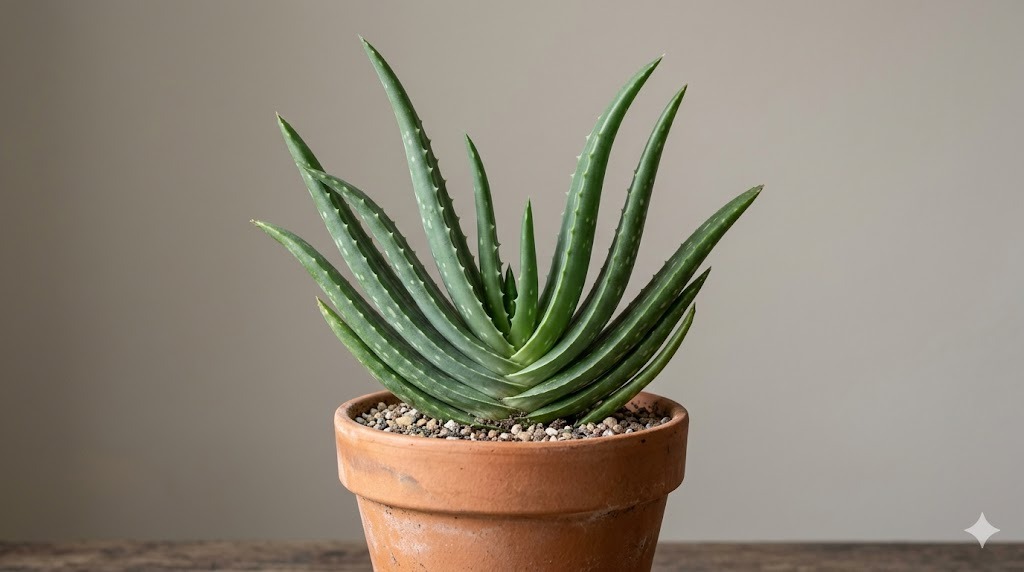
Aloe Vera grows as a rosette of thick, fleshy, upward-curving leaves. The leaves are grey-green, often flecked with pale spots when young, and edged with small soft teeth. Inside, each leaf is filled with a clear, slippery gel.
Indoors it typically reaches 30-60 cm tall and wide. Mature, happy plants may send up a tall flower spike with tubular yellow or orange flowers, though indoor flowering is uncommon. Healthy plants readily produce offsets ("pups") - baby plants around the base.
Note: there are hundreds of Aloe species. True Aloe Vera (Aloe barbadensis miller) is the one used for skin gel. Some ornamental aloes look similar but are not the medicinal species, and several lookalikes are toxic - buy a plant clearly labeled Aloe Vera.
Why People Love It - Qualities & Benefits
- A useful plant: the leaf gel soothes minor burns, sunburn, scrapes, and dry or irritated skin - a genuine practical benefit on your windowsill.
- Almost zero maintenance: it thrives on neglect, needs water only every few weeks, and survives long absences.
- Loves sun: one of the few houseplants that genuinely wants a bright, sunny windowsill - perfect for hot south-facing spots that fry other plants.
- Free plants: healthy aloes produce pups that are easy to separate and grow on.
- Sculptural look: the bold rosette suits modern, minimal, and Mediterranean interiors.
- Long-lived: a well-kept Aloe Vera can last for decades.
Care
Light
Aloe Vera wants lots of bright light, including several hours of direct sun - a south- or west-facing windowsill is ideal. In too little light it grows pale, stretched, and leggy, and the leaves flop outward instead of standing up. If moving it suddenly into intense summer sun, acclimate it gradually to avoid scorching.
Watering
This is the only real way to go wrong. Water deeply but rarely - only when the soil is completely dry all the way through. In practice that is roughly every 2-3 weeks in summer and every 4-6 weeks (or less) in winter. Then water thoroughly and let all excess drain. Overwatering causes the leaves to go soft, mushy, yellow, or translucent, and rots the roots. When in doubt, do not water. A slightly underwatered aloe just looks a little thinner; an overwatered one dies.
Soil & Potting
Use a gritty, fast-draining cactus or succulent mix - or regular potting soil heavily amended with perlite, coarse sand, or grit. Drainage holes are essential. Terracotta pots are ideal because they let the soil dry out.
Humidity & Temperature
Prefers dry air - normal room humidity, or drier, is perfect. Comfortable at 13-27 °C. It is not frost-hardy; keep it above about 10 °C and bring it inside well before any cold snap.
Feeding
Barely needs feeding. A diluted succulent or balanced fertilizer once or twice during spring and summer is plenty.
Repotting
Repot every 2-3 years, or when the pot is crowded with pups. Spring is best. After repotting, wait a week before watering to let any disturbed roots heal.
Propagation
Aloe Vera is propagated mainly from pups (offsets): the small baby plants that appear around the base of a healthy plant. When a pup has a few of its own leaves and ideally some roots, gently separate it from the parent, let the cut surface dry for a day or two (this prevents rot), then pot it in dry succulent mix and water lightly after a week. Aloe Vera does not propagate well from a single leaf cutting - pups are the reliable method.
Common Problems & Pests
- Soft, mushy, translucent, or yellow leaves: overwatering and root rot - the classic killer. Stop watering, unpot, cut away rotten roots, and repot in dry, gritty mix.
- Pale, stretched, leggy growth with flopping leaves: not enough light - move it to a sunnier spot.
- Brown or reddish leaves: sunburn from sudden intense sun, or stress; acclimate gradually.
- Thin, curled, shriveled leaves: the rare case of genuine underwatering - give it a deep drink.
- Pests: generally pest-resistant, but mealybugs and scale occasionally appear; wipe off and treat.
Toxicity & Safety
Mildly toxic to cats and dogs if eaten. The leaf skin and the yellowish layer just beneath it (latex/aloin) contain compounds that cause vomiting, diarrhea, and lethargy in pets. Keep the plant out of reach of pets.
For human use, the clear inner gel is widely used topically on skin to soothe minor burns and irritation. It is generally considered safe applied to the skin. Eating raw aloe leaf is not recommended - the latex layer is a strong laxative and irritant. This page is general information, not medical advice; for anything beyond minor skin care, consult a professional, and do a small patch test first.
Pros & Cons
Pros
- Genuinely useful - soothing gel for minor skin care.
- Extremely low-maintenance and drought-tolerant.
- Loves bright, sunny spots other plants hate.
- Produces free pups.
- Sculptural and long-lived.
Cons
- Rots quickly if overwatered.
- Needs a genuinely sunny spot to stay compact.
- Mildly toxic to pets if eaten.
- Eating the raw leaf is not safe - only the inner gel is used, topically.
Best Suited For
- Beginners and busy people who want a low-effort plant.
- Sunny south- or west-facing windowsills.
- Anyone who wants a plant with a practical use.
- Frequent travelers - it tolerates long absences.
Not ideal for dark rooms, over-attentive waterers, or pet households where a determined pet might eat it.
FAQ
How often should I water Aloe Vera? Only when the soil is completely dry - roughly every 2-3 weeks in summer, every 4-6 weeks or less in winter. Overwatering is the number-one killer; when unsure, wait.
Can I use the gel from my own plant on my skin? Yes - the clear inner gel is traditionally used on minor burns, sunburn, and dry or irritated skin. Slice a mature outer leaf, scoop out the clear gel, and avoid the yellowish latex layer just under the skin. Patch-test first, and treat this as general info, not medical advice.
Why are my Aloe's leaves soft and mushy? Overwatering and root rot. Stop watering, check the roots, cut away any rot, and repot in dry, gritty succulent mix. Soft mushy leaves are almost always too much water.
Why is my Aloe Vera flat and floppy instead of upright? Not enough light. In low light, Aloe Vera stretches, pales, and the leaves splay outward. Move it to a bright, sunny windowsill and new growth will be compact and upright.
What are the little plants around the base? Those are pups - baby aloes. When they have a few leaves and some roots, separate them, let the cut dry for a day or two, and pot them up. Free new plants.