Anthurium (Flamingo Flower)
The Anthurium is the houseplant that seems to be permanently in bloom.
🗓️ Last reviewed: June 2026
Overview
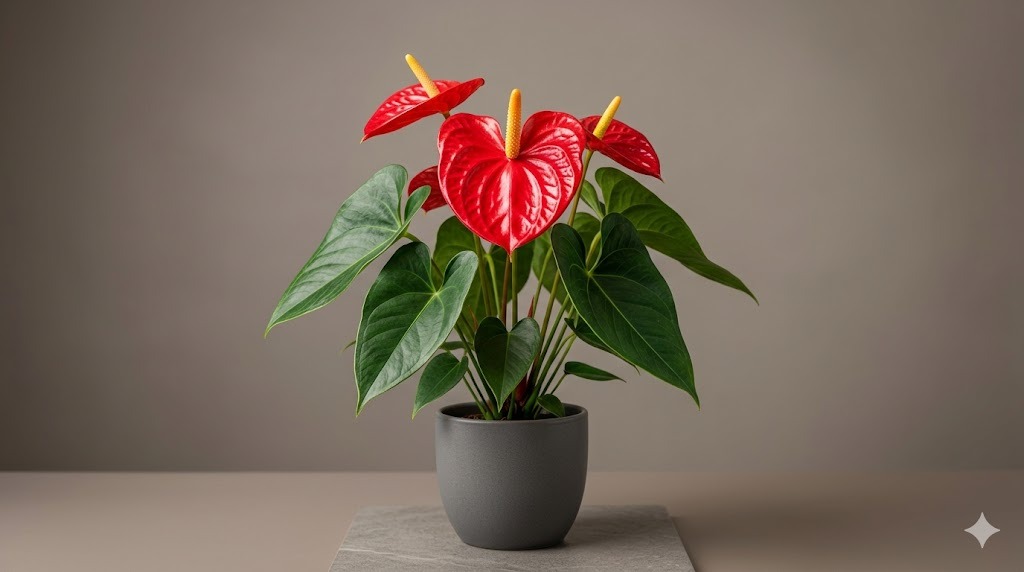
The Anthurium is the houseplant that seems to be permanently in bloom. Its glossy, heart-shaped, almost lacquered "flowers" - most famously in brilliant red, but also pink, white, purple, and even near-black - appear in waves for much of the year, each one lasting for weeks. Combined with deep-green heart-shaped leaves, it brings a tropical, polished, slightly exotic look to a room. Despite the showy appearance, the most popular Anthuriums are reasonably easy to grow once you understand that the "flower" is not really a flower at all, and that - like an orchid - this plant wants airy roots, not dense, soggy soil.
Origin & Natural Habitat
Anthuriums are native to the tropical rainforests of Central and South America, especially Colombia and Ecuador. The most popular flowering types are largely epiphytic or semi-epiphytic - in the wild they grow on or near tree trunks and in leaf litter, with their roots exposed to air, dappled light, warmth, and high humidity. As with orchids, this airy-rooted, humid, shaded origin is the key to keeping them happy indoors.
Appearance
What looks like a glossy, waxy, heart-shaped "flower" is actually a modified leaf called a spathe. The true flowers are tiny, packed onto the central spike - the spadix - that sticks up from the spathe. Spathes come in vivid red, pink, white, coral, purple, green, and dark tones, with a high-gloss, almost artificial sheen. The foliage is glossy, deep-green, and heart-shaped.
Indoors, flowering Anthuriums typically stay compact, around 30-45 cm tall. (There is also a separate group of Anthuriums grown purely for spectacular velvety foliage, such as A. clarinervium - collector plants with slightly different care.)
Why People Love It - Qualities & Benefits
- Blooms almost year-round: few houseplants flower as continuously; spathes last for many weeks each.
- Bold tropical color: the glossy, vivid spathes bring an exotic, polished accent unlike anything else.
- Long-lasting: both the blooms and the plant itself are durable and long-lived.
- Compact: stays small - ideal for tabletops, desks, shelves, and bright bathrooms.
- Doubles as a cut flower: cut Anthurium spathes last for weeks in a vase.
- Greenery and cheer: combines easy-care foliage with a near-permanent splash of color.
Care
Light
Bright, indirect light is ideal - it drives continuous flowering. Too little light and the plant survives but stops blooming and produces only leaves. Avoid harsh direct sun, which scorches the leaves and spathes. A bright spot out of direct sun is the sweet spot.
Watering
Water when the top 3-5 cm of soil is dry, then drain thoroughly - typically weekly, less in winter. Anthuriums dislike both extremes: soggy soil rots their sensitive roots, while complete drought wilts the plant. Aim for lightly moist, never waterlogged. They are somewhat sensitive to tap-water chemicals; filtered or left-out water helps reduce brown leaf tips.
Soil & Potting
Anthuriums need a chunky, airy, fast-draining mix - an orchid-style blend of bark, perlite, and coco coir, or a coarse aroid mix. Standard dense potting soil holds too much water and suffocates the roots. Drainage holes are essential.
Humidity & Temperature
Loves high humidity (60%+), reflecting its rainforest origin - dry air causes brown leaf tips and discourages flowering. Use a humidifier, group plants, or keep it in a bright bathroom. It loves warmth: 18-27 °C, stable, with no cold drafts and nothing below about 15 °C.
Feeding
Feed every 4-6 weeks in spring and summer with a balanced fertilizer, ideally one slightly higher in phosphorus to support blooming, at half strength.
Repotting
Repot every 2-3 years in spring into fresh airy mix. Aerial roots emerging at the base are normal; you can tuck them in or top up with mix.
Propagation
Anthuriums are propagated mainly by division: a mature plant produces offsets/side shoots, and at repotting time the clump can be gently separated into sections, each with leaves and roots, and potted up. Stem cuttings with a node and aerial roots can also be rooted. They can be grown from seed, but that is slow and uncommon at home.
Common Problems & Pests
- No flowers: the most common complaint - usually too little light. Move it brighter (indirect) and feed with a bloom-supporting fertilizer.
- Brown leaf tips: low humidity, tap-water chemicals, or over-fertilizing.
- Yellowing leaves: usually overwatering; check for soggy soil and root rot.
- Brown, soft, mushy roots: root rot from dense soil or overwatering - repot into a chunky, airy mix.
- Spathes turning green or fading: natural aging of an old spathe; sometimes a light or nutrient issue.
- Pale, scorched patches: too much direct sun.
- Pests: mealybugs, spider mites, scale, and aphids; inspect and treat with insecticidal soap.
Toxicity & Safety
Toxic to cats, dogs, and humans if chewed. Like other aroids, Anthuriums contain insoluble calcium oxalate crystals; chewing causes intense mouth and throat irritation, drooling, and vomiting. The sap can also irritate skin. Not usually life-threatening, but genuinely painful - keep it away from pets and small children, and wash hands after handling.
Pros & Cons
Pros
- Blooms almost year-round; long-lasting spathes.
- Bold, glossy, tropical color.
- Compact and long-lived.
- Spathes also work as cut flowers.
Cons
- Toxic to pets and kids if chewed.
- Needs high humidity to thrive and bloom well.
- Won't flower without enough light.
- Needs a special airy mix, not standard soil.
Best Suited For
- Anyone wanting near-continuous indoor color.
- Bright bathrooms and humid rooms.
- Tabletops, desks, and small bright spaces.
- Plant owners with some experience or a humidifier.
Not ideal for dark rooms, very dry homes without humidity help, or pet households with leaf-chewers.
FAQ
Why won't my Anthurium flower? Almost always not enough light. Anthuriums need bright, indirect light to bloom continuously - in low light they survive but produce only leaves. Move it brighter (never direct sun) and feed with a bloom-supporting fertilizer.
Is the red part a flower? Not exactly. The glossy red (or pink, white, purple) heart shape is a modified leaf called a spathe. The true flowers are the tiny ones packed onto the central spike, the spadix.
Why are the leaf tips turning brown? Usually low humidity, chemicals in tap water, or over-fertilizing. Raise the humidity, switch to filtered water, and feed lightly.
Why are my Anthurium's roots rotting? Most often it is potted in dense, ordinary soil that stays too wet. Anthuriums need a chunky, airy, fast-draining mix like an orchid blend. Repot into that and water only when the top of the mix dries.
Is the Anthurium safe for pets? No - it is toxic to cats and dogs if chewed, causing painful mouth irritation and vomiting. Keep it out of their reach.