Bird of Paradise (Strelitzia)
The Bird of Paradise is the houseplant that turns a room into a jungle.
🗓️ Last reviewed: June 2026
Overview
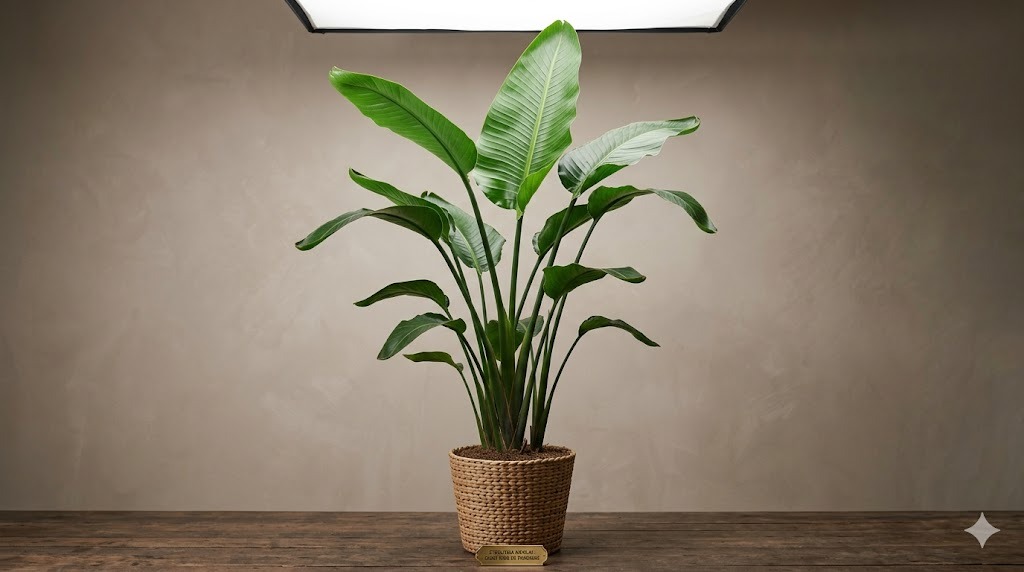
The Bird of Paradise is the houseplant that turns a room into a jungle. With huge, glossy, paddle-shaped leaves rising on tall stalks, it brings instant tropical drama and architectural height. The most common indoor type, Strelitzia nicolai (Giant White Bird of Paradise), is grown for its bold foliage; the smaller Strelitzia reginae is famous for its astonishing orange-and-blue crane-like flowers. As a houseplant it is a striking, fast-growing statement piece - easy enough for a confident owner, as long as it gets the one thing it truly demands: lots of light.
Origin & Natural Habitat
Strelitzia is native to South Africa, where it grows in open, sunny areas - coastal bush, forest clearings, and riverbanks - in warm conditions with strong light. It is named after Queen Charlotte of Mecklenburg-Strelitz, and the flower's resemblance to an exotic bird's head gave the plant its common name. Its sun-loving, warm-climate origin is the heart of its care: indoors it wants the brightest spot you can give it.
Appearance
The Bird of Paradise forms clumps of large, banana-like leaves on long upright stalks. S. nicolai has grey-green paddle leaves and can reach 1.5-2 m or more indoors. S. reginae is more compact, with narrower leaves and the iconic flower - a spiky orange-and-blue bloom emerging from a beak-like green bract. Mature leaves often split naturally along the edges; this is normal and an adaptation to let wind pass through, not damage.
Why People Love It - Qualities & Benefits
- Instant tropical drama: huge leaves and real height transform a room into a jungle.
- Architectural statement: a true floor-standing focal point.
- Fast-growing: rewards good conditions with quick, visible new leaves.
- Spectacular flowers (S. reginae): the crane-like blooms are among the most striking of any plant.
- Long-lived: a well-kept Bird of Paradise becomes a permanent, ever-larger fixture.
Care
Light
The single most important factor. The Bird of Paradise needs lots of bright light, including several hours of direct sun - the brightest window in the home. In insufficient light it grows slowly, weakly, and will not flower. S. reginae in particular needs strong light and maturity (often 3-5 years) to bloom indoors.
Watering
Water thoroughly when the top 3-5 cm of soil is dry - typically weekly in the growing season, less in winter. It likes consistent moisture but not soggy soil; let excess drain. Drooping, curling leaves can signal underwatering; yellowing lower leaves often signal overwatering.
Soil & Potting
Use a rich, well-draining potting mix. Drainage holes are essential. It is a vigorous grower with strong roots.
Humidity & Temperature
Appreciates moderate humidity. Comfortable at 18-27 °C; keep above about 13 °C and away from cold drafts.
Feeding
Feed every 2-4 weeks in spring and summer with a balanced fertilizer - it is a hungry, fast plant.
Repotting
Repot every 1-2 years while young. Note that S. reginae tends to flower better when slightly root-bound, so once mature, avoid over-potting.
Propagation
Propagated by division of the rhizome clump at repotting time - separate sections each with leaves and roots. It can also be grown from seed, but this is slow and seedlings take many years to flower.
Common Problems & Pests
- Leaves splitting: completely normal and natural - not a problem.
- Curling, browning leaf edges: underwatering, low humidity, or too little light.
- Yellowing lower leaves: overwatering, or natural aging.
- No flowers: insufficient light, immaturity, or over-potting (for S. reginae).
- Slow, weak growth: not enough light.
- Pests: spider mites, scale, and mealybugs; inspect and treat.
Toxicity & Safety
Mildly toxic to cats and dogs. The Strelitzia plant - especially the flowers and seeds - contains compounds that cause nausea, vomiting, and drowsiness if eaten. Keep it away from pets and children.
Pros & Cons
Pros
- Dramatic, jungle-like tropical presence.
- Architectural height and bold foliage.
- Fast-growing and rewarding.
- Spectacular flowers (S. reginae).
Cons
- Needs lots of bright light and direct sun.
- Gets large - needs serious floor space.
- Indoor flowering is slow and uncommon.
- Mildly toxic to pets.
Best Suited For
- Very bright rooms with a large sunny window and floor space.
- Anyone wanting a dramatic, tropical statement plant.
- Confident plant owners.
Not ideal for dark or small rooms, or anyone expecting quick indoor flowers from a young plant.
FAQ
Why won't my Bird of Paradise flower indoors? Usually not enough light, or the plant is too young - S. reginae often needs 3-5 years and very bright light, even direct sun, to bloom. Over-potting also discourages flowering; it blooms better slightly root-bound.
Why are my plant's leaves splitting? That is completely normal. Bird of Paradise leaves naturally split along the edges - in the wild it lets wind pass through. It is not damage or a deficiency.
How much light does it really need? A lot. Place it at your brightest window with several hours of direct sun. Insufficient light is the main reason it grows slowly and never flowers.
Is the Bird of Paradise safe for pets? No - it is mildly toxic to cats and dogs, with the flowers and seeds the most toxic parts. Keep it away from pets.