Boston Fern (Nephrolepis exaltata)
The Boston Fern is the lush, cascading classic of the fern world - a soft fountain of arching green fronds that has decorated porches, parlors, and bathrooms for over a century.
🗓️ Last reviewed: June 2026
Overview
The Boston Fern is the lush, cascading classic of the fern world - a soft fountain of arching green fronds that has decorated porches, parlors, and bathrooms for over a century. It brings a full, romantic, old-fashioned greenery that few other plants match, and it is genuinely non-toxic and pet-safe. The catch is humidity: the Boston Fern lives or dies by moist air. Give it the damp, humid spot it craves - a bright bathroom is ideal - and it is lovely and long-lived. Put it in dry living-room air and it will shed crispy fronds all over the floor.
Origin & Natural Habitat
The Boston Fern is a cultivated form of Nephrolepis exaltata, a species native to humid tropical and subtropical regions - Florida, the Caribbean, Central and South America, Africa, and beyond. In the wild it grows in warm, shaded, very humid environments: damp forest floors, swampy ground, and on tree trunks. The popular houseplant form arose in the 1890s when an unusually full, gracefully arching plant was discovered in a shipment in Boston - hence the name. Everything about its care traces back to that humid, shaded, moist origin.
Appearance
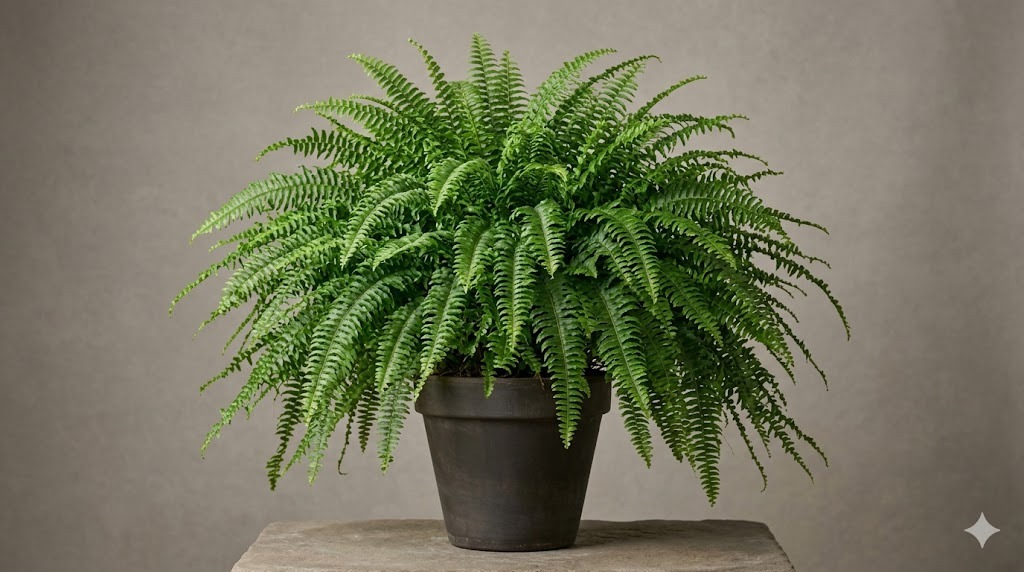
The Boston Fern forms a dense, rounded mound of long, arching fronds. Each frond is made of many small leaflets ("pinnae") arranged along a central rib, giving the feathery, ruffled texture. Fronds gracefully arch outward and down, making it a natural for hanging pots, pedestals, and high shelves. Indoors a healthy plant spreads 60-90 cm across. Related cultivars include the very ruffled 'Fluffy Ruffles' and the fine-textured 'Dallas' and 'Kimberly Queen' (a more upright, slightly more forgiving relative).
Why People Love It - Qualities & Benefits
- Lush, full greenery: few plants give the same soft, abundant, cascading green - instant cozy, romantic atmosphere.
- Pet-safe: non-toxic to cats and dogs, and safe around children.
- Classic and timeless: an heirloom plant with a century of charm; suits traditional, cottage, and boho interiors.
- Great in hanging displays: the arching fronds are made for hanging baskets and pedestals.
- Adds humidity: through transpiration it gently humidifies the air around it, and it pairs perfectly with humid rooms.
- Air quality: featured in NASA's Clean Air Study; the realistic benefit at home is greenery and a touch of added moisture.
Care
Light
Bright, indirect light is ideal - a spot near a window with no harsh direct sun. It tolerates medium light. Direct sun scorches the delicate fronds. Too little light leads to thin, sparse, pale growth.
Watering
Keep the soil consistently moist at all times - never let a Boston Fern dry out completely, as it does not recover gracefully from drought. Water when the surface just begins to feel less wet, before it dries. At the same time, avoid waterlogged, soggy soil. This need for steady moisture means it usually wants watering more often than most houseplants - sometimes every few days in warm weather.
Soil & Potting
Use a rich, moisture-retentive but still draining mix - quality potting soil with peat or coco coir and some perlite. Drainage holes are essential.
Humidity & Temperature
High humidity is essential - this is the make-or-break factor. Aim for 60-80%. In dry indoor air, especially with winter heating, the Boston Fern drops crispy, browning fronds and sheds leaflets everywhere. A humidifier is the most reliable solution; a bright bathroom is the perfect natural home. Keep it warm: 18-24 °C, and away from cold drafts and hot, dry air from radiators and vents.
Feeding
Feed lightly every 4-6 weeks in spring and summer with a diluted balanced fertilizer. Ferns are sensitive to over-feeding.
Repotting & Grooming
Repot every 1-2 years in spring when roots fill the pot. Regularly snip off browned or dead fronds at the base to keep the plant looking fresh and to encourage new growth.
Propagation
The Boston Fern is propagated by division and from runners:
- Division: at repotting, cut or pull the root ball into sections, each with healthy fronds and roots, and pot them up.
- Runners (stolons): the plant sends out thin, fuzzy, leafless runners; pin one down onto moist soil and it will root and form a new plantlet, which can then be separated.
Boston Ferns do not propagate from a single frond cutting. (In nature they also spread by spores, but division is far easier at home.)
Common Problems & Pests
- Crispy, browning fronds and dropped leaflets: the classic problem - almost always low humidity, or the soil drying out. Raise humidity and keep the soil consistently moist.
- Yellowing, pale fronds: can be too little light, underwatering, or - if soggy - overwatering.
- Brown, scorched patches: direct sun.
- Thin, sparse growth: insufficient light or nutrients.
- General decline / sudden shedding: dry air, a cold draft, or letting it dry out completely.
- Pests: watch for spider mites (dry air), scale, and mealybugs. Treating ferns needs care - they can be sensitive to some sprays; test gently and prefer rinsing and mild insecticidal soap.
Toxicity & Safety
Non-toxic and pet-safe. The Boston Fern is considered safe for cats, dogs, and humans - one of the best lush, full plants for a pet household. (Note: "Boston Fern" is sometimes confused with unrelated plants called "ferns" that are not true ferns - the true Boston Fern, Nephrolepis exaltata, is non-toxic.)
Pros & Cons
Pros
- Lush, full, romantic greenery.
- Non-toxic and pet/child-safe.
- Beautiful in hanging baskets and on pedestals.
- Gently humidifies the air; perfect bathroom plant.
Cons
- Demands high humidity - sheds and crisps in dry air.
- Needs frequent, consistent watering; intolerant of drought.
- Drops leaflets and can be messy.
- Not suited to dry living rooms without a humidifier.
Best Suited For
- Bright bathrooms and naturally humid rooms.
- Pet households wanting full, safe greenery.
- Hanging baskets, pedestals, and high shelves.
- Owners happy to water often and run a humidifier.
Not ideal for dry living rooms, forgetful waterers, frequent travelers, or anyone wanting a low-maintenance plant.
FAQ
Why is my Boston Fern turning brown and dropping leaflets? Almost always dry air, or the soil drying out. Boston Ferns need high humidity and consistently moist soil. Move it to a humid spot (a bright bathroom is ideal), run a humidifier, and never let it dry out completely.
How often should I water a Boston Fern? Often - keep the soil consistently moist, never bone dry. In warm weather that can mean every few days. Check the surface frequently and water before it dries out, while avoiding waterlogged soil.
Is the Boston Fern safe for cats and dogs? Yes - the true Boston Fern is non-toxic and pet-safe. It is a great choice of lush greenery for a pet household.
Can a Boston Fern live in a living room? It can, but only if you keep the air humid - a humidifier nearby makes it possible. In normal dry living-room air it will steadily shed crispy fronds. Bathrooms and humid rooms suit it far better.
My fern looks half-dead - can I save it? Often, yes. Cut away all the dead and crispy fronds, move it to a humid spot, keep the soil consistently moist, and be patient - Boston Ferns frequently push out fresh new fronds from the base once conditions improve.