Bromeliad (Guzmania, Aechmea, Neoregelia & more)
Bromeliads are the bold, exotic, long-lasting flowering plants that bring a true tropical splash indoors.
🗓️ Last reviewed: June 2026
Overview
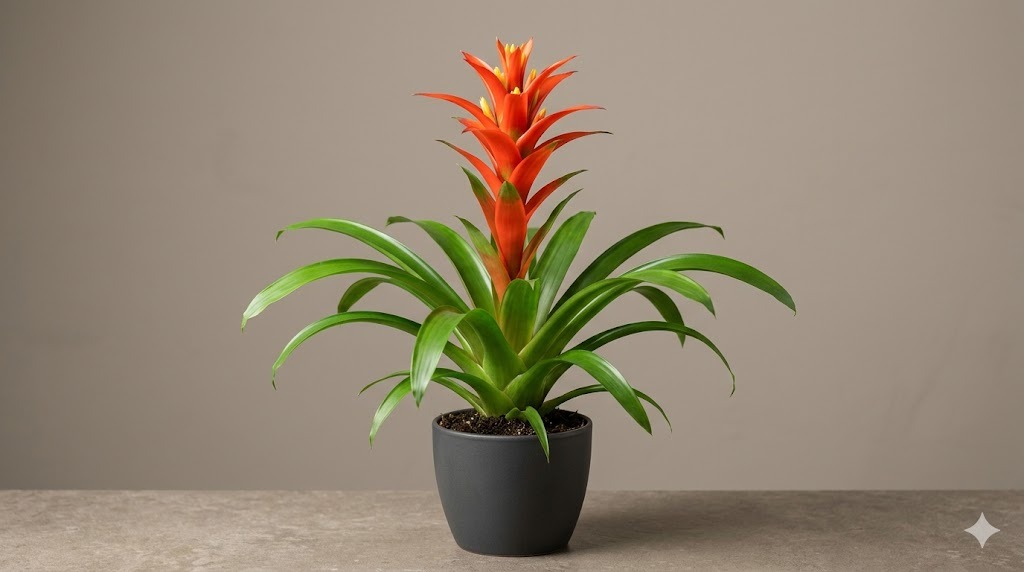
Bromeliads are the bold, exotic, long-lasting flowering plants that bring a true tropical splash indoors. What looks like a single huge, vivid flower - flaming red, orange, pink, or yellow - is usually a colorful central structure that can stay striking for months. Below it sits a neat rosette of strappy leaves, often with its own banding or coloring. Bromeliads are surprisingly easy, pet-safe, and undemanding - with one genuinely unusual quirk: many are watered not through the soil, but in a "tank" or "cup" at the center of the plant. And once a bromeliad flowers, the parent slowly dies, leaving behind babies to carry on.
Origin & Natural Habitat
Bromeliads are native to the Americas, overwhelmingly to the tropical and subtropical regions of Central and South America. Many are epiphytes - they grow perched on trees and rocks, not in soil - collecting rainwater and nutrients in the central cup formed by their tightly-overlapping leaves. (The pineapple is a bromeliad; so are Air Plants.) This epiphytic, tank-watering, tropical origin is the key to how they are grown indoors. Popular indoor genera include Guzmania (smooth-leaved, colorful flower spikes), Aechmea (the silvery "Urn Plant" with a pink bloom), and Neoregelia (grown for a vividly colored center).
Appearance
A bromeliad forms a rosette of stiff, strappy, arching leaves - green, banded, striped, or flushed with color - overlapping at the base to form a watertight central "tank" or "cup." From the center rises the show: a long-lasting, brightly colored bract or flower spike (the true flowers within it are usually small and short-lived). Sizes range from compact 15 cm plants to bold specimens over 50 cm across.
Why People Love It - Qualities & Benefits
- Months-long color: the vivid central bloom can stay striking for several months.
- Bold, exotic tropical look: instant jungle drama.
- Pet-safe: generally considered non-toxic to cats and dogs.
- Easy and undemanding: tougher and simpler than their exotic looks suggest.
- Free baby plants: every bromeliad leaves behind pups after flowering.
- Striking variety: colorful flowers (Guzmania) or colorful foliage centers (Neoregelia).
Care
Light
Bright, indirect light is ideal for most - it brings out the best leaf color and supports the bloom. Avoid harsh direct sun, which scorches the leaves (though some firmer-leaved types tolerate more light). Too little light dulls the color.
Watering - the tank method
This is the unusual part. Many tank-forming bromeliads (Guzmania, Aechmea, Neoregelia) are watered primarily by keeping a little water in the central cup formed by the leaves. Top up the cup, and flush and refresh it regularly (every week or two) so the water does not go stale, stagnant, or smelly. Keep the soil only lightly moist, watering it sparingly - the roots are mainly anchors, and soggy soil rots them. Use filtered, distilled, or rainwater if possible, as bromeliads can be sensitive to chemicals. (In cool conditions, some growers keep the cup emptier to avoid rot - empty and refresh rather than leaving stagnant water.)
Soil & Potting
Use a chunky, very airy, fast-draining mix - an orchid or epiphyte blend. Drainage holes are essential. Bromeliads have small root systems and like small pots.
Humidity & Temperature
Loves moderate to high humidity. Comfortable at 18-27 °C; keep above about 13 °C and away from cold drafts.
Feeding
Feed lightly and infrequently with a diluted fertilizer - applied weakly to the soil or, very dilute, to the cup. Bromeliads need little; over-feeding can harm them.
The Bloom & Pups Cycle
A bromeliad blooms once in its life. The colorful display lasts for months, but after it finally fades, the parent plant slowly declines and dies over the following months - this is completely natural. Before and as it dies, the parent produces pups (offsets) around its base. When a pup is about one-third to one-half the size of the parent (and ideally has some roots), separate it and pot it up - it will grow on and eventually bloom itself. So a bromeliad is never really "lost"; it simply passes the show to its pups. (Tip: a mature pup can sometimes be coaxed to bloom by enclosing it with a ripe apple in a bag for a few days - the apple releases ethylene gas, which triggers flowering.)
Common Problems & Pests
- Browning, fading central bloom: natural - the bloom does not last forever; look for pups.
- Parent plant declining after flowering: natural end of its life cycle - the pups carry on.
- Stale, smelly water in the cup: the cup was not flushed and refreshed - empty and rinse it regularly.
- Brown leaf tips: dry air, or chemicals in tap water.
- Soft, mushy base / rot: overwatered soil, or stagnant water sitting too long.
- Pests: scale and mealybugs occasionally; generally pest-resistant.
Toxicity & Safety
Generally considered non-toxic and pet-safe. Bromeliads are widely regarded as safe for cats and dogs and are not listed as toxic by major pet-poison resources - a reassuring, pet-safe choice of exotic flowering plant.
Pros & Cons
Pros
- Vivid color that lasts for months.
- Bold, exotic tropical look.
- Generally pet-safe.
- Easy and undemanding.
- Leaves behind free pups.
Cons
- Unusual "tank" watering takes getting used to.
- The parent dies after its single bloom.
- Stagnant cup water causes rot/odor if neglected.
- Brown tips with hard tap water.
Best Suited For
- Anyone wanting long-lasting, exotic color.
- Pet households.
- Bright rooms; bathrooms (humidity) suit them well.
- Beginners willing to learn the tank-watering method.
Not ideal for anyone expecting a plant that reblooms on the same rosette, or who will let the central cup go stale.
FAQ
How do I water a bromeliad? Most tank-forming types are watered primarily through the central "cup" formed by the leaves - keep a little water in it and flush and refresh it regularly so it doesn't go stale. Keep the soil only lightly moist; the roots mainly anchor the plant, and soggy soil rots them.
My bromeliad's flower is fading and the plant looks like it's dying - what happened? That is natural. A bromeliad flowers only once, then the parent slowly dies over the following months. But it produces pups - baby plants - around its base. Separate and pot up the pups, and the plant lives on through them.
How do I get a pup to flower? Grow the pup on until it is mature. Then a classic trick is to enclose it with a ripe apple in a bag for a few days - the apple gives off ethylene gas, which can trigger the bromeliad to bloom.
Are bromeliads safe for pets? They are generally considered non-toxic and pet-safe - not listed as toxic by major pet-poison resources. A good exotic option for homes with cats and dogs.
Why is the water in the center going smelly? The central cup was left too long without refreshing. Empty, rinse, and refill the cup regularly - every week or two - to keep the water fresh and prevent rot and odor.