Calathea / Prayer Plant (Calathea & Maranta)
Calatheas and their close relatives, the Marantas, are the showpieces of houseplant foliage.
🗓️ Last reviewed: June 2026
Overview
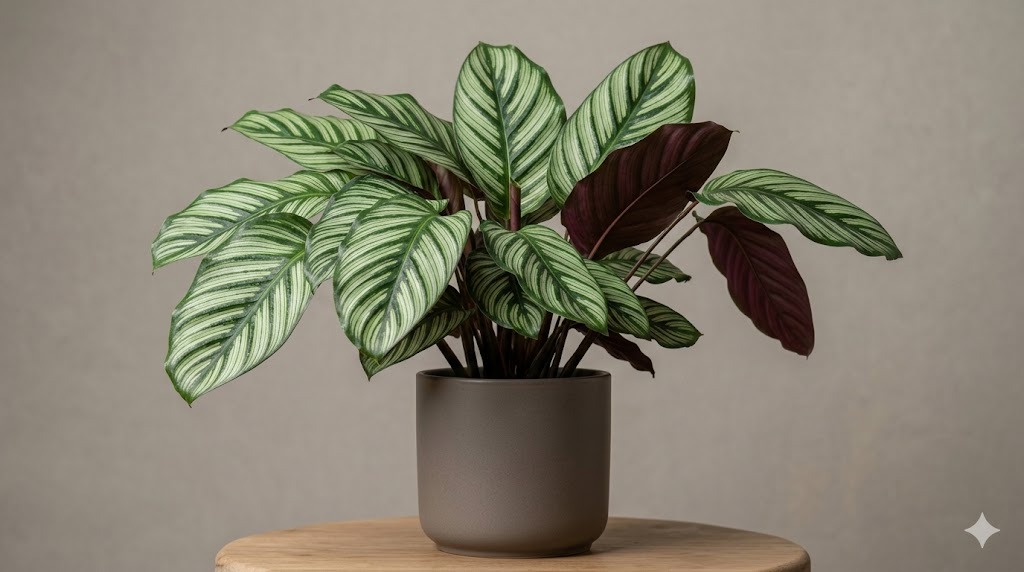
Calatheas and their close relatives, the Marantas, are the showpieces of houseplant foliage. Their leaves are extraordinary - painted with stripes, brushstrokes, and feathered patterns in green, silver, pink, and deep purple undersides - and they move. Every evening the plant raises its leaves upward, as if folding hands in prayer, then lowers them again at dawn. That nightly movement gives the group its common name, the Prayer Plant. They are stunning, living, animated plants - and they are also among the fussiest popular houseplants, demanding humidity, gentle light, and clean water. This is a plant you grow for the love of beautiful, dramatic foliage.
Botanical note: many plants long sold as Calathea have been reclassified into the genus Goeppertia, and the true Prayer Plant is Maranta leuconeura. The whole group belongs to the Marantaceae family and shares the same care, so this guide treats them together.
Origin & Natural Habitat
Calatheas and Marantas come from the tropical rainforests of South and Central America, especially the Amazon basin of Brazil. They grow on the warm, humid, shaded forest floor, under a dense canopy that filters the light to a soft glow. This habitat is the entire key to their care: they evolved for high humidity, warm stable temperatures, gentle filtered light, and consistently moist soil. Replicate the rainforest floor and they thrive; stray from it and they protest with crispy edges.
Appearance
The defining feature is the foliage. Leaves are large, oval to lance-shaped, and patterned with remarkable precision - stripes, blotches, herringbone veining, and metallic sheens - frequently with a rich purple or maroon underside. The other defining feature is movement: the leaves rise and fall daily through a mechanism called nyctinasty, driven by a small swollen joint (the pulvinus) at the base of each leaf.
Popular types: Calathea orbifolia (silver-striped), C. 'Medallion', C. lancifolia (Rattlesnake Plant), C. makoyana (Peacock Plant), C. 'White Fusion', and the Marantas - Maranta leuconeura 'Erythroneura' (Red Prayer Plant) and 'Kerchoveana'. Indoors most stay 30-60 cm tall.
Why People Love It - Qualities & Benefits
- Spectacular foliage: few plants come close to the painted, patterned leaves - they are living artwork.
- The nightly movement: watching the leaves rise in the evening and lower at dawn is genuinely captivating and makes the plant feel alive.
- Pet-safe: Calatheas and Marantas are non-toxic to cats and dogs - a rare combination of dramatic and safe.
- Compact: stays a manageable size, good for shelves and tabletops.
- No direct sun needed: thrives away from bright windows, filling shadier spots with color.
Care
Light
Medium, indirect light - never direct sun, which fades the patterns and scorches the leaves. It evolved on a shaded forest floor, so a spot away from a bright window, or near a north/east window, is ideal. Too little light dulls the markings; too much bleaches them.
Watering
Keep the soil consistently lightly moist - not soggy, never bone dry. This is one of the harder parts: Calatheas dislike drying out and dislike sitting wet. Water quality matters a lot - they are sensitive to chlorine, fluoride, and salts in tap water, which cause brown, crispy leaf edges. Use filtered, distilled, or rainwater, or tap water left out overnight. Water with room-temperature water.
Soil & Potting
Use a rich but well-draining mix that retains some moisture - quality potting soil with perlite and a little coco coir. Drainage holes are essential.
Humidity & Temperature
High humidity is non-negotiable - aim for 60%+ . This is the single biggest reason Calatheas fail indoors. Dry household air causes relentless crispy brown edges. Use a humidifier (the most reliable solution), group plants together, or keep it in a naturally humid room. Calatheas love warmth: 18-27 °C, stable, with no cold drafts and nothing below about 15 °C.
Feeding
Feed lightly every 4-6 weeks in spring and summer with a diluted balanced fertilizer. They are sensitive to fertilizer salt build-up, so go light.
Repotting
Repot every 1-2 years in spring. They like a snug pot; do not over-pot.
Propagation
Calatheas and Marantas are propagated by division, not cuttings. At repotting time, gently tease the root ball apart into clumps, each with healthy leaves and roots, and pot them up separately. Keep divisions warm and humid while they recover. Marantas, with their trailing stems, can additionally be rooted from stem cuttings taken below a node. A single leaf will not propagate.
Common Problems & Pests
- Crispy brown edges: the signature Calathea complaint - caused by low humidity and/or tap-water chemicals. Raise humidity and switch to filtered water.
- Curling leaves: usually underwatering or low humidity; the plant curls to conserve moisture.
- Yellowing leaves: overwatering, or old leaves aging out.
- Faded, washed-out patterns: too much light - move it out of bright/direct light.
- Leaves not moving / staying down: can indicate stress, but is also normal during the day; healthy plants move most noticeably evening to morning.
- Pests: spider mites are very common on Calatheas, especially in dry air - inspect the leaf undersides regularly and treat promptly.
Toxicity & Safety
Non-toxic and pet-safe. Calatheas and Marantas are considered safe for cats, dogs, and humans. They are a great choice for a pet household that wants dramatic foliage without the toxicity of most aroids.
Pros & Cons
Pros
- Spectacular, artwork-like patterned foliage.
- Mesmerizing daily leaf movement.
- Non-toxic and pet-safe.
- Compact; thrives away from direct sun.
Cons
- Fussy - among the more demanding popular houseplants.
- Needs high humidity; crispy edges are very common.
- Sensitive to tap-water chemicals.
- Prone to spider mites.
- Not a good beginner plant.
Best Suited For
- Experienced or committed plant owners who want stunning foliage.
- Naturally humid rooms, or homes with a humidifier.
- Pet households wanting a dramatic but safe plant.
- Shadier spots away from bright windows.
Not ideal for absolute beginners, very dry homes without a humidifier, sunny windowsills, or anyone wanting a low-effort plant.
FAQ
Why does my Calathea have crispy brown edges? The two classic causes: air that is too dry, and chemicals in tap water. Raise the humidity to 60%+ (a humidifier is the most reliable fix) and switch to filtered, distilled, or rainwater. This is the number-one Calathea problem.
Why are the leaves curling? Usually underwatering or low humidity - the plant curls to reduce water loss. Check that the soil is lightly moist and raise the humidity. Some gentle curling at night is also part of its normal movement.
Why have the patterns faded? Too much light. Calatheas evolved on a shaded forest floor; bright or direct light bleaches the markings. Move it somewhere with softer, indirect light.
Are Calatheas safe for pets? Yes - Calatheas and Marantas are non-toxic to cats and dogs. They are one of the best pet-safe options for dramatic foliage.
Why do the leaves move up and down? It is a natural process called nyctinasty. A small swollen joint at the base of each leaf raises the leaves at night and lowers them by day - which is why the group is called the Prayer Plant.