Coffee Plant (Coffea arabica)
The Coffee Plant is the houseplant behind your morning cup - a glossy, attractive, surprisingly easy evergreen shrub that you can genuinely grow indoors.
🗓️ Last reviewed: June 2026
Overview
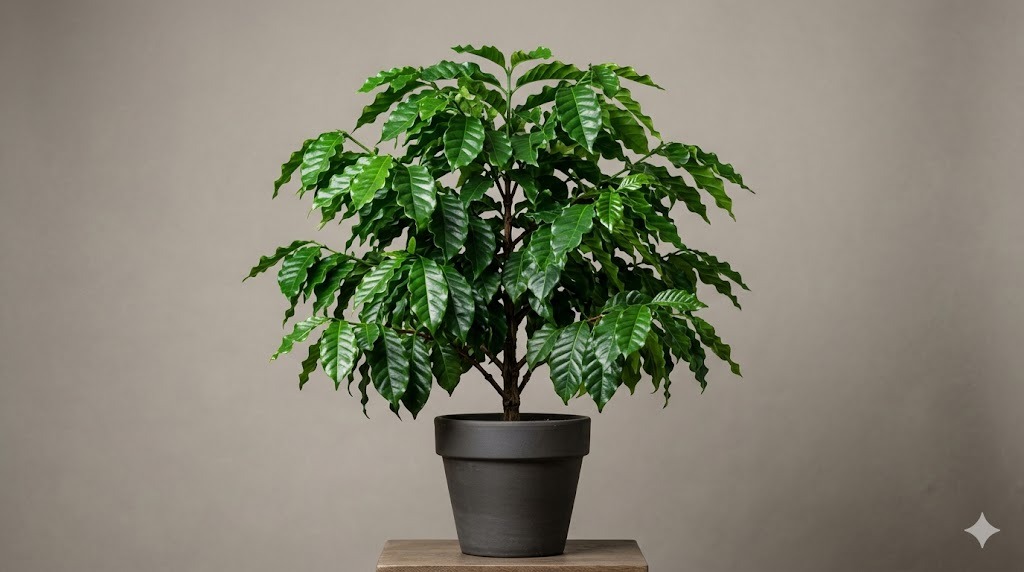
The Coffee Plant is the houseplant behind your morning cup - a glossy, attractive, surprisingly easy evergreen shrub that you can genuinely grow indoors. With deep-green, wavy-edged leaves on a neat, bushy form, it is handsome enough to earn its place purely as foliage. And, with patience and the right conditions, a mature plant can flower with fragrant white blooms and produce real coffee "cherries" - the fruit whose seeds are coffee beans. It is an affordable, novel, rewarding plant: a true conversation piece on the windowsill.
Origin & Natural Habitat
Coffea arabica is native to the highland forests of Ethiopia (and nearby South Sudan and Kenya). It grows naturally as an understory shrub or small tree beneath the forest canopy, in warm, humid, fairly bright but filtered light, at altitude. This shaded-understory, warm, humid origin is the key to its care - it wants bright but indirect light, warmth, humidity, and consistently moist soil, not blazing sun.
Appearance
The Coffee Plant is a bushy evergreen shrub with glossy, deep-green, oval leaves with attractively wavy or rippled edges. Indoors it is usually kept as a compact 0.6-1.5 m plant (and can be pruned to stay smaller), though it can grow larger over years. Mature plants (typically 3-5 years old) produce clusters of small, fragrant, jasmine-scented white flowers, which develop into green berries that ripen to red "coffee cherries", each containing two coffee beans.
Why People Love It - Qualities & Benefits
- Grow your own coffee: the novelty and reward of producing real coffee cherries at home.
- Handsome foliage: glossy, wavy-edged dark-green leaves - attractive even without fruit.
- Fragrant flowers: mature plants bloom with sweetly scented white flowers.
- Easy and affordable: undemanding care, inexpensive, widely available as small plants.
- Compact and bushy: stays a manageable size, especially with pruning.
- A genuine conversation piece.
Care
Light
Bright, indirect light is ideal - it evolved as a forest understory plant. Avoid harsh direct sun, which scorches and bleaches the leaves. Too little light gives sparse, leggy growth. A bright spot out of direct sun is the sweet spot.
Watering
Keep the soil consistently lightly moist - water when the top 2-3 cm feels dry. The Coffee Plant dislikes drying out (it wilts and the leaf edges brown) and equally dislikes soggy, waterlogged soil (root rot). It is fairly thirsty and not drought-tolerant; aim for an even, steady moisture level.
Soil & Potting
Use a rich, well-draining potting mix; a slightly acidic mix suits it. Drainage holes are essential.
Humidity & Temperature
Prefers moderate to high humidity; dry air causes brown leaf tips and edges. Loves warmth: 18-27 °C. It is not frost-hardy and is sensitive to cold - keep it above about 15 °C and away from cold drafts.
Feeding
Feed every 2-4 weeks in spring and summer with a balanced fertilizer; coffee plants are fairly hungry, and feeding supports flowering and fruiting in mature plants.
Repotting & Pruning
Repot every 1-2 years in spring. Prune to keep it bushy and at the size you want - it responds well to pruning.
Flowering & Fruiting
Patience is essential: a Coffee Plant usually needs to be 3-5 years old and mature before it flowers. Good bright light, warmth, humidity, steady moisture, and regular feeding all encourage it. The fragrant white flowers are self-pollinating, so a single indoor plant can set fruit; the green berries slowly ripen to red coffee cherries over several months. Each cherry holds two beans - though an indoor plant yields only a small, novelty harvest, not a real crop.
Propagation
Propagated from fresh seed (an unroasted, fresh green coffee bean - roasted supermarket beans will not grow) or from stem cuttings. Seed is the traditional method but slow; cuttings can be rooted in moist mix with warmth and humidity. Both take patience.
Common Problems & Pests
- Brown leaf tips and edges: dry air, underwatering, inconsistent moisture, or tap-water issues.
- Wilting: underwatering (recovers after watering), or - if the soil is soggy - root rot.
- Yellowing leaves: overwatering, or sometimes nutrient deficiency.
- Scorched, bleached leaves: too much direct sun.
- Leaf drop / blackened leaves: cold damage - keep it warm.
- No flowers: the plant is simply too young (under ~3 years), or needs more light and feeding.
- Pests: mealybugs, spider mites, scale, and aphids; inspect and treat.
Toxicity & Safety
Toxic to cats and dogs. The Coffee Plant contains caffeine and related compounds; the leaves and especially the berries/beans are toxic to pets if eaten, causing vomiting, restlessness, an elevated heart rate, and more serious effects in larger amounts. The unripe berries are also not safe to eat raw for humans. Keep the plant - and any cherries - away from pets and children.
Pros & Cons
Pros
- Novelty of growing real coffee at home.
- Handsome, glossy, wavy-edged foliage.
- Fragrant white flowers on mature plants.
- Easy, affordable, compact.
Cons
- Toxic to cats and dogs (caffeine).
- Needs years of maturity before flowering/fruiting.
- Sensitive to cold; needs warmth.
- Needs consistent moisture and humidity - not drought-tolerant.
Best Suited For
- Anyone who likes the novelty of growing coffee.
- Bright, warm, fairly humid rooms.
- Beginners wanting an easy, attractive foliage plant.
- Patient growers hoping for flowers and cherries.
Not ideal for cold rooms, very dry homes, or pet households with plant-eaters.
FAQ
Can I really grow coffee at home? Yes - Coffea arabica grows well as a houseplant, and a mature plant (usually 3-5 years old) can flower and produce real coffee cherries. Indoors the harvest is small and novelty-sized, not a true crop, but it genuinely works.
Why won't my Coffee Plant flower? Most often it is simply too young - coffee plants typically need to be about 3-5 years old and mature before flowering. Good bright light, warmth, humidity, steady moisture, and feeding all help once it is old enough.
Why are the leaf tips turning brown? Usually dry air, underwatering, or inconsistent moisture. Keep the soil evenly moist, raise the humidity, and keep it warm and away from drafts.
Is the Coffee Plant safe for pets? No - it is toxic to cats and dogs. It contains caffeine, and the leaves and berries can cause vomiting, restlessness, and a raised heart rate if eaten. Keep it away from pets.
Can I grow a Coffee Plant from a supermarket coffee bean? No - roasted coffee beans are dead and will not germinate. You need a fresh, unroasted (green) coffee seed to grow one from seed; otherwise, propagate from a stem cutting or buy a young plant.