Crown of Thorns (Euphorbia milii)
The Crown of Thorns is a tough, sun-loving succulent shrub that does something remarkable: it can flower almost continuously, all year round, even indoors.
🗓️ Last reviewed: June 2026
Overview
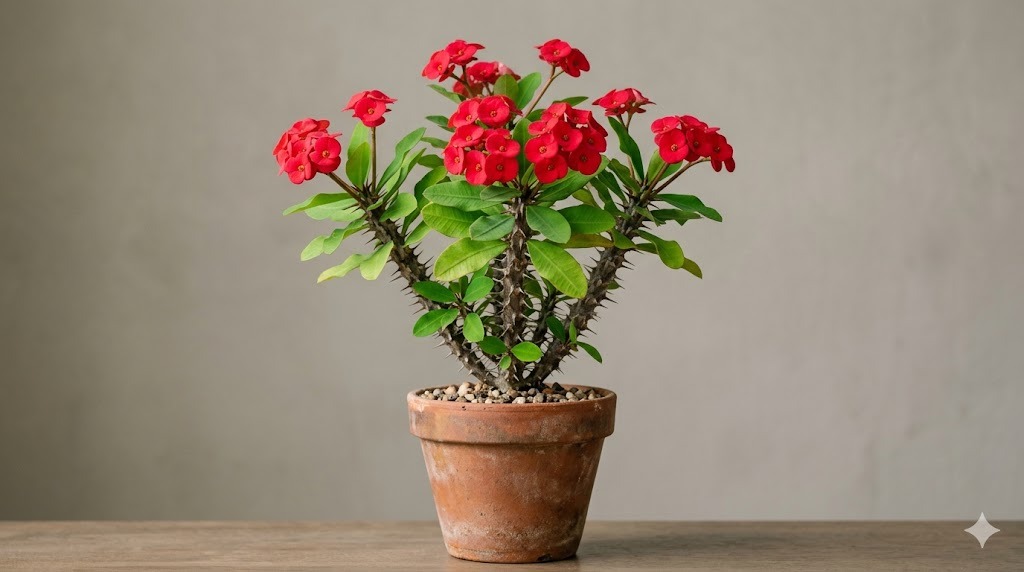
The Crown of Thorns is a tough, sun-loving succulent shrub that does something remarkable: it can flower almost continuously, all year round, even indoors. Its small, jewel-bright blooms - red, pink, yellow, white, or coral - appear in cheerful clusters above thick, spiny stems and bright green leaves. It is drought-proof, long-lived, and wonderfully low-maintenance. The trade-offs are right there in the name and the family: it has genuine thorns, and as a Euphorbia, its milky sap is an irritant. Handle it with a little respect, and it is one of the most rewarding, reliably-blooming plants you can grow.
Origin & Natural Habitat
Euphorbia milii is native to Madagascar, where it grows in hot, dry, sun-baked, rocky conditions. It is a succulent, storing water in its thick stems to survive drought. Its name is tied to legend - it has long been associated with the crown of thorns of the biblical Passion. Its hot, arid, intensely sunny Madagascan origin is the entire care guide: maximum light, gritty soil, infrequent water.
Appearance
The Crown of Thorns is a sprawling, branching succulent shrub with thick, grey-brown, densely thorn-covered stems. New growth carries bright green, teardrop-shaped leaves toward the stem tips. The "flowers" are the charm: what look like small, rounded, colorful petals are actually modified leaves called bracts (true of many Euphorbias), surrounding tiny true flowers - and because they are bracts, the color lasts a long time. Blooms come in red, pink, coral, yellow, and white. Indoors it typically grows 30-90 cm; modern compact hybrids stay smaller and bloom heavily.
Why People Love It - Qualities & Benefits
- Almost year-round flowers: one of the very few houseplants that blooms continuously with enough light.
- Long-lasting color: the colorful bracts hold for weeks.
- Tough and drought-proof: a succulent that thrives on neglect and survives long absences.
- Loves sun: happy on hot, bright windowsills where many plants fail.
- Long-lived: can thrive for many years, even decades.
- Easy to propagate: roots readily from stem cuttings.
Care
Light
The Crown of Thorns needs lots of bright light, including several hours of direct sun - a sunny south- or west-facing window. Light is the engine of its near-continuous flowering: the more sun it gets, the more it blooms. In low light it grows leggy and flowers little or not at all.
Watering
Water as a succulent: thoroughly, then only again when the soil is mostly to fully dry - roughly every 1-2 weeks in summer, less in winter. The thick stems store water; overwatering causes root rot and stem rot, the main cause of death. It tolerates underwatering well. When in doubt, do not water.
Soil & Potting
Use a gritty, fast-draining cactus or succulent mix. Drainage holes are essential.
Humidity & Temperature
Prefers normal-to-dry air. Loves warmth: comfortable at 18-29 °C, and it appreciates being warm. Keep above about 10 °C; not frost-hardy. It can take a slightly cooler, drier winter rest.
Feeding
Feed every 2-4 weeks during the growing season with a diluted balanced or bloom fertilizer to support continuous flowering.
Pruning & Handling
Prune to shape and to encourage bushier, more floriferous growth. Always wear thick gloves - the thorns are real, and the milky sap is an irritant (see Safety). Wash hands and tools after pruning.
Propagation
Easy, from stem cuttings. Cut a stem tip (wear gloves), and - important for a Euphorbia - rinse or blot the cut end to stop the milky sap, then let the cutting callus for several days to a week. Plant the calloused cutting in dry, gritty mix and water sparingly until rooted. Spring and summer are best.
Common Problems & Pests
- No flowers / few flowers: not enough light - this plant needs lots of direct sun to bloom.
- Leggy, sparse growth: insufficient light.
- Leaf drop: some leaf loss is normal, especially in winter or after a change; heavy drop can mean over- or underwatering, or cold.
- Yellowing leaves, soft/mushy stems: overwatering and rot.
- Pests: mealybugs (common, often in stem crevices), spider mites, and scale; inspect and treat.
Toxicity & Safety
Toxic to cats, dogs, and humans - and physically thorny. Two real hazards:
- Thorns: the stems are densely spined; handle with care and keep it where people won't brush against it.
- Irritant sap: like all Euphorbias, it bleeds a milky latex sap that is toxic and a significant irritant - it can cause painful skin and eye irritation, and irritation of the mouth and stomach if chewed. Always wear gloves when handling or pruning, never rub your eyes, and wash hands and tools afterward. Keep it well away from pets and small children.
Pros & Cons
Pros
- Flowers almost year-round in good light.
- Long-lasting, colorful bracts.
- Tough, drought-proof, low-maintenance.
- Loves sunny windowsills.
- Long-lived; easy to propagate.
Cons
- Sharp thorns - must be handled and placed carefully.
- Toxic, irritant milky sap.
- Won't flower without lots of direct sun.
- Rots if overwatered.
Best Suited For
- Bright, sunny windowsills.
- Anyone wanting near-continuous flowers with easy care.
- Succulent lovers.
- Homes without pets or small children that would reach it.
Not ideal for low-light rooms, homes where people/pets would brush against the thorns, or households with curious pets and toddlers.
FAQ
Why won't my Crown of Thorns flower? Almost always not enough light. The Crown of Thorns needs lots of bright light, including several hours of direct sun, to bloom - light is what powers its near-continuous flowering. Move it to your sunniest window.
How often should I water it? As a succulent - thoroughly, then only when the soil is mostly to fully dry, roughly every 1-2 weeks in summer and less in winter. The stems store water; overwatering and rot are the main causes of death.
Is the Crown of Thorns dangerous? It has two hazards: sharp thorns, and a toxic, irritant milky sap typical of Euphorbias. The sap can cause painful skin and eye irritation. Wear gloves when handling it, keep it away from pets and children, and place it where no one will brush against the thorns.
Why is my plant dropping leaves? Some leaf drop is normal, especially in winter or after a move or change in conditions. Heavy leaf drop can signal overwatering, underwatering, or cold - check the soil and keep it warm.
Is the Crown of Thorns safe for pets? No - it is toxic to cats and dogs, and the milky sap is an irritant. Combined with the thorns, it is best kept well out of reach of pets and children.