Cyclamen (Cyclamen persicum)
The Cyclamen is the elegant, cool-season flowering plant that brightens homes through autumn and winter, exactly when most houseplants are resting.
🗓️ Last reviewed: June 2026
Overview
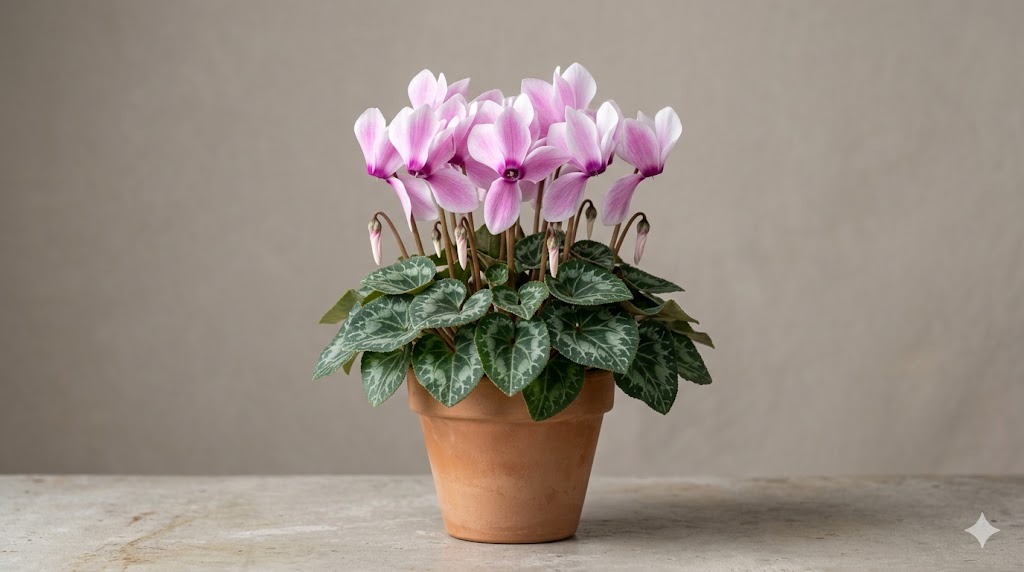
The Cyclamen is the elegant, cool-season flowering plant that brightens homes through autumn and winter, exactly when most houseplants are resting. Its swept-back, butterfly-like flowers - in white, pink, red, and purple - rise on slender stems above a mound of pretty, silver-marbled, heart-shaped leaves. It is a charming, sophisticated plant, but it has an unusual personality: it grows and blooms in the cool months and goes dormant in summer. Understanding that backwards-to-most-plants rhythm is the whole secret to keeping a Cyclamen alive - and reblooming - year after year.
Origin & Natural Habitat
Cyclamen persicum, the florist's cyclamen, is native to the eastern Mediterranean - rocky hillsides and woodlands of the region around the Middle East and Greek islands. It evolved in a climate of mild, wet winters and hot, dry summers. So it grows actively in the cool, moist season and survives the hot, dry summer by going dormant underground as a tuber. This Mediterranean rhythm - active in cool, dormant in heat - is unlike most houseplants and explains everything about its care.
Appearance
The Cyclamen forms a low mound of rounded, heart-shaped leaves, deep green and beautifully marbled with silver patterning. Above them, on slender upright stems, sit the distinctive flowers: five petals swept dramatically upward and back, giving a butterfly- or shuttlecock-like look, in white, pink, rose, red, and purple, some ruffled or bicolored. It grows from a round tuber. Florist cyclamen are usually compact, 15-30 cm; there are also smaller mini cyclamen.
Why People Love It - Qualities & Benefits
- Winter color: blooms abundantly through autumn and winter, when little else does.
- Elegant flowers: the upswept, butterfly-like blooms are distinctive and refined.
- Beautiful foliage: even out of flower, the silver-marbled heart-shaped leaves are lovely.
- Long bloom period: flowers for many weeks, even months, with good care.
- Compact: small and tidy - perfect for tabletops and windowsills.
- Cool-room plant: thrives in cooler spots many houseplants dislike.
Care
Light
Bright, indirect light is ideal during its active growing/flowering season. Avoid hot direct sun. Good light supports continued blooming.
Watering
Watering technique matters. Keep the soil lightly, evenly moist while the Cyclamen is growing and flowering - but water from below (pour into the saucer and let the tuber's roots soak it up, then drain) or carefully at the soil edge. Never pour water over the crown or the top of the tuber - water sitting in the crown causes rot, the most common way Cyclamen die. Avoid both soggy soil and complete drying out during the active season.
Soil & Potting
Use a well-draining potting mix. Drainage holes are essential. The top of the tuber is often left slightly above the soil surface.
Humidity & Temperature
This is the key. Cyclamen are cool-season plants - they love cool conditions, ideally around 10-16 °C, and dislike warm rooms. Hot, dry indoor air (especially near radiators) makes them wilt, yellow, and decline quickly. A cool, bright room, a cool windowsill, or an enclosed porch is ideal. They appreciate moderate humidity.
Feeding
Feed every 2-4 weeks during the active growing/flowering season with a diluted balanced or bloom fertilizer. Do not feed during dormancy.
Grooming
Remove spent flowers and yellowing leaves by twisting and pulling them off cleanly at the base (rather than cutting), which prevents stubs that can rot.
The Dormancy Cycle
This is what confuses everyone. Cyclamen is not an "evergreen" houseplant - it has a yearly cycle:
- Autumn-spring: active growth and flowering, in cool, bright conditions.
- Late spring-summer: as warmth arrives, the plant naturally yellows and the leaves die back. This is not death - it is dormancy. Gradually reduce watering as the foliage fades.
- Summer: rest the dormant tuber in a cool, dry, shaded spot, watering very little or not at all.
- Late summer-autumn: as cool weather returns, resume light watering and bring it back into bright light; new leaves emerge and the cycle begins again.
Many people discard Cyclamen as "dead" in summer - but a dormant tuber, properly rested, reblooms for years.
Propagation
Cyclamen are propagated from seed, which is slow (it can take a year or more to reach flowering size). The tuber generally should not be cut or divided - it does not reliably regrow from pieces and is prone to rot. For most people, Cyclamen are bought, or grown from seed by the patient.
Common Problems & Pests
- Yellowing leaves / wilting / collapse: if in summer, this is usually natural dormancy. In the growing season, it usually means the room is too warm, or a watering problem.
- Crown / tuber rot: water poured over the crown, or overwatering - water from below.
- Drooping despite moist soil: rot, or heat stress.
- Few or short-lived flowers: too warm, too little light, or needing feeding.
- Pests: cyclamen mites (which distort new growth), vine weevils (whose grubs eat the tuber), aphids, and thrips.
Toxicity & Safety
Toxic to cats, dogs, and humans. Cyclamen contains saponins (terpenoid saponins), most concentrated in the tuber/roots; ingestion causes drooling, vomiting, and diarrhea, and large amounts can cause more serious effects, including heart-rhythm problems and seizures. Keep it well away from pets and children, and keep the tuber especially out of reach.
Pros & Cons
Pros
- Abundant flowers through autumn and winter.
- Elegant, distinctive blooms; pretty marbled leaves.
- Long bloom period.
- Compact; thrives in cool rooms.
Cons
- Toxic to pets and people (tuber especially).
- Needs cool conditions - fails in warm rooms.
- Goes dormant in summer (confuses many owners).
- Crown rot if watered incorrectly.
Best Suited For
- Cool, bright rooms - cool windowsills, porches, hallways.
- Anyone wanting winter and autumn color.
- People who will learn its dormancy cycle.
- Compact, tabletop displays.
Not ideal for warm rooms, pet households with plant-eaters, or anyone expecting an evergreen, year-round plant.
FAQ
Why is my Cyclamen yellowing and collapsing? If it is late spring or summer, this is almost certainly natural dormancy - the plant is resting for the hot season, not dying. During the cool growing season, yellowing usually means the room is too warm, or a watering problem.
How do I water a Cyclamen? Keep the soil lightly, evenly moist during growth, but water from below - pour into the saucer and let it soak up, then drain - or water at the soil edge. Never pour water over the crown or the top of the tuber; that causes rot.
My Cyclamen died back in summer - can I save it? Most likely it is just dormant. Rest the tuber in a cool, dry, shaded spot through summer with little or no water. When cool weather returns in autumn, resume watering and bright light, and it should re-sprout and rebloom.
Why does my Cyclamen wilt so fast indoors? Usually because the room is too warm. Cyclamen are cool-season plants - they want around 10-16 °C and bright light. Keep them away from radiators and warm rooms; a cool, bright spot keeps them happy.
Is the Cyclamen safe for pets? No - Cyclamen is toxic to cats and dogs, with the tuber the most toxic part. Ingestion causes vomiting and, in larger amounts, serious effects. Keep it well away from pets.