Jade Plant (Crassula ovata)
The Jade Plant is a small, sturdy succulent tree that can become a lifelong companion - often outliving the person who planted it and passing down through generations.
🗓️ Last reviewed: June 2026
Overview
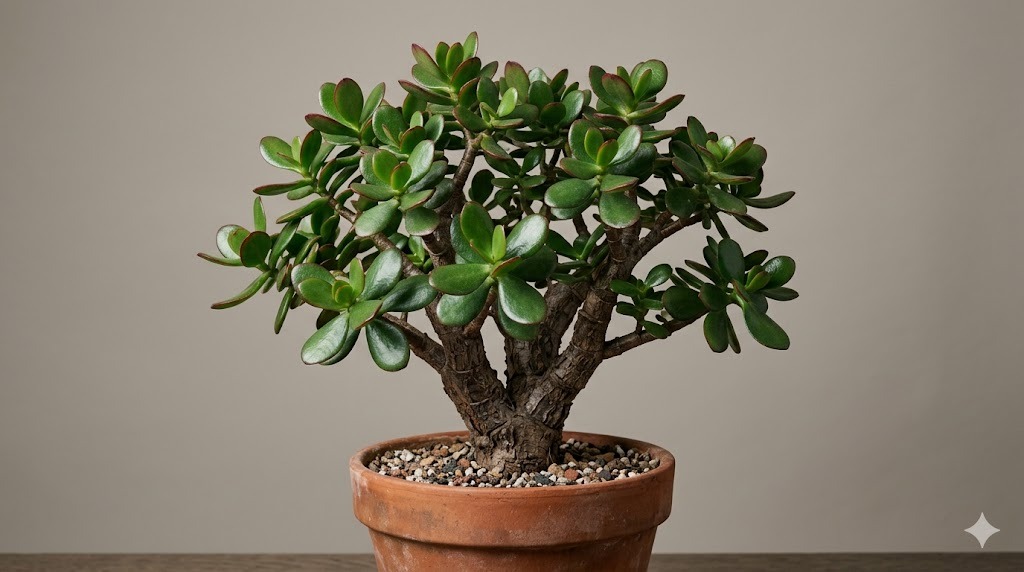
The Jade Plant is a small, sturdy succulent tree that can become a lifelong companion - often outliving the person who planted it and passing down through generations. With thick, glossy, jade-green leaves on a stout woody trunk, it has the look of a miniature bonsai tree with almost none of the work. It is exceptionally easy: it thrives on neglect, asks for little water, and slowly, steadily becomes more characterful and tree-like every year. In many cultures it is considered a symbol of luck, prosperity, and friendship - the classic "money plant" given as a housewarming gift.
Origin & Natural Habitat
The Jade Plant is native to South Africa and Mozambique, where it grows on dry, rocky hillsides and scrubland in hot, sunny, arid conditions. It is a true succulent: it stores water in its plump leaves and thick stems to survive long dry spells. That origin dictates everything about its care - it wants strong light, sharp drainage, and infrequent watering. Treated like the tough, sun-loving desert plant it is, a Jade Plant can live for decades and become a substantial small tree.
Appearance
The Jade Plant has thick, oval, fleshy leaves - smooth, glossy, and rich jade-green, often edged in red when grown in bright sun. The leaves grow in pairs on stems that gradually thicken into a gnarled, woody, tree-like trunk, giving older specimens a natural bonsai appearance. Indoors it commonly reaches 30-90 cm over many years and can eventually exceed a meter. Mature, well-lit plants may produce clusters of small white or pale-pink star-shaped flowers in winter. Popular varieties include 'Hobbit' and 'Gollum' (tubular, curled leaves) and the variegated 'Tricolor'.
Why People Love It - Qualities & Benefits
- Lives for decades: a Jade Plant is a long-term companion and a genuine heirloom - many are handed down through families.
- Bonsai look, easy care: it naturally develops a thick trunk and tree shape, giving a bonsai aesthetic without bonsai discipline.
- Almost unkillable: thrives on neglect, tolerates long absences, and forgives missed waterings.
- Symbol of luck and prosperity: widely given as a housewarming or friendship gift; a meaningful present.
- Loves sun: happy on bright, hot windowsills where many plants struggle.
- Effortless propagation: grows readily from a single leaf or stem.
Care
Light
The Jade Plant wants lots of bright light, including several hours of direct sun - a south- or west-facing window is ideal. Good light keeps it compact and sturdy, deepens the leaf color, and brings out the attractive red leaf margins. In too little light it grows leggy, stretched, and weak, with thin stems and widely spaced leaves.
Watering
Water deeply but infrequently, and only when the soil is completely dry. Roughly every 2-3 weeks in summer and every 4-6 weeks (or less) in winter. The leaves store water, so the plant copes easily with being underwatered. Overwatering is the main cause of death - it rots the roots and makes the leaves go soft, yellow, and mushy, or causes leaves to drop. When in doubt, do not water.
Soil & Potting
Use a gritty, fast-draining cactus or succulent mix. Drainage holes are essential; terracotta pots are ideal. A heavier pot also helps balance the weight of an older, top-heavy plant.
Humidity & Temperature
Prefers dry air; normal room humidity or drier is fine. Comfortable at 16-24 °C. It is not frost-hardy - keep it above about 10 °C. A cooler, drier rest in winter can encourage flowering.
Feeding
Minimal. Feed once or twice during spring and summer with a diluted succulent or balanced fertilizer.
Repotting
Repot infrequently - every 2-4 years. Jade Plants are slow-growing and do not mind a snug pot. Repot in spring and wait a week before watering.
Propagation
The Jade Plant is one of the easiest succulents to propagate:
- Leaf propagation: gently twist off a whole, healthy leaf, let the cut end dry and callus for a few days, then lay it on or barely into dry succulent mix. A tiny new plant and roots form over weeks.
- Stem cuttings: cut a stem section, let it callus for several days to a week, then plant it in dry mix. Stem cuttings root faster and give a bigger plant sooner.
In both cases, the key step is letting the cutting callus before potting - and watering only sparingly until roots establish.
Common Problems & Pests
- Soft, mushy, yellowing leaves, or sudden leaf drop: overwatering and root rot - the classic mistake. Stop watering, check the roots, and repot in dry, gritty mix.
- Leggy, stretched, weak growth: not enough light - move it to a sunny window.
- Shriveled, wrinkled leaves: the rarer case of genuine underwatering - give it a deep drink.
- Leaves dropping after a move: stress from a sudden change in conditions; let it settle.
- Pests: mealybugs are the most common - white fluff in the leaf joints - along with occasional scale. Dab with diluted alcohol or treat with insecticidal soap.
Toxicity & Safety
Toxic to cats and dogs. The Jade Plant is poisonous to pets if eaten - it can cause vomiting, lethargy, incoordination, and a slowed heart rate. The exact toxic compound is not fully identified, but the effect is well documented. Keep it well out of reach of pets. It is generally regarded as only mildly irritating to humans, but it should not be eaten.
Pros & Cons
Pros
- Extremely long-lived - a true heirloom plant.
- Very low-maintenance and drought-tolerant.
- Naturally develops a beautiful bonsai-like form.
- Loves bright, sunny windowsills.
- Easy to propagate; a meaningful gift plant.
Cons
- Toxic to cats and dogs.
- Rots quickly if overwatered.
- Slow-growing - limited change year to year.
- Goes leggy without enough sun.
- Older plants are heavy and top-heavy.
Best Suited For
- Beginners and busy people who want an easy, lasting plant.
- Bright, sunny windowsills.
- Anyone who wants a plant to keep for decades or pass on.
- People looking for a meaningful gift or "lucky" plant.
Not ideal for dark rooms, frequent overwaterers, or pet households with determined plant-eaters.
FAQ
How often should I water a Jade Plant? Only when the soil is completely dry - roughly every 2-3 weeks in summer, every 4-6 weeks or less in winter. The leaves store water, so underwatering is rarely a problem; overwatering is the number-one killer.
Why are my Jade Plant's leaves falling off? Most often overwatering - soft, mushy, yellowing leaves that drop point to soggy soil and root rot. It can also be a stress reaction to a sudden move or a cold draft. Shriveled leaves that drop suggest the opposite, extreme underwatering.
Why is my Jade Plant tall, thin, and floppy? Not enough light. The Jade Plant stretches toward light and becomes leggy and weak in dim spots. Move it to a bright, sunny window for compact, sturdy growth.
Can I really grow a new plant from one leaf? Yes. Twist off a healthy leaf, let the cut end callus for a few days, lay it on dry succulent mix, and water sparingly - a tiny new plant will form over several weeks. Stem cuttings work even faster.
Is the Jade Plant safe around pets? No - it is toxic to cats and dogs and can cause vomiting and lethargy if eaten. Keep it well out of their reach.