Money Tree (Pachira aquatica)
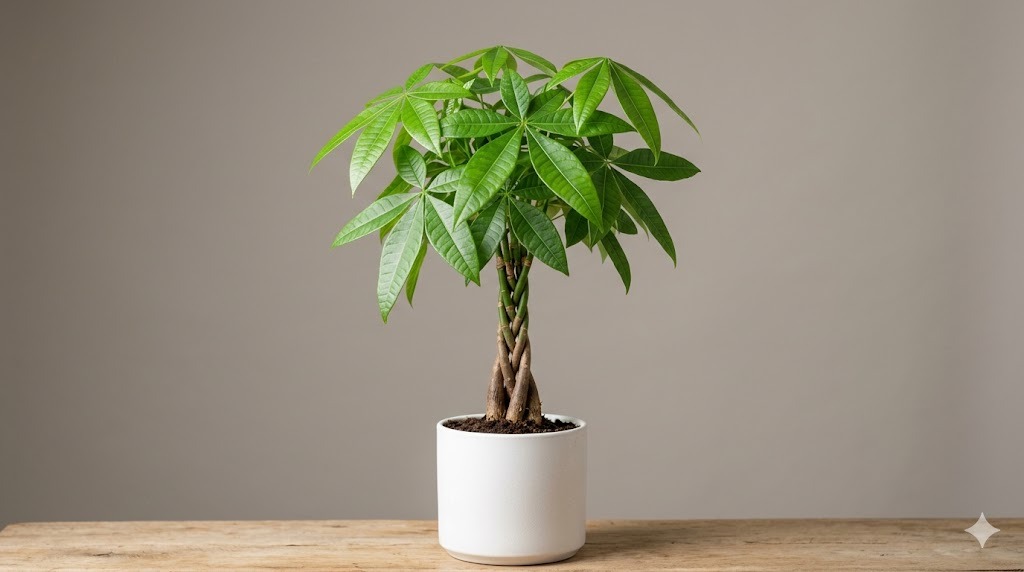
The Money Tree is the houseplant of good fortune - instantly recognizable by its distinctive braided trunk and crown of glossy, hand-shaped leaves.
🗓️ Last reviewed: June 2026
Overview
The Money Tree is the houseplant of good fortune - instantly recognizable by its distinctive braided trunk and crown of glossy, hand-shaped leaves. Said in feng shui to attract prosperity and luck, it is one of the most popular gift plants in the world, given for new homes, new businesses, and new beginnings. Beyond the symbolism, it is a genuinely good houseplant: attractive, forgiving, pet-safe, and tolerant of a range of conditions. It is an easy way to bring a touch of tree-like greenery - and a little luck - indoors.
Origin & Natural Habitat
Pachira aquatica is native to the wetlands and swampy regions of Central and South America, from Mexico to northern Brazil. As the species name aquatica suggests, it naturally grows in or near water, in warm, humid, brightly lit conditions, and in the wild becomes a large tree producing big seed pods with edible nuts. The braided "Money Tree" is a horticultural creation: nursery growers plait the flexible young trunks of several seedlings together while they are supple, and the braid sets as the trunks thicken.
Appearance
The Money Tree has a slender trunk - usually a braid of several intertwined stems - topped with palmate leaves, each made of five to seven glossy, pointed green leaflets radiating like fingers from a central point. Indoors it is commonly sold from small desktop size up to floor plants of 1-2 m. The braided form gives it a neat, sculptural, tree-like look.
Why People Love It - Qualities & Benefits
- Symbol of luck and prosperity: a meaningful gift for housewarmings, new businesses, and celebrations.
- Pet-safe: non-toxic to cats and dogs.
- Distinctive braided trunk: sculptural and tidy, with an instantly recognizable look.
- Forgiving and adaptable: tolerates a range of light and the occasional care lapse.
- Compact to large: available in sizes for a desk or a floor.
- Long-lived: with decent care it lasts for many years.
Care
Light
Bright, indirect light is ideal. It tolerates medium light but grows slowly and can get leggy. Avoid harsh direct sun, which scorches the leaflets. Rotate the plant regularly, as it leans toward light.
Watering
Despite its swampy origins, as a potted houseplant the Money Tree is most often killed by overwatering. Water thoroughly when the top 3-5 cm of soil is dry, then let it drain completely - typically every 1-2 weeks, less in winter. Yellowing leaves and a soft trunk signal overwatering and root rot; wrinkled, drooping leaves can signal underwatering.
Soil & Potting
Use a well-draining potting mix. Drainage holes are essential.
Humidity & Temperature
Appreciates moderate to high humidity. Comfortable at 18-27 °C; keep above about 13 °C and away from cold drafts.
Feeding
Feed every 4-6 weeks in spring and summer with a balanced fertilizer at half strength.
Repotting
Repot every 2-3 years in spring. It does not mind being slightly snug.
Propagation
Propagated from stem cuttings: take a cutting with a few leaves, let it callus briefly, and root it in water or moist soil with warmth and bright light. It can also be grown from its large fresh seeds. Note that braiding requires several young, supple plants grown together - a mature single trunk cannot be braided.
Common Problems & Pests
- Yellowing leaves, soft trunk: overwatering and root rot - the most common cause of death.
- Leaf drop: often a reaction to change - a move, a draft, or a watering shift; some adjustment drop is normal after purchase.
- Brown crispy leaf tips/edges: dry air or underwatering.
- Leggy, stretched growth: insufficient light.
- Pests: spider mites, mealybugs, scale, and fungus gnats; inspect and treat.
Toxicity & Safety
Non-toxic and pet-safe. The Money Tree (Pachira aquatica) is considered safe for cats, dogs, and humans - a pet-safe choice of tree-like greenery, and reassuring for a popular gift plant.
Pros & Cons
Pros
- Non-toxic and pet-safe.
- Distinctive, sculptural braided trunk.
- Meaningful as a luck/prosperity gift.
- Forgiving and adaptable.
- Available in many sizes.
Cons
- Easily overwatered.
- Drops leaves in response to change.
- Can get leggy in low light.
- Braided form is created young - cannot be braided later.
Best Suited For
- Anyone wanting an easy, attractive, symbolic plant.
- Pet households.
- Desks, offices, and homes - as gift or décor.
- Beginners.
Not ideal for habitual overwaterers, or very dark rooms.
FAQ
Why are my Money Tree's leaves turning yellow? Most often overwatering. Despite growing near water in the wild, as a potted plant it rots if kept too wet. Let the top few centimeters of soil dry out before watering, and ensure the pot drains freely.
Why is my Money Tree dropping leaves? Usually a reaction to change - a new location, a draft, or a shift in watering or light. Some leaf drop is normal in the first weeks after purchase. Give it a stable spot and steady care.
Is the braided trunk natural? No - growers braid the flexible young trunks of several seedlings together while they are supple. The braid sets permanently as the trunks thicken. You cannot braid a mature plant.
Is the Money Tree safe for pets? Yes - it is non-toxic and pet-safe for cats and dogs.
Does the Money Tree really bring luck? That is its feng shui symbolism - it is traditionally associated with prosperity and good fortune, which is why it is such a popular gift. As a plant, it simply makes attractive, easy greenery; the luck is up to you.