Monstera Adansonii (Swiss Cheese Vine)
The Monstera Adansonii - the "Swiss Cheese Vine" - is the smaller, trailing, holey cousin of the famous Monstera Deliciosa.
🗓️ Last reviewed: June 2026
Overview
The Monstera Adansonii - the "Swiss Cheese Vine" - is the smaller, trailing, holey cousin of the famous Monstera Deliciosa. Where the Deliciosa is a big floor plant with split leaves, the Adansonii is a fast-growing vine whose leaves are punched with dramatic oval holes (fenestrations) from a young age. It trails beautifully from shelves and hanging pots, climbs eagerly up a pole, grows quickly, and propagates in minutes. Lush, distinctive, and easy, it is one of the most rewarding trailing aroids you can grow.
Origin & Natural Habitat
Monstera Adansonii is native to the tropical rainforests of Central and South America and the Caribbean. Like other Monsteras, it is a climbing vine - it scrambles up tree trunks toward the light, gripping with aerial roots, growing in the warm, humid, shaded understory. The distinctive holes are thought to help the leaves withstand heavy rain and wind and to let light filter down to lower leaves. This humid, shaded, climbing origin shapes its care.
Appearance
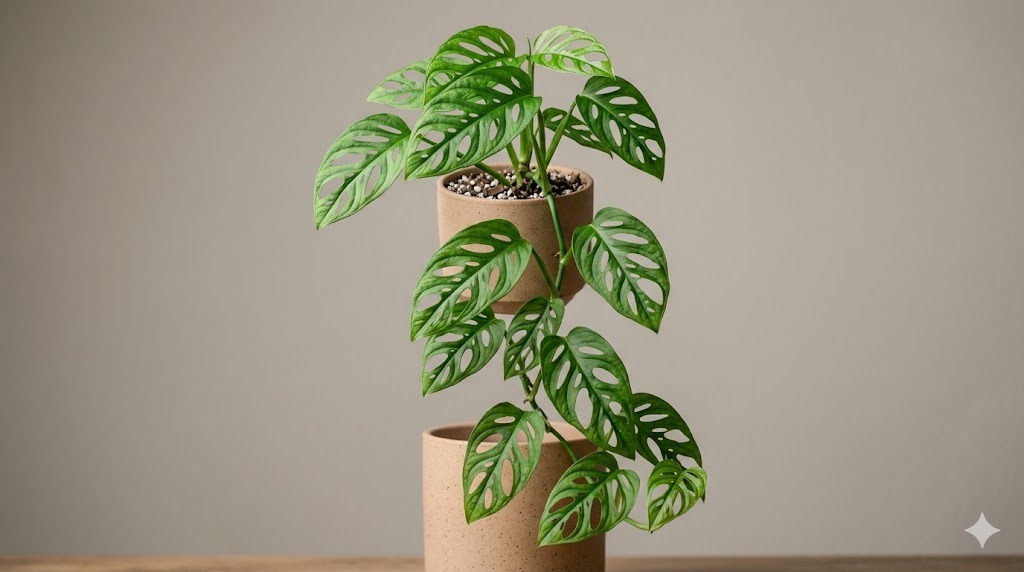
The Monstera Adansonii has thin, oval, pointed leaves perforated with smooth-edged oval holes - the fenestrations are enclosed holes (unlike the Deliciosa, whose splits usually reach the leaf edge). Leaves are mid-to-deep green, sometimes slightly textured. Stems trail or climb 1-3 m and longer. Unlike the Deliciosa, even young Adansonii leaves show holes. There is a rare, prized variegated form.
Why People Love It - Qualities & Benefits
- Dramatic holey leaves: the enclosed fenestrations are striking and unusual.
- Fast and rewarding: grows quickly, with constant visible new growth.
- Versatile: trails gorgeously from shelves and hanging pots, or climbs a moss pole.
- Easy to propagate: roots from cuttings in water within weeks.
- Compact-ish: more space-friendly than the large Monstera Deliciosa.
- Bigger leaves on a pole: climbing produces larger, holier leaves.
Care
Light
Bright, indirect light is ideal - good light drives fast growth and well-fenestrated leaves. It tolerates medium light but grows slower with smaller, less-holey leaves. Avoid harsh direct sun, which scorches the thin leaves.
Watering
Water when the top 3-5 cm of soil is dry, then drain well - typically weekly in summer, every 10-14 days in winter. The Adansonii likes lightly moist (not soggy) soil; overwatering causes yellowing leaves and root rot, while underwatering causes drooping and crispy edges.
Soil & Potting
Use a chunky, airy, well-draining aroid mix - potting soil with perlite, bark, and coco coir. Drainage holes are essential.
Humidity & Temperature
Tolerates normal room humidity but grows lusher and faster with moderate-to-high humidity (50%+). Comfortable at 18-27 °C; keep above about 13 °C and away from cold drafts.
Feeding
Feed monthly in spring and summer with a balanced fertilizer at half strength.
Repotting & Support
Repot every 1-2 years when roots fill the pot. Give it a moss pole or trellis to climb for larger, more dramatically fenestrated leaves, or let it trail. Prune to keep it full and use the cuttings to propagate.
Propagation
Very easy. Cut a stem section just below a node (the point where a leaf and aerial root emerge), ensuring at least one node per cutting. Root the node in water or moist sphagnum moss - roots form within 2-4 weeks - then pot it up. A leaf without a node will not grow. Plant several rooted cuttings together for a full pot.
Common Problems & Pests
- Few or no holes / small leaves: young plant, too little light, or no support to climb - give brighter light and a pole.
- Yellowing leaves: overwatering, or natural aging of old leaves.
- Brown, crispy edges: low humidity or underwatering.
- Leggy vines with sparse leaves: insufficient light - move brighter and prune.
- Black, mushy stems: root rot from soggy soil.
- Pests: spider mites, mealybugs, scale, and thrips; inspect and treat.
Toxicity & Safety
Toxic to cats, dogs, and humans if chewed. Like all Monsteras, the Adansonii contains insoluble calcium oxalate crystals; chewing causes mouth and throat irritation, drooling, and vomiting. Because it trails, keep hanging pots out of reach of cats, and keep it away from children.
Pros & Cons
Pros
- Dramatic, distinctive holey leaves from a young age.
- Fast-growing and rewarding.
- Versatile - trails or climbs.
- Very easy to propagate.
- More space-friendly than Monstera Deliciosa.
Cons
- Toxic to pets and kids if chewed.
- Needs good light and humidity for the best leaves.
- Gets leggy in low light.
- Thin leaves scorch in direct sun.
Best Suited For
- Anyone wanting a fast, distinctive trailing or climbing plant.
- Bright rooms, shelves, and hanging spots.
- Plant owners who enjoy propagating.
- Smaller spaces that can't fit a Monstera Deliciosa.
Not ideal for dark rooms, or pet households with leaf-chewing cats unless hung out of reach.
FAQ
What's the difference between Monstera Adansonii and Deliciosa? The Adansonii is a smaller, trailing vine with thin leaves full of enclosed oval holes, even when young. The Deliciosa is a large floor plant with bigger leaves whose splits usually reach the leaf edge, and it develops fenestration only with maturity.
Why doesn't my Adansonii have many holes? Usually it is young, in too little light, or has nothing to climb. Give it bright, indirect light and a moss pole - climbing in good light produces the largest, holiest leaves.
Can it grow in water? Cuttings root readily in water and can be grown on in water for a long time, though they grow best potted in airy aroid mix.
Is the Monstera Adansonii safe for pets? No - like all Monsteras it is toxic to cats and dogs if chewed, causing mouth irritation and vomiting. Hang it out of reach.
How do I propagate it? Cut a stem below a node (with its aerial root), root the node in water or moss for a few weeks, then pot it up. Every cutting must include a node.