Norfolk Island Pine (Araucaria heterophylla)
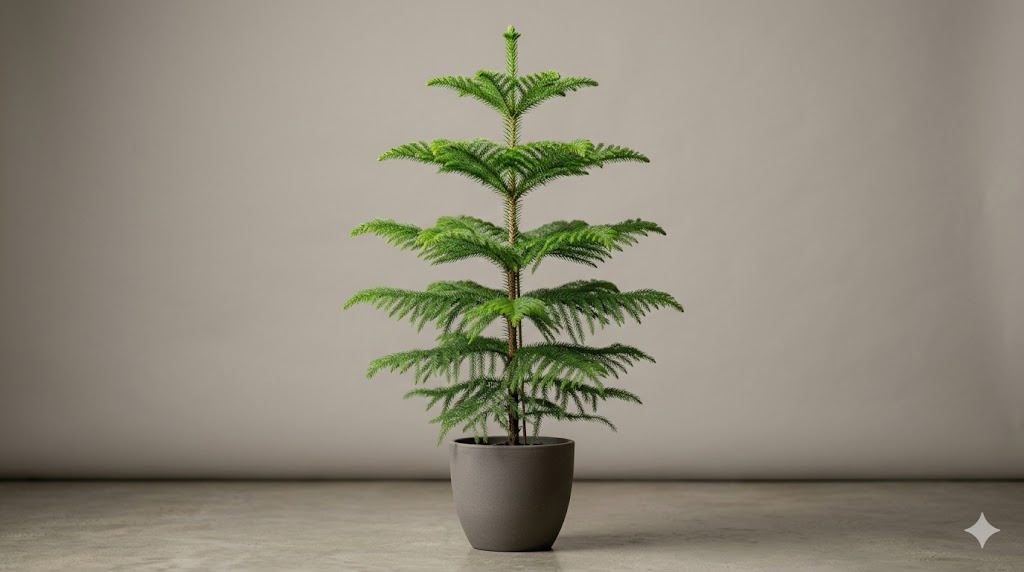
The Norfolk Island Pine is the houseplant that looks like a perfect miniature Christmas tree - soft, symmetrical tiers of feathery green branches climbing a straight central trunk.
🗓️ Last reviewed: June 2026
Overview
The Norfolk Island Pine is the houseplant that looks like a perfect miniature Christmas tree - soft, symmetrical tiers of feathery green branches climbing a straight central trunk. It is widely sold around the holidays as a living, decoratable alternative to a cut tree, but it is a year-round houseplant that, given the right conditions, lasts for many years and grows steadily taller. Despite the name and the look, it is not a true pine and not a cold-hardy outdoor conifer - it is a tender tropical tree that needs bright light and humidity to stay lush.
Origin & Natural Habitat
Araucaria heterophylla is native to Norfolk Island, a small island in the Pacific Ocean between Australia and New Zealand. There it grows into a huge coastal tree, up to 50-65 m tall, in a mild, frost-free, humid maritime climate with bright light and salt-laden air. It is an ancient lineage of conifer, far older than true pines. Its mild, bright, humid island origin is the key to its indoor care - and the reason it cannot survive frost.
Appearance
Indoors, the Norfolk Island Pine has a straight, upright trunk with branches arranged in symmetrical, evenly-spaced tiers (whorls), each branch covered in soft, short, needle-like green foliage. Young plants are dense and conical - the classic "Christmas tree" shape. Indoors it grows slowly to 1.8-3 m over many years; in the wild it is far larger. The soft needles are not prickly.
Why People Love It - Qualities & Benefits
- Living Christmas tree: a real, reusable alternative to a cut tree - decoratable year after year.
- Soft, elegant symmetry: the tiered, feathery form is graceful and architectural.
- Year-round greenery: an evergreen presence, not just a seasonal plant.
- Pet-safe (mildly): generally considered non-toxic / only mildly problematic for pets.
- Long-lived: with good care it grows with you for many years.
- Soft to the touch: unlike true pines, the foliage is not prickly - child-friendly.
Care
Light
Bright, indirect light is essential - ideally near a bright window, with some gentle direct sun tolerated. Insufficient light is the most common reason it declines: branches droop, growth becomes sparse and leggy, and lower branches yellow and drop. Rotate the plant regularly so it grows evenly and symmetrically.
Watering
Keep the soil consistently lightly moist - water when the top 3-5 cm feels slightly dry, then drain well. It dislikes drying out completely (causing branch browning and drop) and equally dislikes soggy soil (root rot). Aim for an even, steady rhythm.
Soil & Potting
Use a well-draining potting mix; a slightly acidic mix suits it. Drainage holes are essential.
Humidity & Temperature
Humidity matters - dry indoor air, especially with winter heating, causes browning, dropping needles. Aim for moderate-to-high humidity with a humidifier or by grouping plants. Comfortable at 16-24 °C. It is not frost-hardy - keep it above about 10 °C and never leave it outdoors in cold weather.
Feeding
Feed every 4-6 weeks in spring and summer with a balanced fertilizer at half strength.
Repotting
Repot every 2-3 years in spring. It does not need a large pot quickly, as it grows slowly.
Propagation
The Norfolk Island Pine is very difficult to propagate at home. It grows naturally from seed. Cuttings rarely succeed - and crucially, a cutting taken from a side branch will only ever grow sideways, never forming the upright, symmetrical tree shape; only the central growing tip produces proper vertical growth. In practice, it is bought, not propagated.
Common Problems & Pests
- Browning, dropping needles and branches: the most common complaint - usually dry air, underwatering, or too little light. Lower-branch loss can be permanent (branches do not regrow once lost).
- Drooping, sparse branches: insufficient light.
- Yellowing: overwatering, or too little light.
- Crispy brown tips: low humidity.
- Leaning / one-sided growth: not rotating the plant.
- Pests: spider mites, mealybugs, and scale; inspect and treat.
Toxicity & Safety
Generally considered non-toxic / only mildly problematic. The Norfolk Island Pine is widely regarded as safe-to-mildly-irritating for pets - eating the foliage may cause mild stomach upset, but it is not seriously toxic. The soft, non-prickly needles also make it safer around children than a true pine. As always, discourage pets from chewing it.
Pros & Cons
Pros
- Living, reusable "Christmas tree."
- Soft, elegant, symmetrical form.
- Year-round evergreen greenery.
- Generally pet-safe and child-friendly (soft needles).
- Long-lived.
Cons
- Drops needles/branches in dry air or low light - and lost branches do not regrow.
- Needs humidity and bright light.
- Not frost-hardy - strictly an indoor plant in cold climates.
- Essentially impossible to propagate at home.
Best Suited For
- Anyone wanting a living, reusable holiday tree.
- Bright rooms with humidity.
- People who want elegant, year-round evergreen greenery.
- Households with children (soft, non-prickly).
Not ideal for dark or very dry rooms, or anyone expecting a tough, neglect-proof plant.
FAQ
Can I plant my Norfolk Island Pine outside? Only in a frost-free, mild climate. It is a tender tropical tree, not a cold-hardy conifer - frost will kill it. In cold climates, keep it strictly as an indoor plant.
Why is my Norfolk Island Pine dropping branches and turning brown? Usually dry air, underwatering, or too little light. Raise the humidity, keep the soil consistently lightly moist, and move it to a brighter spot. Important: lost lower branches do not grow back, so act early.
Is it a real pine? No - despite the name and appearance, it is not a true pine. It belongs to the ancient Araucaria family and is an evergreen conifer relative, far older in lineage than true pines.
Is the Norfolk Island Pine safe for pets? It is generally considered non-toxic to only mildly problematic - eating it may cause a mild stomach upset, but it is not seriously toxic. Its soft, non-prickly needles also make it child-friendly.
Why is my plant growing lopsided? It is reaching toward the light. Rotate the pot regularly so all sides get even light, and it will keep its symmetrical, tiered shape.