Ponytail Palm (Beaucarnea recurvata)
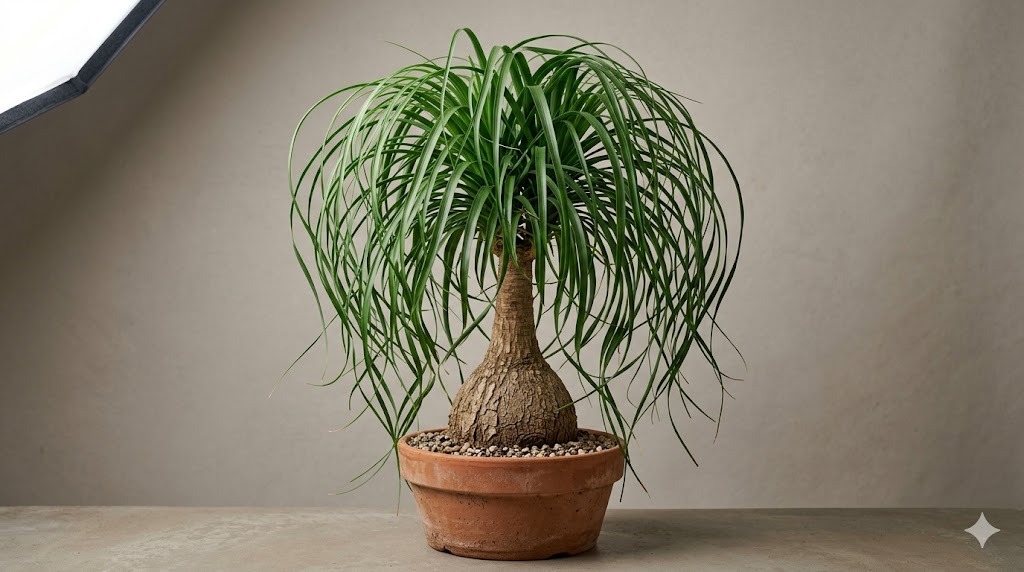
The Ponytail Palm is one of the most charming and characterful houseplants there is - a swollen, bulbous trunk that looks like an elephant's foot, topped with a fountain of long, curling, ribbon-like leaves that spill out like a ponytail.
🗓️ Last reviewed: June 2026
Overview
The Ponytail Palm is one of the most charming and characterful houseplants there is - a swollen, bulbous trunk that looks like an elephant's foot, topped with a fountain of long, curling, ribbon-like leaves that spill out like a ponytail. Despite the name, it is not a palm - it is a succulent, related to agaves and yuccas. That makes it gloriously easy: it stores water in that fat trunk, thrives on neglect, tolerates long absences, and is pet-safe. Slow-growing and long-lived, the Ponytail Palm is a quirky, near-indestructible plant with genuine personality.
Origin & Natural Habitat
Beaucarnea recurvata is native to the dry, semi-desert regions of eastern Mexico. It grows in hot, arid, sun-baked conditions with infrequent rainfall - and survives by storing water in its dramatically swollen trunk base, called a caudex. This desert origin is the entire care guide: lots of light, gritty soil, and very little water. In the wild it slowly becomes a large tree over many decades.
Appearance
The Ponytail Palm's signature feature is its caudex - a thick, bulbous, woody trunk base, broad and bottle-like (the source of the nickname "Elephant's Foot"), tapering to a slimmer stem. From the top cascades a dense tuft of long, narrow, leathery, gracefully curling green leaves. Indoors it grows slowly to 0.6-1.8 m over many years; in the wild it can eventually reach several meters. The leaves are soft, not prickly.
Why People Love It - Qualities & Benefits
- Quirky character: the bulbous trunk and cascading "ponytail" give it real personality.
- Pet-safe: non-toxic to cats and dogs.
- Extremely low-maintenance: stores water in its trunk; thrives on neglect.
- Drought-proof: tolerates long absences - ideal for travelers.
- Long-lived: can live for decades, becoming a treasured heirloom.
- Soft, child-friendly leaves: not prickly, unlike many succulents.
Care
Light
The Ponytail Palm wants lots of bright light, including direct sun - a sunny windowsill is ideal. It tolerates medium light but grows even more slowly. The brighter the spot, the happier and healthier the plant.
Watering
Water like a succulent: thoroughly, then only again when the soil is completely dry - roughly every 2-4 weeks in summer, and much less (every 4-8 weeks or longer) in winter. That swollen trunk is a water reservoir, so the plant copes easily with being underwatered. Overwatering is the only common way to kill it - it causes trunk and root rot. When in doubt, do not water. A healthy caudex is firm and plump; a soft, squishy trunk is a sign of rot.
Soil & Potting
Use a gritty, very fast-draining cactus or succulent mix. Drainage holes are essential; terracotta is ideal.
Humidity & Temperature
Prefers dry air; normal room humidity or drier is fine. Comfortable at 18-27 °C. Keep above about 10 °C; not frost-hardy.
Feeding
Minimal - a diluted succulent fertilizer once or twice in spring and summer.
Repotting
Repot rarely - every 3-5 years or more. The Ponytail Palm is slow-growing and actually does well slightly pot-bound; a snug pot can also help keep its size in check. Do not over-pot, as a large volume of wet soil invites rot.
Propagation
The Ponytail Palm is difficult to propagate at home. It grows naturally from seed (slow). Mature plants sometimes produce offsets ("pups") at the base of the trunk; these can be carefully removed with some roots, allowed to callus, and potted up - but pups are not guaranteed, and propagation overall is slow and unreliable. Most people simply buy plants.
Common Problems & Pests
- Soft, squishy trunk; brown, mushy base: trunk and root rot from overwatering - the main and often fatal problem.
- Brown leaf tips: underwatering, very dry air, or fluoride/salts in tap water - largely cosmetic; trim with scissors.
- Yellowing leaves: overwatering, or natural loss of the oldest lower leaves.
- Very slow / no growth: normal - the Ponytail Palm is naturally extremely slow.
- Pests: generally pest-resistant, but spider mites, mealybugs, and scale can occasionally appear.
Toxicity & Safety
Non-toxic and pet-safe. The Ponytail Palm is considered safe for cats, dogs, and humans - and its soft, non-prickly leaves also make it child-friendly. A genuinely safe, easy plant for any home.
Pros & Cons
Pros
- Quirky, characterful look.
- Non-toxic and pet/child-safe.
- Extremely low-maintenance and drought-proof.
- Long-lived - a potential heirloom.
- Soft, non-prickly leaves.
Cons
- Rots quickly if overwatered.
- Very slow-growing.
- Hard to propagate at home.
- Brown leaf tips are common (cosmetic).
Best Suited For
- Beginners and very busy or travel-prone owners.
- Bright, sunny windowsills.
- Pet households and homes with children.
- Anyone wanting an easy, characterful, long-lived plant.
Not ideal for chronic overwaterers, dark rooms, or anyone wanting fast growth.
FAQ
Is the Ponytail Palm actually a palm? No - despite the name and look, it is not a palm. It is a succulent, related to agaves and yuccas. That is why it stores water in its swollen trunk and needs succulent-style care.
How often should I water a Ponytail Palm? Only when the soil is completely dry - roughly every 2-4 weeks in summer, much less in winter. The swollen trunk stores water, so overwatering is the only common way to kill it. When in doubt, wait.
Why is the trunk going soft? A soft, squishy trunk means rot from overwatering - a serious and often fatal sign. Stop watering immediately, check the roots, cut away rot, and repot into dry, gritty mix. A healthy caudex should be firm.
Is the Ponytail Palm safe for pets? Yes - it is non-toxic and pet-safe for cats and dogs, and its soft leaves make it child-friendly too.
Why is my Ponytail Palm barely growing? That is completely normal - the Ponytail Palm is naturally very slow-growing. Bright light and a little feeding in summer help, but expect slow, gradual growth over years.