Rubber Plant (Ficus elastica)
The Rubber Plant is the easy way to have a dramatic indoor tree.
🗓️ Last reviewed: June 2026
Overview
The Rubber Plant is the easy way to have a dramatic indoor tree. A close relative of the famously fussy Fiddle Leaf Fig, it delivers much of the same bold, tree-in-the-room presence - large, thick, glossy leaves on an upright trunk - but with far more forgiving, beginner-friendly care. It is tough, adaptable, fast-growing in good light, and available in striking dark-burgundy and variegated forms. If you want vertical drama without the diva behavior, the Rubber Plant is the answer.
Origin & Natural Habitat
The Rubber Plant is native to the tropical rainforests of South and Southeast Asia - from northeastern India through Malaysia and Indonesia. In the wild it is a huge tree, reaching 30-40 m, that often begins life as an epiphyte and drops aerial roots to the ground, sometimes becoming a "strangler" around its host tree. Its name comes from its milky white latex sap, which was once tapped as a commercial source of rubber before the rubber tree (Hevea) took over that role.
Appearance
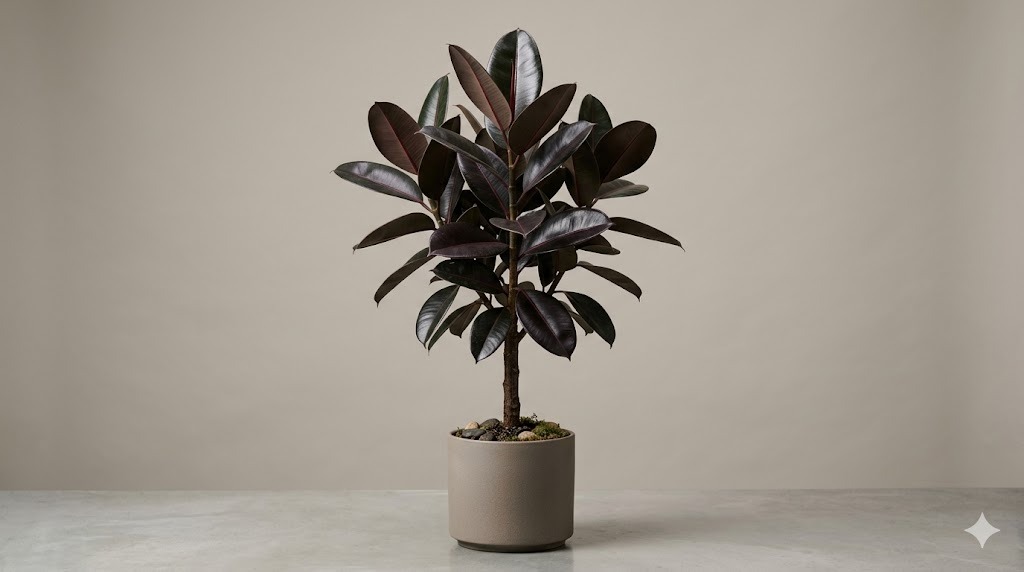
The Rubber Plant has large, oval, thick, leathery leaves with a high-gloss finish, held on a sturdy upright trunk. New leaves emerge wrapped in a colorful protective sheath (often pink or red) that drops away as the leaf unfurls.
Popular varieties:
- 'Robusta' - the classic, big deep-green leaves.
- 'Burgundy' / 'Abidjan' - dark, dramatic near-black burgundy foliage.
- 'Tineke' - variegated, with cream, green, and pink marbling.
- 'Ruby' - striking pink, cream, and green variegation.
- 'Melany' - compact, with smaller, slightly cupped dark leaves.
Indoors it commonly grows 1.5-3 m tall and, with pruning, can be shaped into a branched tree or kept as a single column.
Why People Love It - Qualities & Benefits
- Statement tree, easy mode: the vertical, tree-like drama of a Fiddle Leaf Fig with much more forgiving care.
- Glossy, bold foliage: the thick, shiny leaves look polished and substantial; burgundy and variegated forms are genuinely striking.
- Fast in good light: rewards a bright spot with quick, visible new leaves.
- Adaptable and tough: tolerates a fair range of light and the occasional missed watering.
- Shapeable and long-lived: can be pruned to branch and kept for many years, becoming a true indoor tree.
- Greenery and presence: a healthy Rubber Plant anchors a room with the calming effect of a large living plant.
Care
Light
Bright, indirect light is ideal and brings the best color, especially in variegated and burgundy types - variegated forms lose their pattern in low light. It tolerates medium light but grows slowly and leggily there. It can take some gentle direct sun once acclimated. Insufficient light leads to leaf drop and a bare, stretched trunk.
Watering
Water thoroughly when the top 3-5 cm of soil is dry, then drain well - typically weekly in summer, every 10-14 days in winter. The Rubber Plant dislikes both soggy roots (root rot, yellowing leaves) and prolonged drought (drooping, dropping leaves). It is more forgiving than the Fiddle Leaf Fig but still appreciates a steady rhythm.
Soil & Potting
Use a well-draining mix - quality potting soil with added perlite and a little bark. Drainage holes are essential.
Humidity & Temperature
Tolerates normal room humidity; appreciates moderate humidity (around 40-50%). Comfortable at 16-27 °C. Keep above about 12 °C and away from cold drafts and heating vents.
Feeding
Feed every 2-4 weeks in spring and summer with a balanced liquid fertilizer. Stop in winter.
Repotting
Repot every 1-2 years in spring, moving up one pot size. Mature trees can be top-dressed instead - replace the top few centimeters of soil annually.
Pruning & Cleaning
Prune the top growing tip to encourage branching and control height - the plant readily pushes out side branches. Wipe the large glossy leaves with a damp cloth regularly; they collect dust, which dulls them and blocks light. The cut sap is a mild irritant - wipe it and wash your hands.
Propagation
Propagate from stem-tip cuttings: cut a section with a few leaves, let the milky sap stop bleeding, and root it in water or moist soil with warmth and bright light - roots form over several weeks. Larger or woodier sections root more reliably by air-layering: wound the stem, wrap it in moist sphagnum moss and plastic until roots form, then cut below the root mass and pot it up.
Common Problems & Pests
- Leaf drop: the most common issue - caused by overwatering, underwatering, cold drafts, or a sudden change in conditions. Some loss of older lower leaves is natural.
- Yellowing leaves: usually overwatering; check drainage and let the soil dry more.
- Brown crispy edges: underwatering or very dry air.
- Loss of variegation: not enough light - move variegated types brighter.
- Leggy, bare lower trunk: low light, or natural with age; prune to encourage bushier growth.
- Pests: spider mites, mealybugs, and scale; inspect regularly and treat with insecticidal soap or neem oil.
Toxicity & Safety
Mildly toxic to cats and dogs, and irritating to humans. The milky latex sap contains irritant compounds; chewing causes mouth irritation, drooling, and stomach upset, and the sap can irritate skin and eyes. It is not usually serious, but keep it away from pets and children, and wash your hands after pruning. People with latex allergies should handle it with care.
Pros & Cons
Pros
- Dramatic indoor-tree presence, much easier than a Fiddle Leaf Fig.
- Bold, glossy foliage; striking burgundy and variegated forms.
- Fast-growing in good light.
- Adaptable and reasonably forgiving.
- Shapeable and long-lived.
Cons
- Drops leaves in response to overwatering, drafts, or change.
- Variegated forms need bright light to keep their color.
- Mildly toxic; sap irritates skin and stains.
- Gets large - needs floor space.
Best Suited For
- Anyone who wants a statement indoor tree without Fiddle-Leaf-Fig fuss.
- Bright rooms with floor space.
- Beginners ready for their first larger plant.
- Owners who like glossy, bold, modern foliage.
Not ideal for dark rooms, very drafty spots, or pet households with determined leaf-chewers.
FAQ
Is the Rubber Plant easier than a Fiddle Leaf Fig? Yes - noticeably. It is a close relative with similar tree-like drama, but it is more tolerant of light variation, watering lapses, and minor disturbance. It is a good first "big plant."
Why is my Rubber Plant dropping leaves? Most often overwatering or underwatering, a cold draft, or a sudden change in its environment. Steady watering, a stable spot away from drafts and vents, and patience usually fix it. Some loss of the oldest lower leaves is normal.
Why is my variegated Rubber Plant turning plain? Not enough light. Variegated 'Tineke' and 'Ruby' need bright, indirect light to keep their cream and pink coloring. Move it closer to a bright window.
How do I make it bushier instead of one tall stem? Prune the top growing tip. The Rubber Plant branches readily after a cut, giving you a fuller, multi-stemmed tree. Note the cut will bleed milky sap - wipe it up.
Is the sap dangerous? The milky latex sap is a mild irritant - it can irritate skin and eyes and is mildly toxic if chewed. Wash your hands after pruning, keep it from pets and kids, and take extra care if you have a latex allergy.