Staghorn Fern (Platycerium)
The Staghorn Fern is one of the most dramatic and unusual plants you can grow indoors - a fern that you mount on a wall like living artwork.
🗓️ Last reviewed: June 2026
Overview
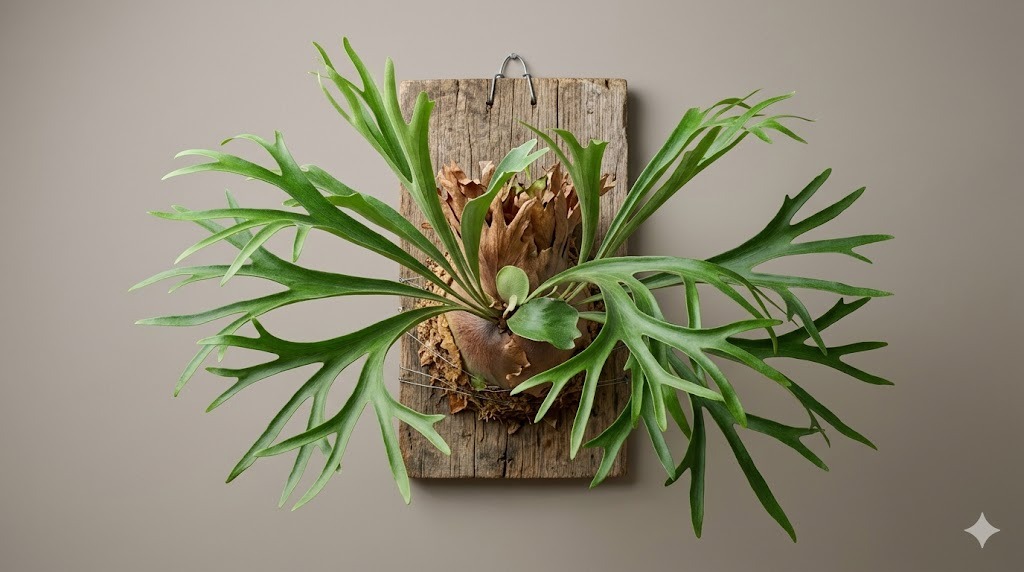
The Staghorn Fern is one of the most dramatic and unusual plants you can grow indoors - a fern that you mount on a wall like living artwork. Its large, antler-shaped fronds arch and branch like the horns of a stag (hence the name), while a flat, round "shield" frond hugs the mounting surface. It is an epiphyte, growing without soil, and a mounted Staghorn Fern is a genuine showpiece. It needs more attention than an average houseplant - particularly with watering and humidity - but it is far more achievable than its exotic looks suggest.
Origin & Natural Habitat
Platycerium ferns are native to tropical and subtropical regions of Southeast Asia, Australia, Africa, and South America. They are epiphytes - they grow attached to tree trunks and branches, never in soil, in warm, humid, dappled-light forest conditions. They collect rainwater, falling debris, and nutrients in their fronds and shield. This soil-free, tree-mounted, humid origin is the whole key to growing them - which is why they are traditionally mounted on a board rather than potted.
Appearance
The Staghorn Fern has two completely different types of fronds:
- Shield (basal) fronds: flat, round, plate-like fronds that grow against the mounting surface, clasping it. They start green and turn brown and papery as they age - this browning is normal and healthy, not a problem. They protect the roots and catch water and nutrients.
- Foliar (antler) fronds: the dramatic, arching, branching, antler-shaped fronds that give the plant its name and its show.
A mature mounted plant can be impressively large. Platycerium bifurcatum is the most common and forgiving species for indoors.
Why People Love It - Qualities & Benefits
- Living wall art: mounted on a board, it is a true sculptural showpiece - unlike any other plant.
- Dramatic, unusual form: the antler fronds are unmistakable and striking.
- Space-saving: grows on a wall, using no floor or shelf space.
- Soil-free: an epiphyte, traditionally grown mounted, not potted.
- Pet-safe: generally considered non-toxic to cats and dogs.
- A rewarding project: mounting and growing one is genuinely satisfying.
Care
Light
Bright, indirect light is ideal - it evolved under a dappled forest canopy. Avoid harsh direct sun, which scorches the fronds. It tolerates medium light but grows slower.
Watering
This is the main challenge. How you water depends on how it is grown:
- Mounted: the usual method is to soak the whole mount - submerge the root ball/shield area in water for 10-20 minutes - then let it drain and dry. Frequency varies hugely with conditions: roughly once a week, more in hot dry weather, less in cool humid conditions or winter.
- Potted: water when the moss/medium is approaching dry.
Let it dry adequately between waterings - overwatering and constantly soggy roots cause rot, the main killer. Underwatering shows as wilting, browning antler fronds. A useful guide: check the weight of the mount - light means dry.
Mounting & Medium
Staghorn Ferns are traditionally mounted on a wooden board with a pad of sphagnum moss around the root ball, secured with wire or fishing line. They can also be grown in a pot or hanging basket using a chunky, airy, fast-draining epiphyte mix (bark, moss). They are not grown in ordinary soil.
Humidity & Temperature
Loves high humidity - it is a tropical epiphyte. Bathrooms, kitchens, and humid rooms suit it; a humidifier helps in dry homes. Comfortable at 16-27 °C; keep above about 10 °C and away from cold drafts.
Feeding
Feed occasionally during the growing season - roughly monthly - with a diluted balanced fertilizer added to the soak water, or by tucking a banana peel or organic matter behind the shield fronds (a traditional method, mimicking the debris it catches in the wild).
Propagation
Propagated by separating pups (offsets) - Platycerium bifurcatum and similar species produce small plantlets around the base, which can be carefully cut away with a portion of root/shield and mounted or potted separately. Some species spread by spores, but pup division is far easier at home.
Common Problems & Pests
- Browning shield fronds: normal - the flat basal fronds naturally age to brown and papery. Do not remove them; they protect the plant.
- Browning, wilting antler fronds: underwatering, or too little humidity.
- Black, mushy base; rotting: overwatering - soggy conditions and poor airflow.
- Pale, scorched fronds: too much direct sun.
- Drooping antler fronds: often a watering issue - check whether too wet or too dry.
- Pests: scale and mealybugs can appear; treat carefully, as ferns can be sensitive to some sprays.
Toxicity & Safety
Generally considered non-toxic and pet-safe. Staghorn Ferns are widely regarded as safe for cats and dogs and are not listed as toxic by major pet-poison resources.
Pros & Cons
Pros
- Dramatic, sculptural living wall art.
- Unique antler-frond form.
- Space-saving - grows on a wall.
- Generally pet-safe.
- A rewarding, satisfying plant to grow.
Cons
- Watering (soaking) takes more effort than a normal houseplant.
- Needs high humidity.
- Mounting is a project in itself.
- Can rot if overwatered or poorly ventilated.
Best Suited For
- Anyone wanting a true statement, living-art plant.
- Bright, humid rooms - bathrooms are excellent.
- Plant lovers who enjoy a hands-on project.
- Pet households.
Not ideal for people wanting a low-effort, set-and-forget plant, or very dry, dark rooms.
FAQ
Why are the round flat fronds turning brown? That is completely normal. The flat, plate-like shield (basal) fronds naturally age from green to brown and papery. They are not dying - they protect the roots. Do not pull them off.
How do I water a mounted Staghorn Fern? Soak the whole mount - submerge the root-ball and shield area in water for 10-20 minutes - then let it drain and dry. Roughly once a week, adjusting for your conditions. Lifting the mount to feel its weight helps: light means it is dry and ready for a soak.
Do I have to mount it on a board? It is the traditional and most natural way, since it is a tree-dwelling epiphyte, and it makes a stunning display. But you can also grow it in a pot or hanging basket using a chunky, airy epiphyte mix - never ordinary soil.
Are Staghorn Ferns safe for pets? They are generally considered non-toxic and pet-safe, and are not listed as toxic by major pet-poison resources.
Why are the antler fronds going brown and crispy? Usually underwatering or low humidity. Soak it more often and raise the humidity - a bathroom or a humidifier helps. (Remember: browning of the flat shield fronds, by contrast, is normal.)