String of Hearts (Ceropegia woodii)
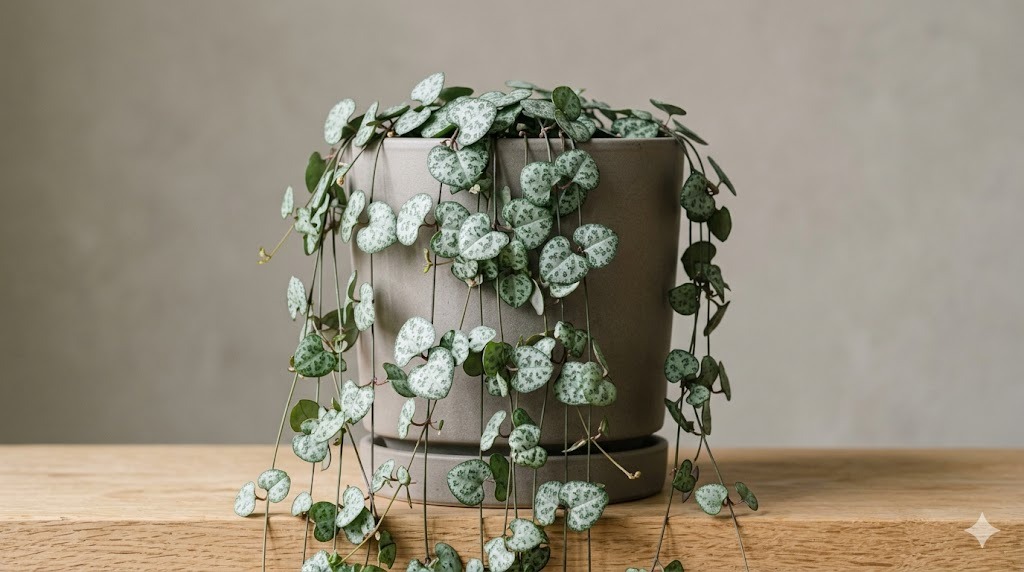
The String of Hearts is one of the most delicate and romantic of all trailing houseplants - long, fine, thread-like vines strung with small, heart-shaped leaves, marbled green and silver with purple undersides.
🗓️ Last reviewed: June 2026
Overview
The String of Hearts is one of the most delicate and romantic of all trailing houseplants - long, fine, thread-like vines strung with small, heart-shaped leaves, marbled green and silver with purple undersides. Cascading from a high shelf or hanging pot, a mature plant can trail well over a meter, like a curtain of tiny hearts. It is a semi-succulent, which makes it surprisingly easy: it stores water in its leaves and a tuber, tolerates neglect, and propagates with almost magical ease. For a graceful, forgiving, fast-trailing plant, the String of Hearts is hard to beat.
Origin & Natural Habitat
Ceropegia woodii is native to southern Africa - South Africa, Eswatini, and Zimbabwe - where it grows trailing and scrambling over rocks and through scrub in bright, fairly dry conditions. It is a semi-succulent: it stores water in its fleshy heart-shaped leaves and in underground and stem tubers. This bright, dry, semi-succulent origin is the key to its care - it wants good light and infrequent watering, more like a succulent than a typical tropical trailing plant.
Appearance
The String of Hearts has very fine, wiry, purple-tinged trailing stems carrying pairs of small (1-2 cm), heart-shaped leaves. The leaves are dark green marbled with silver-grey on top and purple beneath; in bright light the whole plant takes on more silver and purple tones. Stems trail 1-2 m and longer. The plant produces curious small tubular pinkish flowers, and forms little round aerial tubers ("beads" or "pearls") along the stems at the nodes - which double as a built-in propagation method. A variegated form (pink, cream, green) is popular.
Why People Love It - Qualities & Benefits
- Delicate, romantic look: the curtain of tiny hearts is unlike anything else.
- Fast, dramatic trailing: quickly grows long, elegant cascades.
- Semi-succulent and forgiving: stores water; tolerates neglect and missed waterings.
- Wonderfully easy to propagate: vine cuttings and aerial tubers both root readily.
- Compact root system: stays small at the base while trailing dramatically.
- Beautiful in hanging pots and high shelves.
Care
Light
Bright, indirect light is essential - and a little gentle direct sun is welcomed. Good light keeps the leaves close together along the stem, brings out the silver marbling and purple tones, and keeps the plant full. In low light the stems grow leggy with widely-spaced leaves, the marbling fades, and (for variegated forms) the color weakens.
Watering
Treat it as a semi-succulent: water thoroughly, then let the soil dry out almost completely before watering again - roughly every 2 weeks in summer, much less in winter. The leaves and tubers store water; overwatering causes soft, yellowing leaves and root/tuber rot, the main cause of death. Plump, firm leaves mean it is well-watered; slightly soft, flattening leaves mean it is ready for a drink. When in doubt, wait.
Soil & Potting
Use a gritty, fast-draining cactus or succulent mix. Drainage holes are essential. A shallow pot suits its compact root system.
Humidity & Temperature
Tolerates normal-to-dry room air; high humidity is unnecessary. Comfortable at 18-26 °C; keep above about 10 °C - not frost-hardy.
Feeding
Feed sparingly - once or twice in spring and summer with a diluted succulent fertilizer.
Grooming
The crown can thin over time. To keep the plant full, lay trimmed strands or cuttings back onto the soil surface in the same pot, where they root and thicken the display.
Propagation
The String of Hearts is delightfully easy to propagate, with several methods:
- Aerial tubers: the little round "beads" that form along the stems can be pressed onto moist soil (while still attached, or detached) and will root into new plants.
- Stem cuttings: lay a strand of vine on top of moist soil - it roots from the nodes where it touches.
- Water propagation: strands can also root in water.
- Tuber division: the underground tuber can be divided.
Let cuttings callus briefly, keep the soil barely moist until rooted, and avoid overwatering.
Common Problems & Pests
- Soft, yellowing, mushy leaves: overwatering and root/tuber rot - the classic killer.
- Leggy stems with widely-spaced leaves: not enough light.
- Faded marbling / loss of silver and purple: insufficient light.
- Shriveled, flat, deflating leaves: underwatering - water thoroughly.
- Sparse, bald crown: natural thinning with age - refresh by laying cuttings back on the soil.
- Pests: mealybugs are the main enemy, often hiding among the dense leaves and at the roots; also aphids and scale.
Toxicity & Safety
Non-toxic and pet-safe. The String of Hearts is considered safe for cats, dogs, and humans - a pet-safe choice of trailing plant, though, like any dangling plant, hanging it high helps keep curious cats from playing with the strands.
Pros & Cons
Pros
- Delicate, romantic, distinctive look.
- Fast-trailing - quick dramatic cascades.
- Semi-succulent - forgiving and drought-tolerant.
- Extremely easy to propagate (several ways).
- Non-toxic and pet-safe.
Cons
- Goes leggy and fades in low light.
- Rots quickly if overwatered.
- Fine strands are delicate and tangle easily.
- Crown can thin with age.
Best Suited For
- Bright rooms, high shelves, and hanging pots.
- Beginners wanting an easy, rewarding trailing plant.
- Pet households.
- Anyone who enjoys propagating.
Not ideal for dark rooms, chronic overwaterers, or low-light spots.
FAQ
Why is my String of Hearts leggy with big gaps between the leaves? Not enough light. In low light the stems stretch and the leaves space far apart. Move it to bright, indirect light (a little gentle sun is fine) for compact growth with closely-spaced leaves.
How often should I water String of Hearts? Treat it as a semi-succulent - water thoroughly, then let the soil dry out almost completely first. Roughly every 2 weeks in summer, much less in winter. Plump leaves mean wait; softening leaves mean water. Overwatering is the main killer.
What are the little round balls on the stems? Those are aerial tubers - sometimes called beads or pearls. They form at the nodes and are a built-in propagation method: press one onto moist soil and it roots into a new plant.
Why are the leaves soft and yellow? Overwatering and rot. The leaves and tubers store water, so soggy soil quickly causes root and tuber rot. Let it dry out fully, check the roots, and repot into gritty mix.
Is the String of Hearts safe for pets? Yes - it is non-toxic and pet-safe. Hanging it high still helps, since cats may want to play with the trailing strands.