String of Pearls (Senecio rowleyanus / Curio rowleyanus)
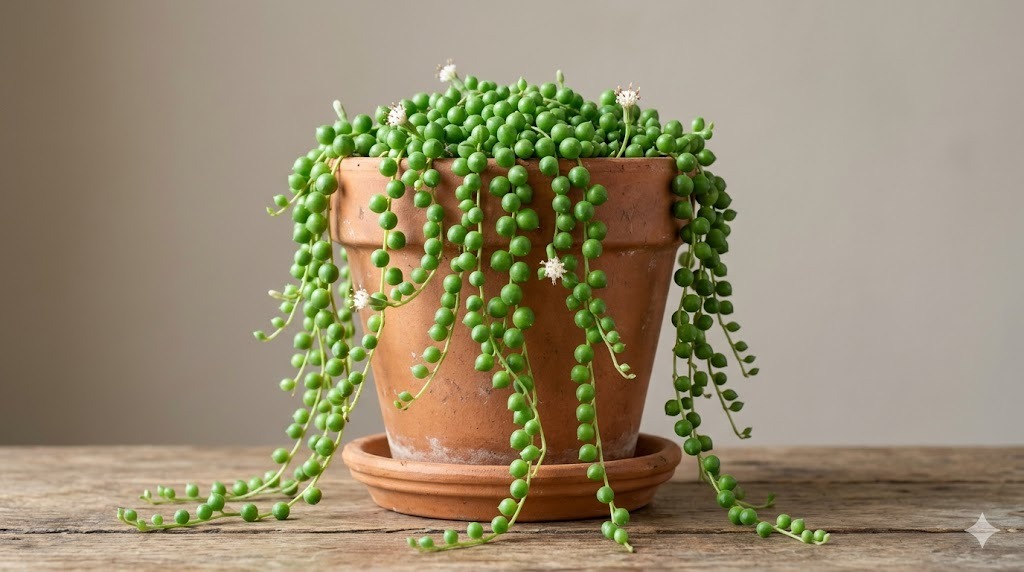
String of Pearls is one of the most distinctive and photogenic of all houseplants - long, delicate strands of small, round, pea-like beads that spill over the edge of a pot like a green waterfall.
🗓️ Last reviewed: June 2026
Overview
String of Pearls is one of the most distinctive and photogenic of all houseplants - long, delicate strands of small, round, pea-like beads that spill over the edge of a pot like a green waterfall. It is a trailing succulent, and that single fact explains both its appeal and its reputation: in the right spot - bright light and the discipline to barely water it - it is striking and surprisingly easy, but treat it like a normal leafy houseplant and it rots away fast. It is a plant best suited to a sunny shelf and a hands-off owner.
Origin & Natural Habitat
String of Pearls is native to the dry, arid regions of southwestern Africa. It grows along the ground as a creeping mat, with its strands rooting where they touch the soil, often sheltering in the shade of rocks and other plants. It is fully a succulent, adapted to intense light, heat, and long droughts. Each little "pearl" is a water-storage organ. That desert-mat origin is the entire care guide: bright light, gritty soil, and very little water.
Botanical note: long known as Senecio rowleyanus, it has been reclassified into the genus Curio. Both names refer to the same plant.
Appearance
The plant consists of slender, trailing stems strung with small, spherical, green "pearls" - each bead roughly the size of a pea. Each pearl has a thin translucent stripe, a "window," that lets light into the interior for photosynthesis while minimizing water loss. Stems trail to 60-90 cm or more, making it a classic hanging-pot and high-shelf plant. Mature, happy plants produce small, fuzzy white flowers that smell faintly of cinnamon. A close relative, String of Tears, has slightly pointed beads.
Why People Love It - Qualities & Benefits
- Unique, sculptural look: nothing else resembles a cascade of green beads - it is a true conversation piece.
- Highly photogenic: a favorite for styled shelves, hanging displays, and plant photography.
- Low water needs: as a succulent it tolerates neglect and long gaps between watering.
- Loves sunny spots: thrives on bright windowsills where leafier plants would scorch.
- Easy to propagate: strands root readily, so one plant quickly fills more pots.
- Compact rootball: the plant stays small at the base while trailing dramatically - efficient use of space.
Care
Light
String of Pearls needs lots of bright light - including some gentle direct sun. A bright windowsill is ideal. In insufficient light, the strands grow sparse and leggy with widely spaced pearls, and the plant weakens. It is one of the few trailing plants that genuinely wants a sunny spot. Acclimate it gradually to intense direct sun to avoid scorching the beads.
Watering
This is where String of Pearls is won or lost. Water thoroughly but infrequently, only when the soil is fully or almost fully dry - roughly every 2-3 weeks in summer, and considerably less in winter. The pearls are the clue: plump, firm beads mean the plant is well-watered; slightly shriveled, softening pearls mean it is ready for a drink. Overwatering causes the pearls to burst, turn mushy, and the strands to rot - the number-one cause of death. When in doubt, do not water.
Soil & Potting
Use a gritty, fast-draining cactus or succulent mix. A shallow pot suits its shallow root system. Drainage holes are essential; terracotta helps the soil dry.
Humidity & Temperature
Prefers normal-to-dry air; high humidity is unnecessary and, combined with damp soil, encourages rot. Comfortable at 18-26 °C. Keep it above about 10 °C - it is not frost-hardy.
Feeding
Feed sparingly - once or twice during spring and summer with a diluted succulent fertilizer. It needs very little.
Repotting & Grooming
Repot infrequently. To keep the plant full rather than thin and bald on top, lay trimmed strands or cuttings back onto the soil surface in the same pot - they root and thicken the display.
Propagation
String of Pearls is very easy to propagate:
- Lay strands on soil: cut a healthy strand, lay it flat on the surface of dry succulent mix (pearls in contact with the soil), and it roots from the contact points within a few weeks.
- Bury a node: strip a few pearls from the end of a strand and press that bare section into the soil.
Let cuttings callus for a day first, keep the soil barely moist until rooted, and avoid overwatering. Adding cuttings back into the parent pot is the best way to keep it lush.
Common Problems & Pests
- Mushy, bursting, translucent pearls; rotting strands: overwatering - the classic killer. Cut away rotted sections, let it dry out, and propagate any healthy strands.
- Shriveled, deflated pearls: underwatering (or, confusingly, root rot preventing water uptake) - check the soil and roots.
- Sparse, leggy strands with widely spaced pearls: not enough light.
- Bald, thin crown on top: natural with age - refresh by laying cuttings back on the soil.
- Pests: mealybugs and aphids are the main culprits, often hiding among the pearls; spider mites can also appear. Inspect closely and treat with insecticidal soap.
Toxicity & Safety
Toxic to cats, dogs, and humans if eaten. String of Pearls contains irritant compounds; ingestion causes drooling, vomiting, diarrhea, and lethargy, and the sap can cause skin irritation. Because the dangling beads look like toys or food and tempt cats and children, hang it well out of reach.
Pros & Cons
Pros
- Unique, sculptural, highly photogenic.
- Low water needs; tolerates neglect.
- Thrives in bright, sunny spots.
- Easy and fast to propagate.
- Compact root system.
Cons
- Rots quickly if overwatered - unforgiving of mistakes.
- Needs a genuinely bright, sunny spot.
- Toxic to pets and people; tempting dangling beads.
- Strands are delicate and break easily when handled.
- Crown can go bald with age.
Best Suited For
- Bright, sunny windowsills and high shelves.
- Hands-off owners who can resist overwatering.
- Hanging displays and styled plant shelves.
- People with some succulent experience.
Not ideal for dark rooms, habitual overwaterers, pet households (the dangling beads tempt cats), or true beginners.
FAQ
How often should I water String of Pearls? Only when the soil is fully or nearly fully dry - roughly every 2-3 weeks in summer, much less in winter. Watch the pearls: plump and firm means wait; slightly shriveled means water. Overwatering is by far the most common way to kill it.
Why are the pearls going mushy and translucent? Overwatering. The beads burst and the strands rot when the soil stays too wet. Cut away the mushy sections, let the plant dry out, and propagate any firm, healthy strands as a backup.
Why are the pearls shriveled? Usually underwatering - give it a thorough drink and they should plump up. But shriveled pearls can also mean root rot, where damaged roots can't take up water even though the soil is wet. If watering doesn't help, check the roots.
Why is my String of Pearls thin and leggy? Not enough light, or natural aging of the crown. Move it to a bright, sunny spot, and lay trimmed cuttings back onto the soil to thicken it up.
Is String of Pearls safe for pets? No - it is toxic to cats and dogs if eaten. The dangling beads are especially tempting to cats, so hang it well out of reach.