Venus Flytrap (Dionaea muscipula)
The Venus Flytrap is the most famous plant in the world - the plant that eats.
🗓️ Last reviewed: June 2026
Overview
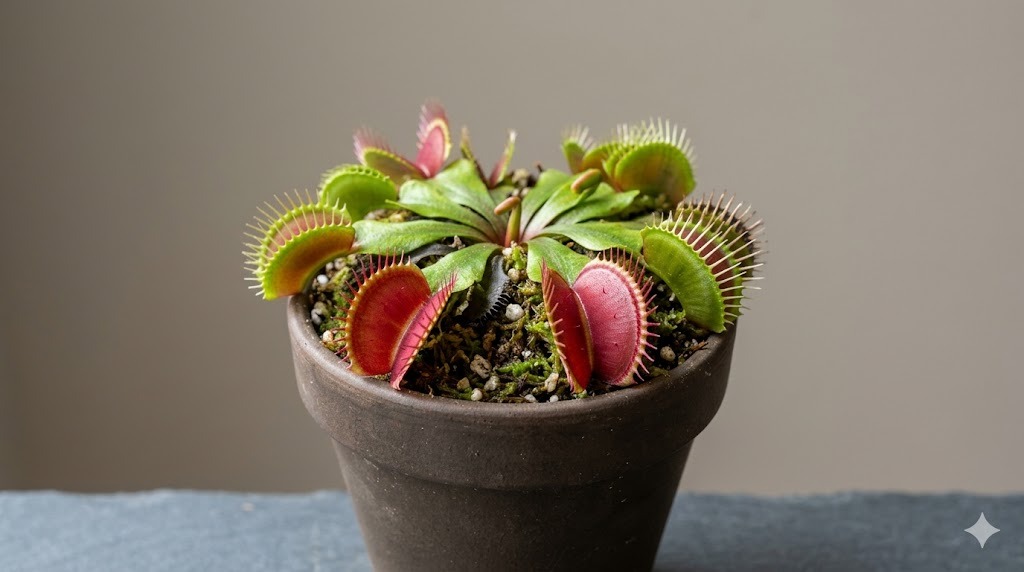
The Venus Flytrap is the most famous plant in the world - the plant that eats. Its hinged, fringed traps snap shut on insects in a fraction of a second, then slowly digest them. It is endlessly fascinating, a brilliant plant for curious kids and adults alike. But it is also the plant most often killed by kindness and misunderstanding. Almost everything a beginner instinctively does - use tap water, pot it in normal soil, keep it on a dark shelf, feed it hamburger, poke the traps for fun - is wrong. Grown correctly, by its very specific and rather strange rules, the Venus Flytrap is a tough, rewarding, long-lived plant.
Origin & Natural Habitat
The Venus Flytrap is native to a tiny region - the subtropical wetlands and boggy pine savannas of North and South Carolina, in the southeastern United States. It grows in nutrient-poor, acidic, waterlogged, sandy-peaty bog soil, in full, bright sun. Because the soil is so poor in nutrients (especially nitrogen), the plant evolved to get those nutrients another way - by catching and digesting insects. Crucially, it also experiences cold winters and goes through a genuine winter dormancy. Every odd care rule comes straight from this very specific habitat.
Appearance
The Venus Flytrap is a small plant - usually only 10-15 cm across - forming a low rosette of leaves. Each leaf ends in the famous trap: two hinged lobes, rimmed with stiff, interlocking "teeth" (cilia), and lined inside with tiny sensitive trigger hairs and a reddish, often vivid interior. When prey touches the trigger hairs the right way, the trap snaps shut. Mature plants send up a tall stalk of small white flowers in spring.
Why People Love It - Qualities & Benefits
- A plant that moves and eats: genuinely captivating - nothing else does this.
- Brilliant for curious minds: a favorite first plant for children and science lovers.
- Fascinating to watch: the snapping traps and the slow digestion are mesmerizing.
- A real conversation piece: instantly memorable.
- Long-lived: grown correctly, it survives and grows for many years.
- Compact: tiny - fits any sunny windowsill.
Care
Water - the #1 killer
This is the single most important rule. Never use tap water. Venus Flytraps are extremely sensitive to the minerals, salts, chlorine, and fluoride in tap and bottled mineral water - these build up and kill the plant. Use only distilled water, reverse-osmosis water, or rainwater. Keep the soil constantly wet - these are bog plants. The standard method is the water tray: stand the pot in a saucer of distilled/rainwater so the soil stays permanently moist from below.
Soil
Never use normal potting soil or compost - the nutrients in it will burn and kill the roots. Use a nutrient-free, acidic medium: a mix of sphagnum peat moss and perlite or silica sand (or pure long-fibered sphagnum moss). No fertilizer, ever.
Light
Full, bright, direct sun - lots of it. The Venus Flytrap is a full-sun bog plant; it needs several hours of direct sunlight a day. A bright sunny windowsill, or outdoors in summer, is ideal. Indoors without enough light it weakens; many growers use a strong grow light. Good light brings out the vivid red trap interiors.
Feeding
It catches its own food. If grown outdoors or near an open window, it will catch enough insects itself. Indoors you can occasionally feed it a live or freshly-killed small insect (a fly, a small bug) - placed in a trap and gently triggered. Never feed it human food - no meat, no hamburger, no cheese. It cannot digest these, and they rot the trap. Feed sparingly; it does not need much.
Don't Play With the Traps
Each trap can only open and close a limited number of times in its life. Snapping the traps shut for fun, with no prey inside, wastes the trap's energy - and a trap triggered repeatedly for nothing will blacken and die early. Resist the temptation, and never let children poke them.
Dormancy
The Venus Flytrap must have a cold winter dormancy - this is not optional, and skipping it weakens and eventually kills the plant. For about 3-4 months in winter, it needs cold temperatures (roughly 2-10 °C), reduced light, and much less water. Many traps and leaves blacken and die back during dormancy - this is normal. An unheated windowsill, garage, porch, or even a refrigerator method is used to give it this cold rest. In spring it re-sprouts.
Propagation
Propagated by division of the rhizome (separate the clumps a healthy plant forms), from leaf pullings (a whole leaf pulled with a bit of the white base, laid on damp medium), or from seed (slow - years to a mature plant). Flower stalks can be cut off to redirect energy into the plant, as flowering is demanding for a small plant.
Common Problems & Pests
- Whole plant weakening and dying: almost always tap water (mineral poisoning), wrong soil (nutrient burn), or no winter dormancy.
- Traps blackening: some blackening is normal - old traps die and are replaced, and traps blacken after digesting prey or being triggered without food. Widespread, rapid blackening signals a care problem (water, soil, light).
- Weak, floppy, all-green growth: not enough light.
- No red color inside the traps: insufficient light.
- Traps not closing: old/tired traps, or the plant is low on energy.
- Pests: aphids and fungus gnats can occasionally trouble it; treat carefully.
Toxicity & Safety
Non-toxic and pet-safe. The Venus Flytrap is considered non-toxic to cats, dogs, and humans - it poses no poisoning risk. The traps are far too small and weak to harm a pet or a person (a closing trap on a fingertip is a harmless, gentle pinch). It is genuinely a safe plant; the only "danger" is to small insects.
Pros & Cons
Pros
- Utterly fascinating - a plant that moves and eats.
- Brilliant for children and curious minds.
- Non-toxic and pet-safe.
- Compact; long-lived if grown correctly.
Cons
- Very specific, unusual care - most beginners kill it through misunderstanding.
- Must have distilled/rain water and nutrient-free soil.
- Needs full sun and a cold winter dormancy.
- Easy to harm by playing with the traps.
Best Suited For
- Curious people, science enthusiasts, and children (with supervision).
- Bright, sunny windowsills (or grow lights), with a cold spot for winter.
- Anyone willing to follow its specific rules exactly.
Not ideal for anyone who won't commit to distilled water, special soil, full sun, and winter dormancy - or who can't resist poking the traps.
FAQ
Why did my Venus Flytrap die? The three classic killers: tap water (the minerals poison it - use only distilled or rainwater), normal potting soil (the nutrients burn the roots - use nutrient-free peat/sand mix), and no winter dormancy. Get those three right and the plant is tough.
Can I feed it meat or human food? No - never. The Venus Flytrap can only digest live or fresh insects. Meat, hamburger, cheese, and other human foods cannot be digested and will rot the trap. If it gets enough sun and the occasional bug, it feeds itself.
Is it bad to make the traps snap shut for fun? Yes. Each trap can only close a limited number of times in its life, and closing on nothing wastes its energy. Repeatedly triggering empty traps makes them blacken and die early. Don't poke the traps, and don't let children do it.
Why are the traps turning black? Some blackening is normal - old traps die off and are replaced, and traps blacken after digesting prey. But widespread, rapid blackening usually means a care problem: tap water, wrong soil, or too little light.
Is the Venus Flytrap dangerous or toxic? No - it is non-toxic and completely safe for pets and people. The traps are tiny and far too weak to hurt anything bigger than an insect.