Yucca (Yucca elephantipes)
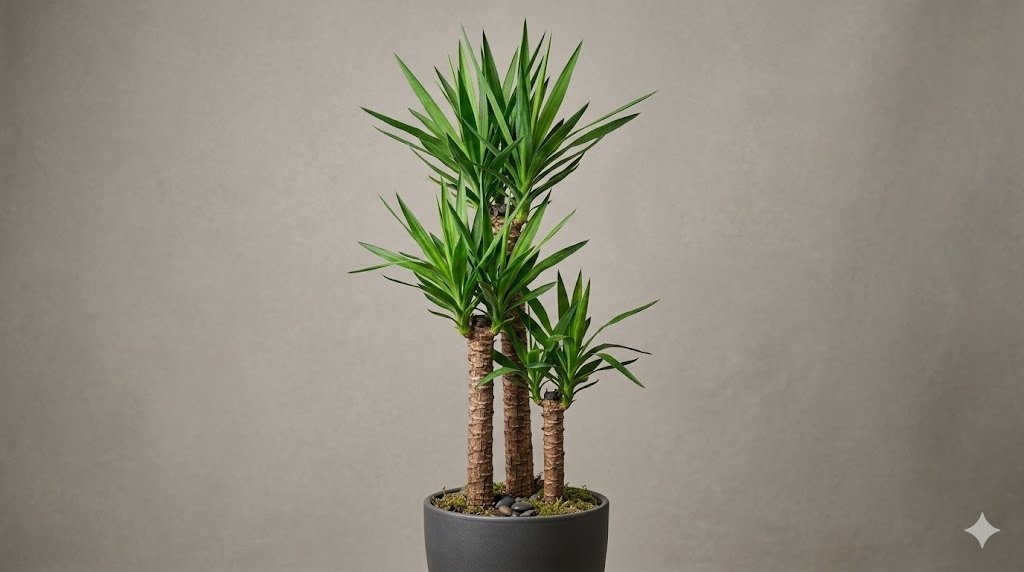
The indoor Yucca is the tough, architectural, low-effort statement plant - a sturdy woody trunk (often several, at different heights) topped with bold rosettes of stiff, sword-shaped green leaves.
🗓️ Last reviewed: June 2026
Overview
The indoor Yucca is the tough, architectural, low-effort statement plant - a sturdy woody trunk (often several, at different heights) topped with bold rosettes of stiff, sword-shaped green leaves. It brings strong, modern, sculptural lines to a room and asks for very little: it loves sun, shrugs off drought, and tolerates neglect with ease. The most common houseplant species, Yucca elephantipes (the Spineless Yucca), has soft-tipped leaves, making it more practical indoors than its sharp-pointed desert cousins. For an easy, dramatic, drought-proof plant, the Yucca is hard to beat.
Origin & Natural Habitat
Yuccas are native to the hot, dry regions of the Americas - Mexico, the southwestern United States, and Central America - where they grow in arid, sun-baked deserts, scrubland, and dry plains. They are adapted to intense sun, sparse rainfall, and poor, sharply-draining soil, storing water in their trunks and roots. This desert origin is the entire care guide: lots of light, gritty soil, and very little water.
Appearance
The indoor Yucca has a thick, woody, cane-like trunk - often sold as a cluster of two or three canes cut to staggered heights - topped with dense, spreading rosettes of long, stiff, sword-shaped, blue-green to green leaves. Yucca elephantipes leaves have soft, non-spiny tips (unlike sharp desert yuccas). Indoors it grows slowly to 1-2 m. Mature outdoor plants produce tall spikes of creamy-white flowers; indoor flowering is uncommon.
Why People Love It - Qualities & Benefits
- Architectural drama: strong, sculptural, modern lines - a true statement plant.
- Extremely low-maintenance: drought-tolerant, sun-loving, and forgiving of neglect.
- Tough and long-lived: survives missed waterings, travel, and beginner mistakes.
- Sun-loving: thrives in bright, hot windows where many plants struggle.
- Soft-tipped (Y. elephantipes): the indoor species is not spiky, unlike outdoor yuccas.
- Tidy and slow: does not outgrow its space quickly.
Care
Light
The Yucca wants lots of bright light, including direct sun - a bright, sunny window is ideal. It is one of the best plants for a hot, sunny spot. It tolerates medium light but grows slower, weaker, and leggier there. The brighter, the better.
Watering
Water like a drought-adapted plant: thoroughly, then only again when the soil is mostly to completely dry - roughly every 1-2 weeks in summer, and considerably less in winter. The Yucca stores water and is far more tolerant of underwatering than overwatering. Soggy soil causes trunk and root rot, the main cause of death. When in doubt, do not water.
Soil & Potting
Use a well-draining, gritty mix - a cactus/succulent mix, or potting soil with plenty of added sand and perlite. Drainage holes are essential. A heavy pot helps balance a tall, top-heavy plant.
Humidity & Temperature
Prefers normal-to-dry air; humidity is unnecessary. Comfortable at 16-27 °C; tolerant of a cooler winter rest. Keep above about 7-10 °C; the indoor species is not frost-hardy.
Feeding
Minimal - feed once or twice during spring and summer with a diluted balanced fertilizer.
Repotting & Pruning
Repot every 2-3 years; it does not mind being slightly snug. If a Yucca grows too tall, the trunk can be cut at the desired height - it will sprout a new rosette of leaves below the cut, and the cut-off top can be rooted.
Propagation
Easy, from trunk/cane cuttings: cut a section of woody trunk, let the cut end callus for several days to a week, then plant it upright in gritty mix (keep track of which end is "up"). It roots and sprouts new growth. The leafy top can also be rooted as a cutting. Offsets/pups around the base can be divided off too. Spring is best.
Common Problems & Pests
- Yellowing leaves, soft/mushy trunk: overwatering and trunk/root rot - the classic killer. A soft trunk is a serious sign.
- Brown leaf tips: dry air, underwatering, or fluoride/salts in tap water - largely cosmetic.
- Yellowing/browning of the lowest leaves: natural - old leaves are shed as the plant grows; just remove them.
- Leggy, weak growth: insufficient light.
- Pests: generally pest-resistant, but spider mites, scale, and mealybugs can occasionally appear.
Toxicity & Safety
Mildly toxic to cats and dogs. Yuccas contain saponins; if chewed, they cause vomiting and, in larger amounts, more pronounced digestive upset and weakness in pets. It is not usually serious, but keep it away from pets that chew plants. The indoor Yucca elephantipes has soft, non-spiny leaf tips, making it safer to brush past than sharp-leaved outdoor yuccas.
Pros & Cons
Pros
- Bold, architectural, modern statement plant.
- Extremely low-maintenance and drought-tolerant.
- Tough, long-lived, beginner-friendly.
- Loves bright, sunny spots.
- Soft-tipped indoor species - not spiky.
Cons
- Mildly toxic to cats and dogs.
- Rots quickly if overwatered.
- Needs a genuinely bright spot to thrive.
- Slow-growing; can get top-heavy.
Best Suited For
- Bright, sunny rooms with floor space.
- Beginners and busy or travel-prone owners.
- Anyone wanting an architectural, low-effort statement plant.
- Hot windows where other plants struggle.
Not ideal for dark rooms, chronic overwaterers, or pet households with determined leaf-chewers.
FAQ
How often should I water an indoor Yucca? Only when the soil is mostly to completely dry - roughly every 1-2 weeks in summer, much less in winter. The Yucca stores water and tolerates drought easily; overwatering, causing trunk and root rot, is the main way it dies. When in doubt, wait.
Why is the trunk going soft? A soft, mushy trunk means rot from overwatering - a serious, often fatal sign. Stop watering immediately, check the roots, cut away rotten tissue, and repot into dry, gritty mix. A healthy Yucca trunk is firm.
Why are the bottom leaves turning yellow and brown? Some shedding of the lowest, oldest leaves is completely normal as the Yucca grows - just pull or trim them off. Widespread yellowing higher up usually means overwatering.
My Yucca is too tall - can I cut it? Yes. The trunk can be cut at the height you want; the Yucca will sprout a new leaf rosette below the cut, and you can root the cut-off top as a new plant.
Is the Yucca safe for pets? It is mildly toxic to cats and dogs - chewing causes vomiting and digestive upset. Keep it away from pets that chew plants. The indoor species at least has soft, non-spiny leaf tips.