Black Trumpet
The black trumpet (Craterellus cornucopioides), also called horn of plenty or trumpet of the dead, is a thin, dark, funnel-shaped mushroom that hides superbly among fallen leaves - and rewards the forager who spots it with one of the richest, most fragrant flavours in the woods.
🗓️ Last reviewed: June 2026
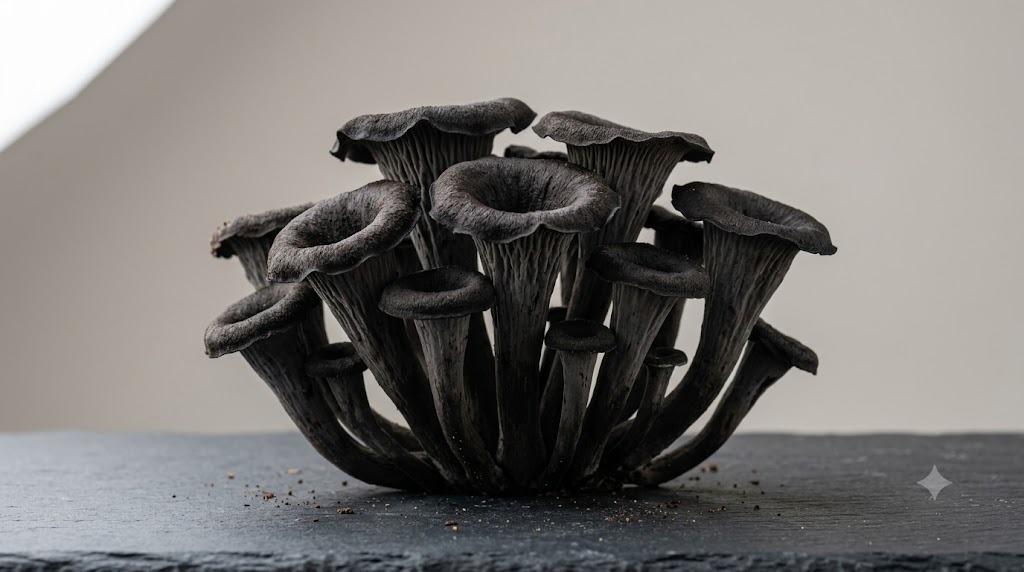
Overview
The black trumpet (Craterellus cornucopioides), also called horn of plenty or trumpet of the dead, is a thin, dark, funnel-shaped mushroom that hides superbly among fallen leaves - and rewards the forager who spots it with one of the richest, most fragrant flavours in the woods. A close relative of the chanterelle, it is mycorrhizal and cannot be cultivated, making every black trumpet a foraged prize.
Identification & Appearance
A hollow, trumpet- or funnel-shaped mushroom 3-12 cm tall, in dark grey, brown, or near-black, with a thin, wavy, brittle body. The outer surface is smooth or faintly wrinkled with no true gills. It is thin-fleshed and easily missed against dark leaf litter.
Where It Grows
Black trumpets grow in late summer and autumn in mycorrhizal partnership with hardwoods - especially oak and beech - on mossy or leaf-littered ground across temperate forests of the Northern Hemisphere, often in large scattered troops.
Foraging & Cultivation
Black trumpets cannot be cultivated - their root partnership with trees defeats farming. They are foraged, and because their dark colour camouflages them so well, finding the first one of a patch is the hard part; after that, many often appear nearby.
Growing Conditions
Light
Dappled woodland shade; black trumpets fruit on shaded forest floors among leaf litter.
Watering
They fruit in the damp of late summer and autumn, after rain.
Temperature & Substrate
A late-summer-to-autumn woodland species, growing only with living tree roots and not on any artificial substrate.
Culinary Use
Black trumpets have an intense, smoky, almost truffle-like aroma that concentrates beautifully when dried - many cooks consider them better dried than fresh, ground into a fragrant powder for sauces, pasta, and eggs. Fresh, they suit cream sauces and risotto. Cook them thoroughly.
Health & Nutrition
Low in calories, a source of fibre, B vitamins, and antioxidants. As with chanterelles, the value is culinary - flavour far outweighs nutritional standout.
⚠️ Safety note
Black trumpets have no deadly look-alikes, which makes them relatively forager-friendly, but as with all wild mushrooms, only eat them with expert confirmation and always cooked.
Pros & Cons
Pros
- Intense, smoky, truffle-like aroma.
- Dries superbly into a fragrant powder.
- No deadly look-alikes.
Cons
- Cannot be cultivated - foraged only.
- Dark colour makes them hard to spot.
- Thin-fleshed; quantity adds up slowly.
Best Suited For
- Foragers who enjoy a rewarding hunt.
- Cooks who want a deeply aromatic dried mushroom.
Not ideal for home growers - black trumpets cannot be farmed.
FAQ
Why is it called trumpet of the dead? Folklore - the dark trumpets appear around late autumn and were said to grow from the departed; it is harmless and choice.
Fresh or dried? Many cooks prefer black trumpets dried, as drying intensifies their smoky, truffle-like aroma.
Can I grow them? No - they are mycorrhizal and depend on living trees, so they are foraged in late summer and autumn.