Button Mushroom
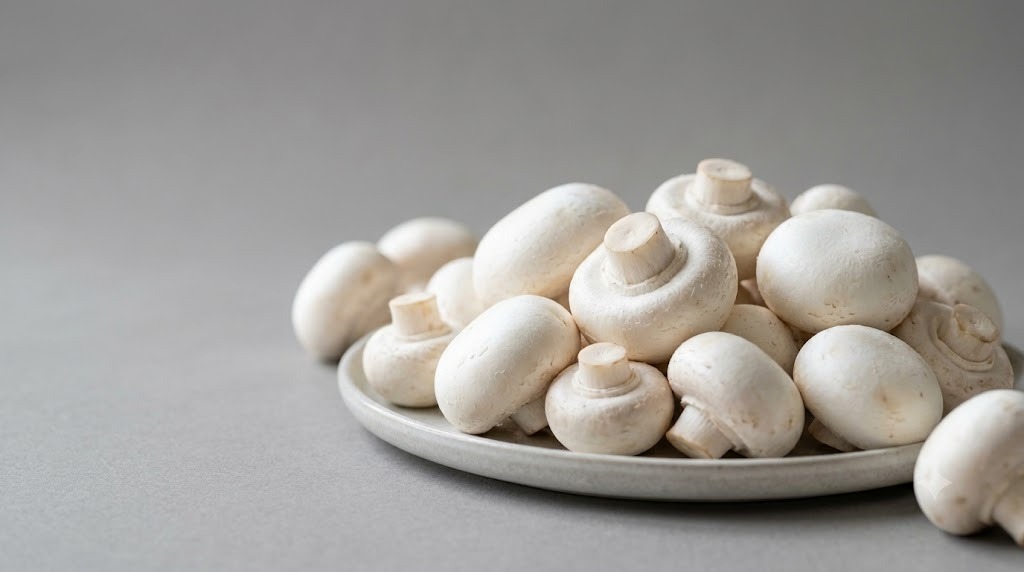
The button mushroom (Agaricus bisporus) is the most cultivated and most eaten mushroom on Earth - the familiar small white mushroom of every supermarket.
🗓️ Last reviewed: June 2026
Overview
The button mushroom (Agaricus bisporus) is the most cultivated and most eaten mushroom on Earth - the familiar small white mushroom of every supermarket. The same species, harvested later or in its brown strain, becomes cremini and portobello. It is grown on composted substrate rather than wood, which makes home cultivation a different craft from oyster or shiitake, but a rewarding one for gardeners comfortable with compost.
Identification & Appearance
A smooth, rounded white or pale-brown cap 2-10 cm across on a short, straight stem with a thin ring. Young "button" caps are closed; as they open, pink gills show beneath, darkening to chocolate-brown with age. Spore print dark brown. The brown strain is the cremini; left to mature it is the portobello.
Where It Grows
In the wild, Agaricus species grow in grassland, pasture, and compost-rich soil rather than on wood, appearing in rings and scattered groups after rain. The cultivated strain descends from selections first grown in 18th-century French caves.
How to Grow at Home
Button mushrooms are grown on pasteurised, composted substrate - traditionally straw-based horse manure compost. The compost is spawned, colonised warm and dark, then covered with a moist "casing" layer of peat or coir that triggers fruiting. Kits supply pre-spawned compost ready to case and crop. It is more involved than wood-loving mushrooms but produces several flushes.
Growing Conditions
Light
No light is needed at all - button mushrooms fruit happily in complete darkness, unlike wood-rotting species.
Watering
Keep the casing layer evenly moist with light misting; humidity around 80-90%. Avoid soaking, which invites bacterial spotting.
Temperature & Substrate
Colonisation around 24°C; fruiting after a drop to 16-18°C. Substrate: pasteurised composted straw/manure, topped with a peat or coir casing layer.
Culinary Use
Mild and versatile - eaten raw in salads, sliced into sauces and soups, sautéed, or stuffed. The white button is the most delicate; flavour deepens as the mushroom matures toward cremini and portobello. One of the few mushrooms commonly eaten raw, though cooking improves digestibility.
Health & Nutrition
Low calorie, a useful source of B vitamins, potassium, selenium, and fibre. Like all mushrooms it builds vitamin D under sunlight. Modest amounts of antioxidants and beta-glucans.
Common Problems
- No pins after casing - casing too dry, or temperature not dropped.
- Bacterial blotch (brown spots) - overwatering and poor airflow.
- Cobweb or green mould - contamination; maintain clean conditions and fresh casing.
Pros & Cons
Pros
- Universally useful, mild flavour.
- Fruits in darkness - no light setup needed.
- Multiple flushes from one bed.
Cons
- Compost-based growing is more complex than wood substrates.
- Slower and fussier than oyster mushrooms.
- Needs a casing layer step.
Best Suited For
- Gardeners comfortable with compost.
- Growers wanting the most familiar, all-purpose mushroom.
Not ideal for beginners wanting the simplest possible first grow.
FAQ
Are white, cremini and portobello different mushrooms? No - all are Agaricus bisporus. Cremini is the brown strain; portobello is a fully mature cremini.
Do button mushrooms need light? No. They fruit fine in the dark, which is why they were historically grown in caves and cellars.
Can I grow them in my garden? Yes - a shaded, composted bed can produce button mushrooms outdoors in mild weather.