Chaga
Chaga (Inonotus obliquus) is unlike any other mushroom on this list - it is not a soft fruit body but a hard, charcoal-black mass that grows for years on living birch trees in cold northern forests.
🗓️ Last reviewed: June 2026
Overview
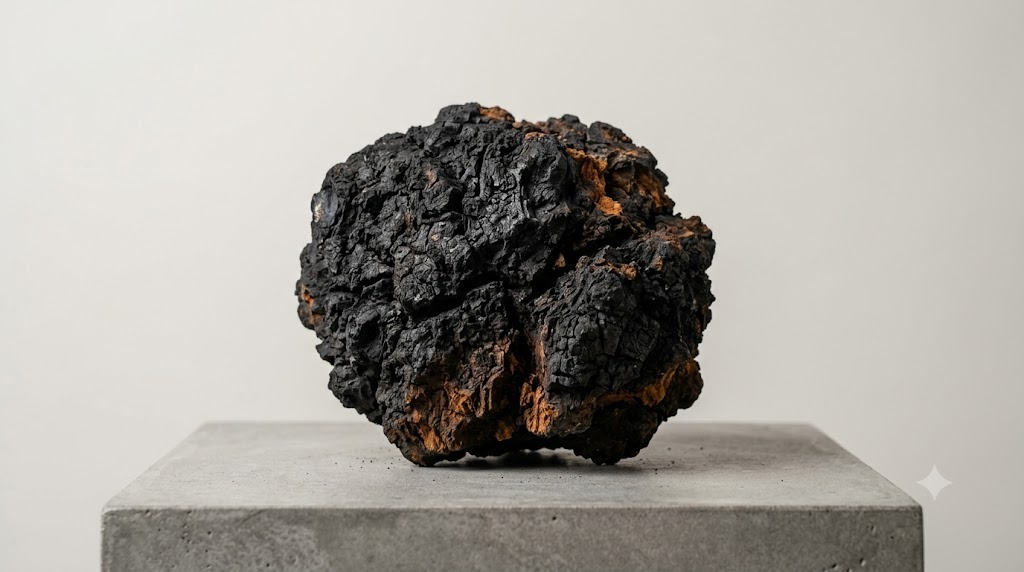
Chaga (Inonotus obliquus) is unlike any other mushroom on this list - it is not a soft fruit body but a hard, charcoal-black mass that grows for years on living birch trees in cold northern forests. It looks like burnt wood and is far too hard to eat; it is harvested, dried, ground, and brewed into a dark, earthy tea. Long used across Russia, Scandinavia, and northern Asia, chaga is gathered from the wild rather than cultivated.
Identification & Appearance
A rugged, cracked, black external mass - the "sterile conk" - 10-40 cm across, resembling a chunk of burnt charcoal on a birch trunk. Inside it is rusty orange-brown and corky. The true spore-producing surface forms separately and is rarely seen. It looks nothing like a typical mushroom.
Where It Grows
Chaga grows almost exclusively on living birch trees in cold-climate forests of Russia, Scandinavia, the Baltic states, northern Asia, Canada, and the northern United States. It develops slowly over many years.
Foraging & Cultivation
Chaga is not commercially cultivated in any practical way - it is harvested from wild birch. Sustainable harvest matters: take only part of a large conk, leave the rest to regrow, and never strip a tree bare. Because it grows so slowly, over-harvesting depletes forests. Buy from responsible suppliers if not gathering it yourself, and be certain of the tree and identification.
Growing Conditions
Light
Not applicable to cultivation - wild chaga grows on exposed birch trunks in cold northern light.
Watering
Not applicable - chaga draws moisture and nutrients from the living birch host over years of slow growth.
Temperature & Substrate
A cold-climate species; it grows only on living birch in northern forests and is not raised on artificial substrate.
Culinary Use
Chaga is never eaten - it is brewed. Dried chunks or powder are simmered very gently for a long time (boiling hard destroys some compounds) into a dark, mild, slightly vanilla-earthy tea, sometimes blended with other herbs. It is a beverage and functional ingredient, not a food.
Health & Nutrition
Chaga is rich in antioxidants, melanin, and beta-glucans, and is one of the most popular functional mushrooms in northern folk tradition, studied for immune and antioxidant effects. It is consumed as tea or extract. It can interact with blood-sugar and blood-thinning medication, so check before regular use.
Common Problems
- Over-harvesting - chaga regrows extremely slowly; unsustainable collection harms forests.
- Misidentification - black burls and old bark can be mistaken for chaga; learn it well or buy from a trusted source.
- Hard boiling - destroys some active compounds; simmer gently.
Pros & Cons
Pros
- A revered northern functional mushroom.
- Stores indefinitely once dried.
- Rich in antioxidants.
Cons
- Cannot be practically cultivated - wild-harvested only.
- Slow-growing and easily over-harvested.
- Not a food - purely a tea/extract.
Best Suited For
- People in northern birch regions who can harvest sustainably.
- Anyone interested in traditional functional mushroom teas.
Not ideal for home cultivation - chaga is one mushroom you cannot grow on a shelf.
FAQ
Can I grow chaga at home? Not practically - it grows over years on living birch and is not cultivated commercially.
How is it used? Dried and gently simmered into a tea, or processed into powders and extracts. It is never eaten as a food.
Is harvesting it sustainable? Only if done carefully - take part of a conk, leave the rest, and never over-harvest, since chaga regrows very slowly.