Giant Puffball
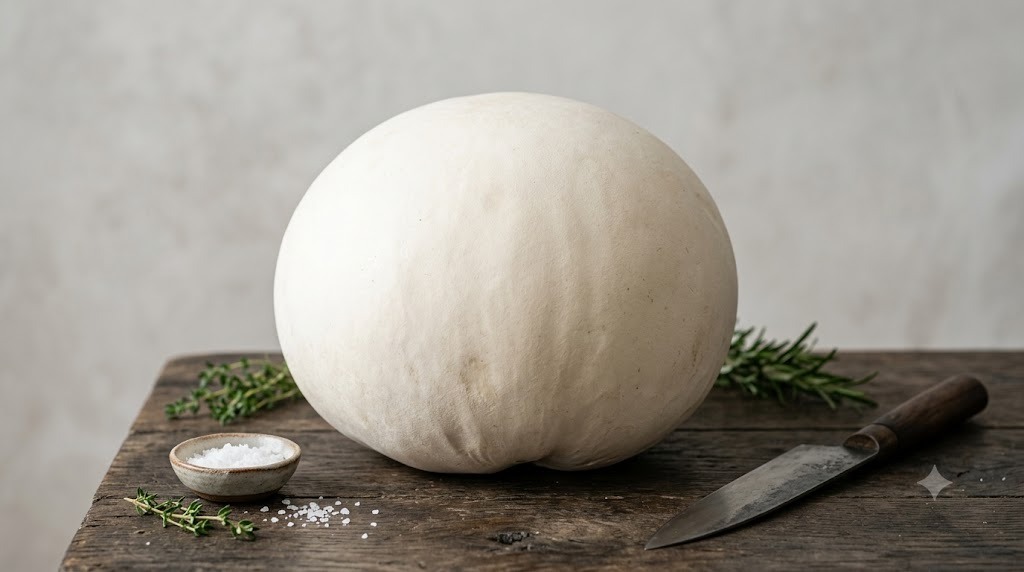
The giant puffball (Calvatia gigantea) is the most unmistakable mushroom a forager can find - a smooth white ball, sometimes as large as a beach ball, sitting in a meadow.
🗓️ Last reviewed: June 2026
Overview
The giant puffball (Calvatia gigantea) is the most unmistakable mushroom a forager can find - a smooth white ball, sometimes as large as a beach ball, sitting in a meadow. Caught young, when the inside is pure firm white, it is a fine edible with a mild flavour and a texture that takes on whatever it is cooked with. Its sheer size and distinctiveness make it one of the safest wild mushrooms to recognise.
Identification & Appearance
A large, round to slightly flattened white ball, typically 10-50 cm across (occasionally far larger), with a smooth or slightly suede-like skin and no stem, cap, or gills. Inside, an edible young puffball is pure, even white like a marshmallow. As it ages the interior turns yellow, then olive-brown and powdery with spores.
Where It Grows
Giant puffballs grow in late summer and autumn in meadows, pastures, grassy field edges, and open woodland across temperate regions of the Northern Hemisphere, often appearing in the same spots each year.
Foraging & Cultivation
Giant puffballs are foraged, not cultivated - they are saprotrophic soil dwellers that have not been brought into reliable cultivation. They are, however, one of the easiest wild mushrooms to identify thanks to their size and form.
Growing Conditions
Light
Open, sunny to lightly shaded grassland - giant puffballs fruit in the open, unlike most woodland mushrooms.
Watering
They fruit after late-summer and autumn rains, when pasture soil is damp.
Temperature & Substrate
A late-summer-to-autumn species of grassland soil; it is not grown on any artificial substrate.
Culinary Use
Only pure-white young puffballs are edible. The firm flesh is sliced thick like bread and fried, breaded as "puffball steaks", or cubed into stews and stir-fries - it is mild and soaks up flavour. Always cut one open before cooking: it must be solid white throughout. Cook it thoroughly.
⚠️ Safety note
Always slice a suspected puffball top to bottom. Edible giant puffball is uniformly white inside. If you see any developing gill pattern or a shadowy mushroom outline within, it is not a puffball but the deadly young button of an Amanita - discard it. Yellow or brown interiors mean the puffball is too old to eat.
Health & Nutrition
Low in calories, a source of protein, fibre, and antioxidants. A light, mild mushroom whose appeal is texture and versatility.
Pros & Cons
Pros
- Among the easiest wild mushrooms to identify.
- Huge - one find can feed many.
- Mild, versatile, takes on other flavours.
Cons
- Edible only at the young, pure-white stage.
- Cannot be cultivated.
- Bland on its own - needs seasoning.
Best Suited For
- Newer foragers wanting a safe, distinctive wild mushroom.
- Cooks who like a mild, sliceable "mushroom steak".
Not ideal for home growers - puffballs cannot be farmed.
FAQ
How do I know a puffball is safe to eat? Cut it in half top to bottom. It must be pure, even white inside, with no gills or any outline of a mushroom - that outline would mean a deadly young Amanita.
Can I eat an old yellow puffball? No - once the inside yellows or browns it is past edible and develops an unpleasant taste.
Can puffballs be grown? No - they are foraged from grassland and have not been brought into cultivation.