Hedgehog Mushroom
The hedgehog mushroom (Hydnum repandum), also called sweet tooth or wood hedgehog, is a forager's favourite for one very reassuring reason: it has almost no dangerous look-alikes.
🗓️ Last reviewed: June 2026
Overview
The hedgehog mushroom (Hydnum repandum), also called sweet tooth or wood hedgehog, is a forager's favourite for one very reassuring reason: it has almost no dangerous look-alikes. Instead of gills it has soft spines under the cap, and it carries a sweet, nutty, faintly peppery flavour close to a chanterelle. It is a mycorrhizal woodland species, so it is foraged rather than grown.
Identification & Appearance
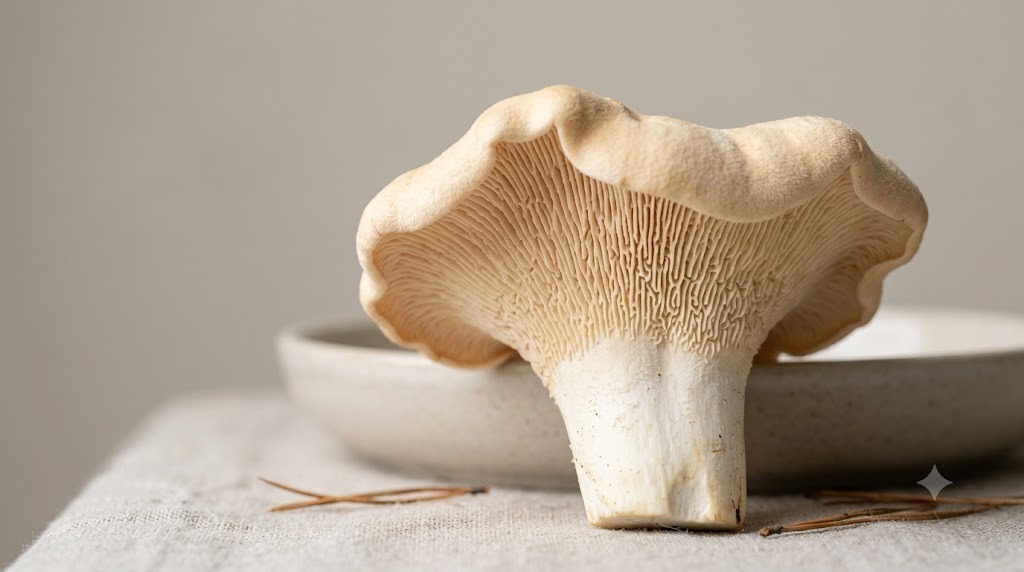
An irregular, cream to pale-orange cap 3-15 cm across, often lobed and uneven. Its defining feature is the underside: a dense layer of soft, brittle, downward-hanging spines or "teeth" instead of gills or pores. The stem is pale and stout, often off-centre. Flesh is white, firm, and bruises faintly orange.
Where It Grows
Hedgehog mushrooms grow in autumn in mycorrhizal partnership with conifers and broadleaf trees across temperate forests of the Northern Hemisphere, often on mossy ground and frequently near chanterelles.
Foraging & Cultivation
Like chanterelles and porcini, the hedgehog mushroom depends on living tree roots and cannot be cultivated - it is strictly a foraged species. Its lack of toxic look-alikes makes it one of the safest mushrooms for newer foragers to learn, though expert confirmation is still wise.
Growing Conditions
Light
Dappled woodland shade; it fruits on shaded, mossy forest floors.
Watering
It fruits in the damp of autumn, a week or two after rain.
Temperature & Substrate
An autumn woodland species. It grows only with living tree roots and cannot be raised on any substrate.
Culinary Use
Hedgehog mushrooms are firm and hold their shape well, with a sweet, nutty taste. They are excellent sautéed, in sauces, with eggs, or alongside chanterelles. Older specimens can turn slightly bitter, so younger ones are preferred. Cook them thoroughly.
Health & Nutrition
Low in calories, a source of fibre, B vitamins, and antioxidants. Their appeal is culinary - a tasty, beginner-friendly wild edible.
Pros & Cons
Pros
- Virtually no dangerous look-alikes - beginner-friendly to learn.
- Sweet, nutty, chanterelle-like flavour.
- Firm texture that cooks well.
Cons
- Cannot be cultivated - foraged only.
- Older specimens can be bitter.
- Seasonal, autumn-only.
Best Suited For
- Newer foragers wanting a safe wild mushroom to learn.
- Cooks who enjoy chanterelle-style mushrooms.
Not ideal for home growers - it cannot be farmed.
FAQ
Why is the hedgehog mushroom good for beginners? It has no dangerous look-alikes and a unique toothed underside, making it one of the safest wild mushrooms to identify - though expert confirmation is still recommended.
Can I grow it? No - it is mycorrhizal and depends on living trees. It is foraged in autumn.
Why are mine bitter? Older hedgehog mushrooms develop bitterness; pick young specimens for the best flavour.