King Oyster Mushroom
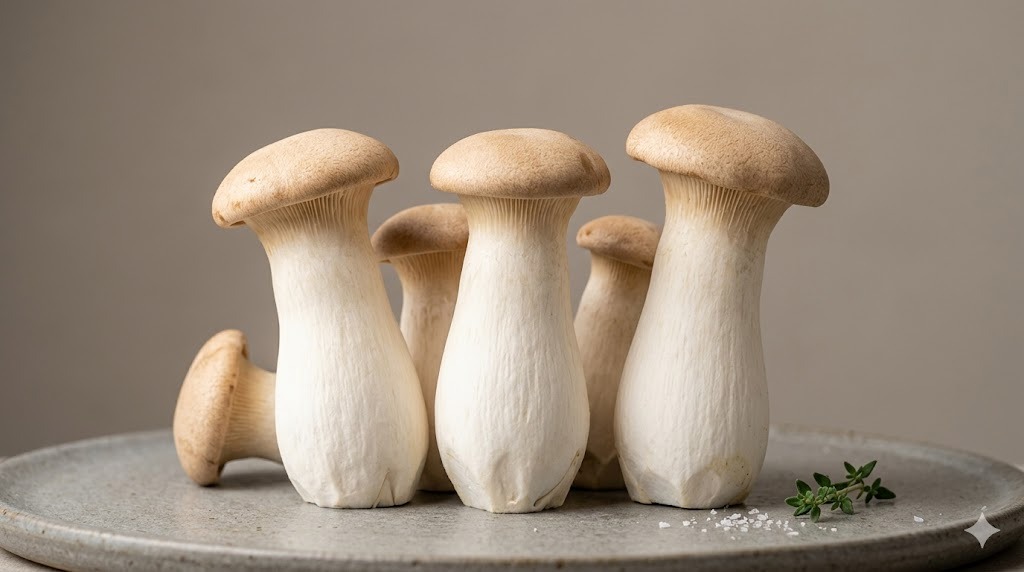
The king oyster (Pleurotus eryngii) is the largest and meatiest of the oyster family, prized for a thick white stem that stays firm and succulent when cooked.
🗓️ Last reviewed: June 2026
Overview
The king oyster (Pleurotus eryngii) is the largest and meatiest of the oyster family, prized for a thick white stem that stays firm and succulent when cooked. Unlike its soft cousins it is grown for the stem rather than the small caps, and slices of it are widely used as a scallop or meat substitute. It is a little slower and fussier than common oyster mushrooms but well within reach of a home grower.
Identification & Appearance
King oysters have a tall, club-shaped white to cream stem 3-15 cm long and a small, flat, tan-brown cap. The flesh is dense and pure white throughout. Gills run partway down the stem. Wild specimens are firmer and more compact than the bulky cultivated form.
Where It Grows
Native to Mediterranean grasslands, the Middle East, and parts of Asia, it grows in association with the roots and decaying stems of plants in the carrot family (Eryngium - sea holly), unusual among oyster mushrooms. It fruits in spring and autumn in dry, open country.
How to Grow at Home
King oyster is grown on supplemented hardwood sawdust rather than straw - it needs more nutrition than common oysters. Sterilised sawdust blocks with bran are inoculated with grain spawn, colonised for 3-4 weeks, then cooled and given fresh air to fruit. It fruits best as a few large mushrooms rather than big clusters, so growers often limit pinning to produce thick, market-style stems.
Growing Conditions
Light
Low, indirect light is sufficient and helps cap formation; a bright room away from direct sun is ideal during fruiting.
Watering
Humidity of 85-95% is needed, but king oyster dislikes water sitting on the surface - mist the air rather than the mushrooms, and ensure good airflow to prevent bacterial blotch.
Temperature & Substrate
Colonisation around 24°C; fruiting is triggered by a drop to 15-18°C. Substrate: sterilised hardwood sawdust supplemented with wheat or rice bran.
Culinary Use
The firm stem is the prize - slice it into thick rounds, score, and sear for a scallop-like result, or shred lengthwise for a pulled-pork texture. It holds up to grilling, roasting, and braising far better than any other oyster mushroom and keeps a pleasant bite.
Health & Nutrition
High in protein and fibre, low in fat, and a source of ergothioneine, an antioxidant amino acid concentrated in mushrooms. King oyster also contains beta-glucans linked to immune and metabolic support.
Common Problems
- Bacterial blotch (orange-brown sunken spots) - too much surface moisture; mist less, ventilate more.
- Many small mushrooms instead of a few big ones - thin the pins early for larger stems.
- Slow or patchy colonisation - substrate not sterilised thoroughly or spawn rate too low.
Pros & Cons
Pros
- Meaty, versatile stem with excellent texture.
- Long shelf life - keeps over a week refrigerated.
- Mild flavour that suits many cuisines.
Cons
- Needs sterilised (not just pasteurised) substrate.
- Slower than common oyster mushrooms.
- Lower total yield per block.
Best Suited For
- Growers ready for a slightly more advanced project.
- Cooks who want a firm, meat-like mushroom.
- Anyone wanting a mushroom that stores well.
Not ideal for absolute beginners without a way to sterilise substrate.
FAQ
Why grow king oyster for the stem? The stem is the thick, firm, flavour-holding part - the caps are small and secondary.
Can I grow it on straw like other oysters? It performs poorly on straw; supplemented hardwood sawdust gives far better results.
How do I get big scallop-sized stems? Limit the number of pins per block so the fungus channels energy into a few large fruits.