Lion's Mane Mushroom
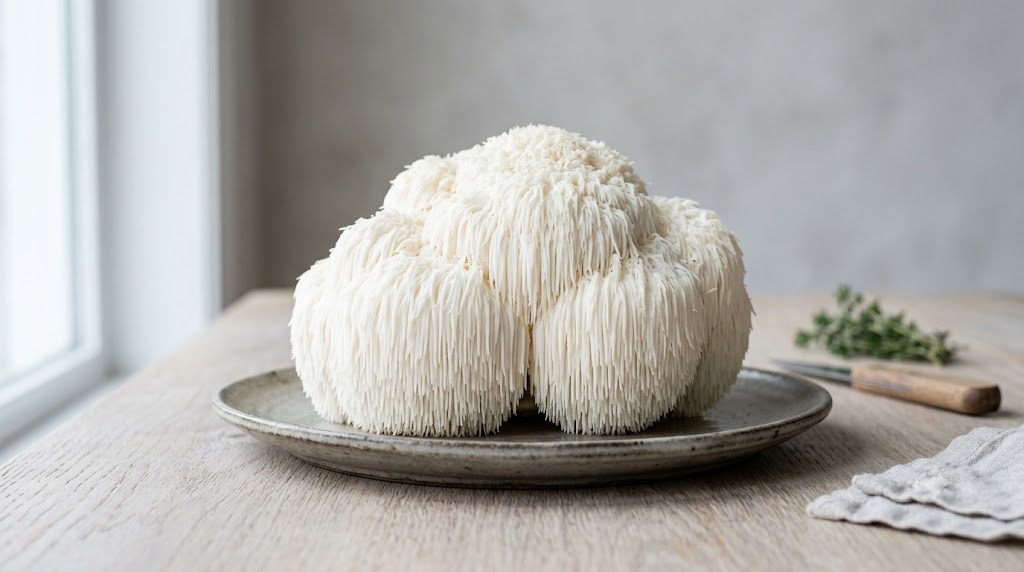
Lion's mane (Hericium erinaceus) is unlike any other cultivated mushroom - a soft white globe of cascading icicle-like spines, with a tender texture and a flavour widely compared to crab or lobster.
🗓️ Last reviewed: June 2026
Overview
Lion's mane (Hericium erinaceus) is unlike any other cultivated mushroom - a soft white globe of cascading icicle-like spines, with a tender texture and a flavour widely compared to crab or lobster. It is both a gourmet ingredient and one of the most studied medicinal mushrooms, valued for compounds linked to nerve health. It grows well on sawdust blocks indoors and is a satisfying, slightly more advanced project.
Identification & Appearance
A single rounded white cushion, 8-25 cm across, covered in soft hanging spines 1-4 cm long instead of a cap and gills. Young specimens are pure white; with age they yellow and the spines lengthen. There is no recognisable stem. Spore print white.
Where It Grows
A wood-rotting fungus of hardwoods - especially oak, beech, and maple - across the Northern Hemisphere. In the wild it grows from wounds and dead sections high on living and standing dead trees, fruiting in late summer and autumn.
How to Grow at Home
Lion's mane is grown on sterilised supplemented hardwood sawdust blocks. After 2-4 weeks of colonisation the block is given fresh air and humidity, and a single mushroom forms from each opening. It is sensitive to stale air - good ventilation is essential for the spines to form properly rather than turning into a cauliflower-like mass.
Growing Conditions
Light
Low, indirect light is enough; lion's mane is not light-demanding but a dim ambient glow helps.
Watering
Humidity of 85-95% with gentle misting of the air, not the mushroom directly - water sitting on the spines causes discolouration.
Temperature & Substrate
Fruits at 15-21°C. Substrate: sterilised hardwood sawdust supplemented with bran. Fresh air exchange is critical.
Culinary Use
Lion's mane has a seafood-like taste and a meaty, shreddable texture. Tear it into chunks, dry-sear to remove moisture, then sauté in butter - it makes an excellent crab-cake or "scallop" substitute. Cook it through; the texture improves with browning.
Health & Nutrition
Low calorie, good protein and fibre. Lion's mane contains hericenones and erinacines, compounds studied for stimulating nerve growth factor, plus beta-glucans for immune support. It is one of the most popular mushrooms in supplement form.
Common Problems
- Cauliflower-like, no spines - too much carbon dioxide; increase fresh air.
- Pink or brown discolouration - water pooled on the surface, or the mushroom is over-mature.
- Bitterness - picked too late; harvest while still white.
Pros & Cons
Pros
- Unique seafood-like flavour and texture.
- Highly valued medicinal mushroom.
- Compact - one tidy fruit per opening.
Cons
- Needs sterilised substrate and good ventilation.
- Short shelf life; discolours easily.
- Lower yield than oyster mushrooms.
Best Suited For
- Growers ready for a step beyond oyster mushrooms.
- Cooks wanting a seafood alternative.
- Anyone interested in functional, medicinal mushrooms.
Not ideal for beginners without sterile technique or good airflow.
FAQ
Why did my lion's mane grow into a blob with no spines? Carbon dioxide build-up. It needs steady fresh air to form proper hanging spines.
When do I harvest? While the mushroom is still white and the spines are short to medium - yellowing means it is past its best and turns bitter.
Does cooking destroy the benefits? Cooking is necessary for digestion and flavour; the studied compounds are reasonably heat-stable.