Paddy Straw Mushroom
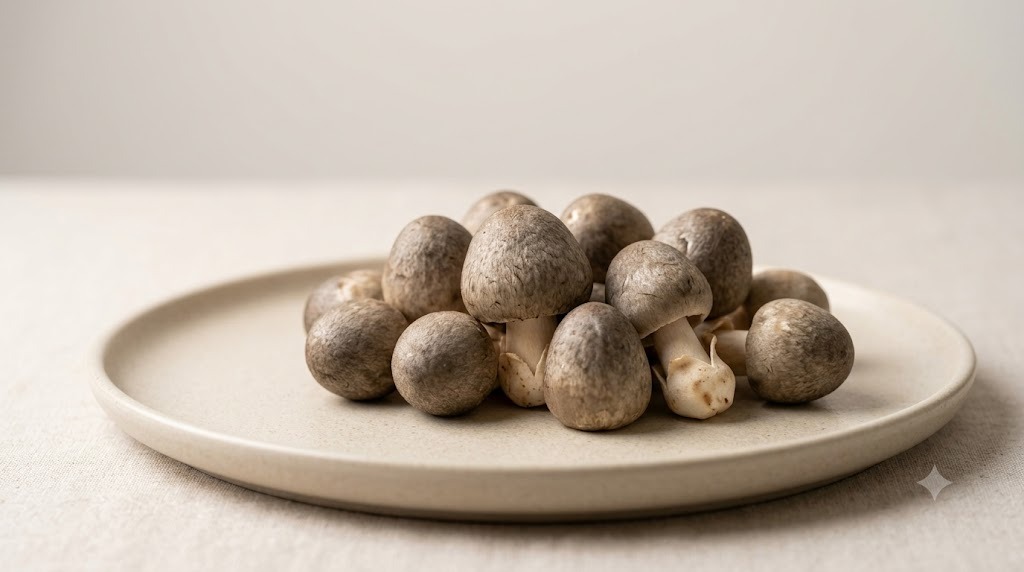
The paddy straw mushroom (Volvariella volvacea) is the great tropical cultivated mushroom - grown for centuries across Southeast Asia on rice straw, fast to crop, and harvested as small egg-shaped buttons before the cap opens.
🗓️ Last reviewed: June 2026
Overview
The paddy straw mushroom (Volvariella volvacea) is the great tropical cultivated mushroom - grown for centuries across Southeast Asia on rice straw, fast to crop, and harvested as small egg-shaped buttons before the cap opens. It is the third most cultivated mushroom worldwide, yet little known in cooler countries because it demands real warmth. For growers in hot climates it is one of the quickest crops there is.
Identification & Appearance
Harvested young, it is a smooth grey-brown egg, 3-8 cm tall, wrapped in a membranous outer veil. If left to grow, the cap breaks free and opens umbrella-like, leaving a cup-shaped "volva" (sac) at the stem base - a key identification feature. Gills pale, turning pink; spore print pink.
Where It Grows
A warm-climate decomposer of rice straw, compost, and plant debris across tropical and subtropical Asia. It cannot survive cold and fruits only in genuinely hot, humid conditions.
How to Grow at Home
Paddy straw is grown on pasteurised rice straw or cotton-waste compost piled into beds. It colonises fast in heat and fruits within a week or two, cropping over a short, intense period. It needs no sterile lab work - just heat and humidity - but in temperate regions a heated, humid space is essential.
Growing Conditions
Light
Low, indirect light is enough; paddy straw is not light-demanding.
Watering
Very high humidity (85-95%) and a consistently damp straw bed; in the tropical climate it evolved for, moisture is constant.
Temperature & Substrate
Strongly heat-loving - fruits at 28-35°C and dies below about 15°C. Substrate: pasteurised rice straw or cotton-waste compost.
Culinary Use
Paddy straw mushrooms are mild and tender, a staple of Thai, Chinese, and Vietnamese cooking - added to soups, curries, and stir-fries. They are usually sold canned outside Asia because fresh ones spoil within a day or two. Always cook them thoroughly.
Health & Nutrition
Low calorie, good protein and fibre, B vitamins, and beta-glucans. A light, easily digestible mushroom.
Common Problems
- No fruiting - almost always too cold; paddy straw needs 28-35°C.
- Buttons opening too fast - harvest promptly at the egg stage; they mature in hours.
- Very short shelf life - use within a day of harvest.
⚠️ Safety note
The unopened "egg" of the paddy straw mushroom resembles the deadly young Amanita (death cap and relatives), which also has a volva. Never forage egg-stage mushrooms - only eat paddy straw from known cultivation.
Pros & Cons
Pros
- Very fast - crops within 1-2 weeks.
- No sterile lab technique needed.
- Hugely productive in hot climates.
Cons
- Demands tropical warmth - useless in cool homes without heating.
- Extremely short shelf life.
- Egg stage resembles deadly Amanita - never forage it.
Best Suited For
- Growers in hot, humid climates.
- Anyone with a heated, humid grow space wanting a fast crop.
Not ideal for cool-climate growers without strong heating.
FAQ
Why is it always sold canned? Fresh paddy straw mushrooms spoil within a day or two, so they are canned for export.
Why does it need to be so warm? It is a tropical species that evolved in hot rice paddies and simply will not fruit in cool conditions.
Is the egg stage dangerous to forage? The egg stage looks like deadly young Amanita mushrooms. Only ever eat cultivated paddy straw mushrooms.