Porcini (King Bolete)
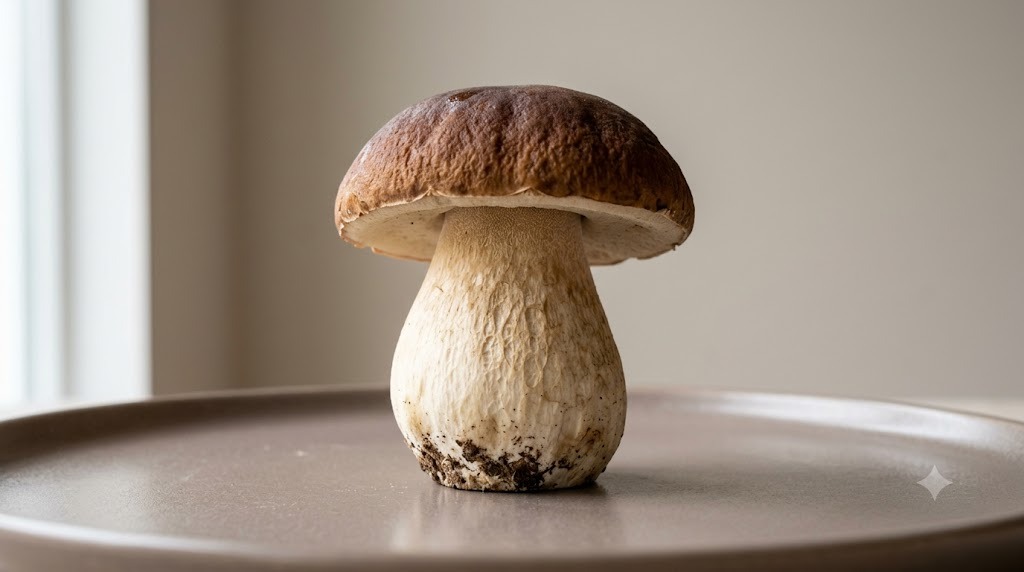
Porcini (Boletus edulis), the king bolete, is one of the world's great wild mushrooms - a stout, handsome mushroom with a brown bun-like cap and a swollen pale stem, carrying a deep, nutty, profoundly savoury flavour.
🗓️ Last reviewed: June 2026
Overview
Porcini (Boletus edulis), the king bolete, is one of the world's great wild mushrooms - a stout, handsome mushroom with a brown bun-like cap and a swollen pale stem, carrying a deep, nutty, profoundly savoury flavour. It is the mushroom of Italian and Eastern European cooking, dried by the tonne for winter use. Like other mycorrhizal mushrooms it cannot be farmed and is foraged from forests.
Identification & Appearance
A robust mushroom with a smooth, rounded brown cap 8-25 cm across, often glossy when damp. The thick, bulbous stem is pale cream with a fine raised network near the top. Underneath the cap is a layer of tiny pores - white when young, yellowing then greening with age - not gills. Flesh stays white and does not bruise blue.
Where It Grows
Porcini grows in summer and autumn in mycorrhizal partnership with the roots of pine, spruce, birch, oak, and beech across the temperate Northern Hemisphere. It fruits in the same forest spots year after year.
Foraging & Cultivation
Porcini cannot be cultivated - its bond with tree roots resists all farming attempts, so it is harvested wild. It is foraged fresh in season and dried in vast quantities. Trusted dried porcini is the practical way to enjoy it year-round if you do not forage.
Growing Conditions
Light
Dappled woodland light; porcini fruits on shaded forest floors among its host trees.
Watering
It needs a damp forest - porcini flushes appear a week or two after warm-season rains.
Temperature & Substrate
A summer-to-autumn woodland species. It grows only with living tree roots and cannot be raised on any artificial substrate.
Culinary Use
Porcini is intensely savoury and nutty. Fresh young caps are sublime sliced and pan-fried; dried porcini, rehydrated, gives extraordinary depth to risotto, pasta, soups, and sauces, and the soaking liquid is liquid gold. It is one of the few mushrooms whose dried form is arguably better than fresh. Cook it well.
⚠️ Safety note
Most boletes are safe, but a few are toxic or intensely bitter. Avoid any bolete with red or orange pores, or flesh that stains deep blue when cut - true porcini has white-to-yellow pores and white, non-bluing flesh. Never eat a wild bolete without expert confirmation.
Health & Nutrition
Porcini is a good source of protein, fibre, B vitamins, selenium, and antioxidants, and is unusually rich in glutamate, the source of its intense umami. Low in calories, high in flavour.
Pros & Cons
Pros
- Profound, nutty, umami flavour.
- Dries superbly - often better dried than fresh.
- A world-class gourmet mushroom.
Cons
- Cannot be cultivated - foraged only.
- Some toxic/bitter bolete look-alikes.
- Wild harvests vary year to year.
Best Suited For
- Foragers with access to pine, oak, or birch woodland.
- Cooks who want the deepest mushroom flavour available.
Not ideal for home growers - porcini cannot be farmed.
FAQ
Can porcini be grown? No - it depends on living tree roots and cannot be cultivated. It is foraged or bought dried.
Fresh or dried - which is better? Both are excellent; dried porcini concentrates the flavour and many cooks prefer it for sauces and risotto.
How do I avoid a bad bolete? Steer clear of boletes with red/orange pores or flesh that stains strongly blue, and always get expert confirmation.