Portobello Mushroom
The portobello is not a separate species but the fully mature brown form of Agaricus bisporus - the same mushroom as the white button and the cremini, simply grown on.
🗓️ Last reviewed: June 2026
Overview
The portobello is not a separate species but the fully mature brown form of Agaricus bisporus - the same mushroom as the white button and the cremini, simply grown on. Allowing the cap to open wide concentrates the flavour into something deep, meaty, and savoury, and the large flat caps have become a kitchen staple as a vegetarian "steak" and burger base. For a home grower it is simply a matter of patience: leave creminis to mature.
Identification & Appearance
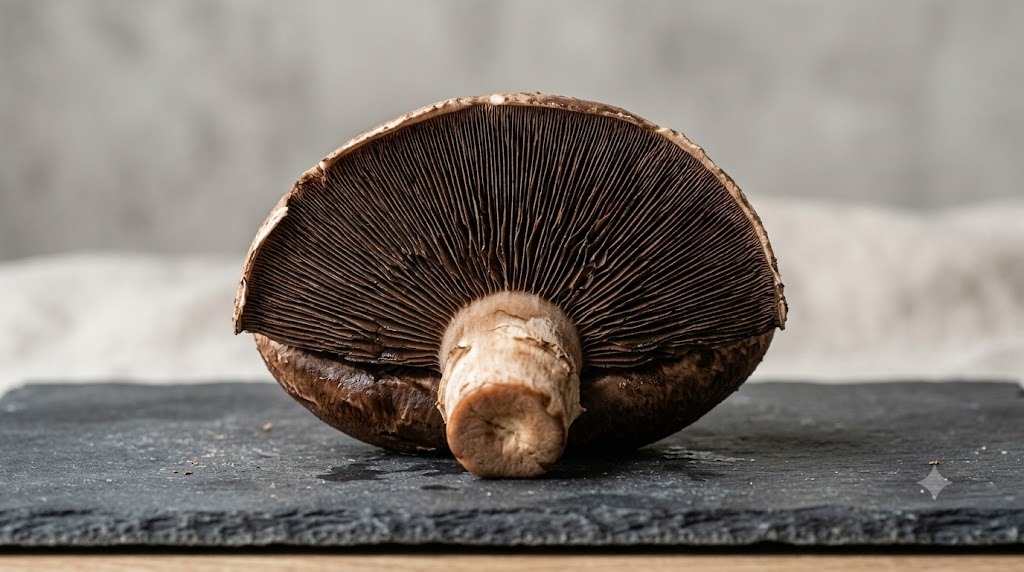
A broad, flat, open brown cap 10-15 cm or more across, exposing dark chocolate-brown gills underneath. The stem is thick and fibrous. Compared with the closed white button, the portobello is drier, denser, and far more flavourful.
Where It Grows
As Agaricus bisporus, it descends from a compost- and pasture-dwelling species. The portobello stage does not occur as a distinct wild mushroom - it is a harvesting choice, letting the cap reach full maturity.
How to Grow at Home
Grow exactly as for button mushrooms - on pasteurised composted substrate with a casing layer - but using the brown strain and simply waiting. Harvest the white-button stage early, the cremini stage at mid-maturity, and the portobello stage once caps have opened fully flat. The longer the mushroom grows, the more substrate it uses, so portobellos reduce total count for larger size.
Growing Conditions
Light
No light required; like all Agaricus mushrooms, the portobello matures fine in darkness.
Watering
Keep the casing layer moist with light misting at 80-90% humidity; mature caps bruise and spot if wet.
Temperature & Substrate
Fruiting at 16-18°C. Substrate: pasteurised composted straw/manure with a peat or coir casing layer.
Culinary Use
The big caps are made for grilling and roasting - marinate and griddle whole as a burger or "steak," stuff and bake, or slice for hearty sautés. The open gills hold marinade well but release dark juices, so portobellos are often cooked gill-side up first. Robust enough to stand in for meat.
Health & Nutrition
Low calorie, good fibre, B vitamins, potassium, and selenium. Mature caps are slightly more concentrated in flavour and minerals than young buttons, and develop more vitamin D when exposed to sunlight.
Common Problems
- Caps dropping spores everywhere - fully mature portobellos shed heavy brown spores; harvest before they over-ripen.
- Watery texture when cooked - cook hot and consider removing gills to reduce moisture.
- Bruising and spotting - handle gently; mature caps mark easily.
Pros & Cons
Pros
- Deep, meaty flavour - excellent meat substitute.
- Large caps ideal for grilling and stuffing.
- Same easy species as the button mushroom.
Cons
- Compost-based cultivation, same complexity as button mushrooms.
- Larger size means fewer mushrooms per bed.
- Releases a lot of dark spores at full maturity.
Best Suited For
- Cooks wanting a hearty, grillable mushroom.
- Gardeners already growing button mushrooms.
Not ideal for growers wanting maximum mushroom count from a small bed.
FAQ
Is a portobello just a big mushroom? Yes - it is a mature Agaricus bisporus, the same species as the white button and cremini.
Should I remove the gills? Optional - removing them reduces dark "bleeding" juices and gives a cleaner-looking dish.
Why does my portobello taste stronger than a white button? Maturity concentrates flavour; the longer the cap grows, the deeper and meatier it becomes.