Truffle
The truffle (Tuber species) is the most valuable mushroom on Earth - a knobbly underground fungus whose intoxicating aroma makes the finest kinds worth more than their weight in silver.
🗓️ Last reviewed: June 2026
Overview
The truffle (Tuber species) is the most valuable mushroom on Earth - a knobbly underground fungus whose intoxicating aroma makes the finest kinds worth more than their weight in silver. Unlike every other mushroom here, the truffle fruits entirely below ground in partnership with tree roots, and is found by trained dogs or pigs. It cannot be "grown" on a shelf, but it can be cultivated in a slow, long-term way: by planting trees inoculated with truffle fungus.
Identification & Appearance
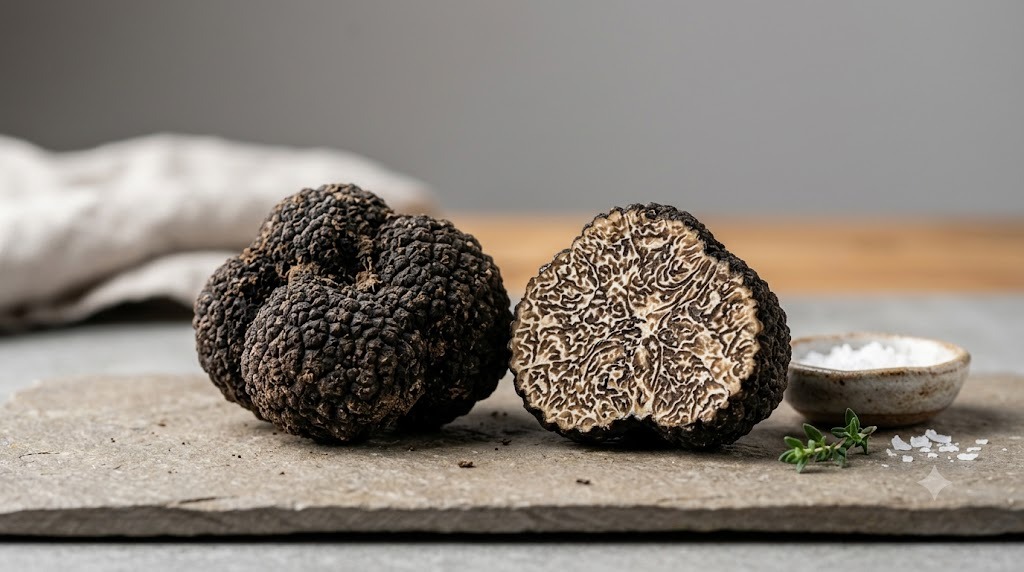
A rounded, irregular, knobbly underground body 2-10 cm across, dark brown to black (or pale tan in some species), with a warty or marbled skin. Cut open, the interior shows a fine pale-and-dark marbled veining. There is no cap, stem, or gills - the whole thing is an underground spore mass. The aroma is powerful and unmistakable.
Where It Grows
Truffles grow underground in mycorrhizal partnership with the roots of oak, hazel, beech, and pine, in well-drained, often limestone-rich soils. The famous black Périgord and white Alba truffles come from parts of France and Italy, but truffle species occur across temperate regions worldwide.
Cultivation
Truffles cannot be grown like other mushrooms - but they can be farmed over the long term through "truffle orchards." Tree seedlings (usually oak or hazel) are inoculated with truffle spores at the nursery and planted in suitable soil. With the right climate, soil pH, and patience, the trees may begin producing truffles underground after roughly 4-10 years, harvested each season with a trained dog.
Growing Conditions
Light
Full sun for the host trees of a truffle orchard; the truffles themselves form in darkness underground.
Watering
Truffle orchards need well-drained soil and managed irrigation - consistent but never waterlogged moisture, especially through summer.
Temperature & Substrate
A temperate-climate fungus needing warm summers and cool winters. It grows only on the roots of inoculated host trees in suitable, often alkaline, well-drained soil - never on artificial substrate.
Culinary Use
Truffles are used in tiny amounts for their extraordinary aroma - shaved raw and thinly over pasta, risotto, eggs, and meats at the very end of cooking, as heat destroys the fragrance. They are intensely seasonal and do not keep, so they are used fresh within days. (Cheap "truffle oil" is usually synthetic flavouring, not real truffle.)
Health & Nutrition
Truffles contain protein, fibre, and antioxidants, but they are eaten in such small quantities that their role is purely about aroma and flavour, not nutrition.
Pros & Cons
Pros
- The most prized and valuable culinary fungus.
- An inoculated truffle orchard can produce for decades.
- Unforgettable aroma.
Cons
- "Cultivation" takes 4-10 years and the right soil and climate.
- Found only with trained dogs or pigs.
- Extremely short shelf life; very expensive.
Best Suited For
- Landowners willing to plant a long-term truffle orchard.
- Cooks who want a once-in-a-while luxury ingredient.
Not ideal for anyone wanting a quick or indoor mushroom crop.
FAQ
Can I grow truffles at home? Not on a shelf - but you can plant truffle-inoculated trees and, with the right soil and climate, harvest truffles underground after several years.
Why are truffles so expensive? They grow underground, take years to produce, must be found with trained animals, and last only days - supply is tiny and demand is high.
Is truffle oil real truffle? Usually not - most truffle oil is flavoured with a synthetic aroma compound rather than real truffle.