Turkey Tail Mushroom
Turkey tail (Trametes versicolor) is one of the most common bracket fungi in the world and one of the most studied medicinal mushrooms.
🗓️ Last reviewed: June 2026
Overview
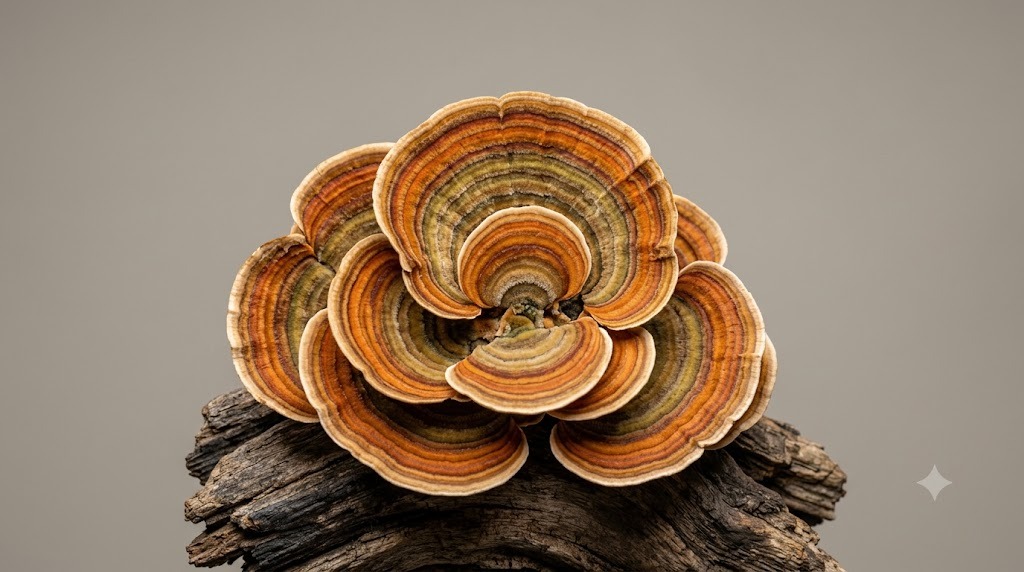
Turkey tail (Trametes versicolor) is one of the most common bracket fungi in the world and one of the most studied medicinal mushrooms. Its concentric bands of colour fan out like a wild turkey's tail across dead wood. It is thin, tough, and inedible as food, but it is easy to grow, easy to dry, and brews into a mild medicinal tea - a good introduction to functional-mushroom cultivation.
Identification & Appearance
Thin, leathery brackets 3-8 cm across in overlapping rosettes, banded in concentric rings of brown, tan, grey, blue, rust, and cream - the colours vary widely. The underside is white to pale with very fine pores (a key feature separating it from look-alikes). Flexible when fresh, hard when dry.
Where It Grows
A wood-rotting fungus found year-round on dead hardwood logs, stumps, and branches across every temperate forest in the world. It is one of the most abundant fungi anywhere.
How to Grow at Home
Turkey tail grows readily on sterilised supplemented hardwood sawdust or on logs. It colonises quickly and forms its banded brackets over several weeks with light and fresh air. Because it is so vigorous and competitive, it is relatively forgiving of beginner mistakes.
Growing Conditions
Light
Indirect light is needed to develop the colourful concentric banding; in darkness it grows pale and shapeless.
Watering
High humidity (85-95%) keeps the brackets forming well; the thin fruit bodies tolerate variable moisture better than fleshy mushrooms.
Temperature & Substrate
Grows across a wide range, roughly 15-28°C. Substrate: sterilised supplemented hardwood sawdust or hardwood logs.
Culinary Use
Turkey tail is not eaten as food - it is too thin and tough to chew. It is used by simmering the dried, chopped brackets into a long, gentle tea or decoction, often blended with other herbs. The flavour is mild, woody, and slightly earthy.
Health & Nutrition
Turkey tail is among the best-researched medicinal mushrooms. It is rich in two well-studied polysaccharide compounds, PSK and PSP, investigated for immune support - PSK is an approved adjunct cancer therapy in Japan. It is taken as a tea or supplement, not a food.
Common Problems
- Pale, unbanded growth - too little light; turkey tail needs light for its colours.
- Confusion with look-alikes - several "false turkey tail" fungi exist; the true species has tiny pores, not a smooth underside.
- Tough texture - expected; it is never meant to be eaten as a vegetable.
Pros & Cons
Pros
- Easy and vigorous to grow.
- A leading, well-studied medicinal mushroom.
- Dries and stores indefinitely.
Cons
- Not edible as food.
- Purely for tea and extracts.
- Look-alikes make wild foraging risky for beginners.
Best Suited For
- Growers interested in medicinal mushrooms.
- Beginners wanting an easy functional-mushroom project.
Not ideal for anyone wanting a culinary mushroom.
FAQ
Can I eat turkey tail? Not as food - it is too tough. It is simmered into a medicinal tea or made into extracts.
Is it really used in medicine? Yes - its PSK compound is an approved cancer-treatment adjunct in Japan, and the mushroom is widely studied for immune support.
How do I tell it from false turkey tail? True turkey tail has a finely pored white underside; false turkey tail has a smooth underside.