Indoor Composting: Bokashi, Worm Bins, Countertop
Three indoor composting methods compared - bokashi fermentation, worm bins (vermicompost), and countertop electric composters - with honest notes on smell, cost, and output.
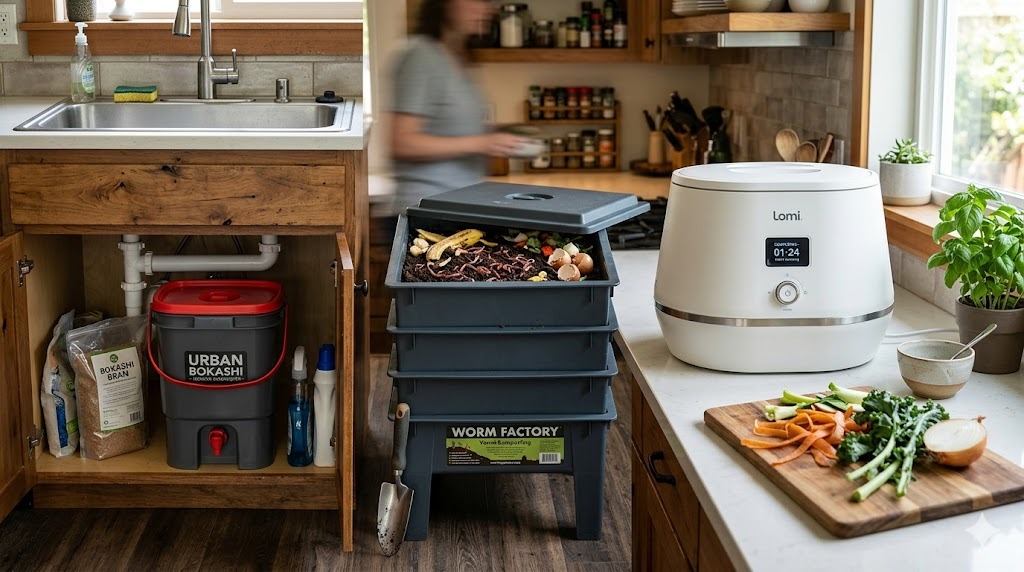
A flat without a garden, an apartment with no balcony - these used to be the end of any composting ambition. They aren’t anymore. There are now three credible indoor composting methods, each producing real, plant-feeding compost from your kitchen scraps without smelling, attracting flies, or filling your home with rotting vegetables. The technology has caught up with the lifestyle.
But the three methods are very different - different cost, different output, different commitment. A worm bin is a living ecosystem you’ll feed twice a week. Bokashi is a fermentation bucket that lives under the sink. An electric countertop composter is essentially a small oven that dehydrates food scraps into a soil amendment in 4 hours. They produce different end products and suit different households.
This guide compares all three honestly - what each does, what it doesn’t, what it costs, and how to choose.
What “Indoor Compost” Actually Means
The traditional outdoor compost pile relies on aerobic decomposition driven by bacteria, oxygen, and time - typically 6 months to mature compost. Indoors, you can’t realistically run a 1-cubic-metre aerobic pile.
The three indoor methods are workarounds:
- Bokashi - anaerobic fermentation, not strictly composting. Produces a pickled pre-compost that needs to finish breaking down (in soil or a worm bin).
- Vermicomposting (worm bins) - worms do the work. Slow but produces premium plant food (worm castings).
- Electric countertop composters - high-tech dehydrators that grind and dry scraps into a coarse mealy soil amendment, not true compost.
Pick based on what you want at the end: a fertiliser, a soil conditioner, or just reduced bin volume.
Method 1: Bokashi
A 20 L bucket with a tight lid and a drainage tap at the bottom. You layer food scraps with bokashi bran (an inoculant of EM - effective microorganisms). The bran ferments the scraps anaerobically, producing a pickled mass and a strong-smelling liquid (“bokashi tea”) that drains from the bottom.
Process
- Add scraps daily; sprinkle 1-2 tablespoons of bokashi bran on top each time.
- Press down to remove air pockets.
- Drain the bokashi tea every 2-3 days via the tap - dilute 1:100 with water and use as plant fertiliser.
- When the bucket is full, seal and ferment 2 weeks.
- After fermentation, the contents look pickled (not rotted). Bury in soil, mix into a worm bin, or add to an outdoor compost pile.
What you can compost
Almost everything - including meat, dairy, citrus, onions, and cooked food (which true composting often excludes).
Pros
- Handles all food waste.
- No smell when sealed properly (slight vinegar smell on opening).
- Compact - single bucket lives under a sink.
- Fast - bucket fills in 2 weeks for a small household, then 2 weeks fermenting.
- Excellent liquid fertiliser as a byproduct.
Cons
- Output isn’t ready-to-use compost - needs to finish in soil or a worm bin.
- You need a place to bury or finish the contents (a garden patch, a deep pot, or an outdoor bin).
- Bokashi bran is a recurring cost (£8-15 per kg, lasts 2-3 months).
- The brief vinegar smell when opening puts some people off.
Cost
- Two-bucket starter set (so one ferments while the other fills): £40-70.
- Bran refill: ~£8 every 2 months.
Verdict
Best for flat-dwellers with access to a garden or large plant pots where the fermented contents can finish. The liquid alone is worth it.
Method 2: Worm Bin (Vermicomposting)
A stackable plastic bin with a population of red wiggler worms (Eisenia fetida) that eat kitchen scraps and produce worm castings - premium plant food often called “black gold.”
Process
- Set up a bin with bedding (shredded newspaper, coir, leaves) and 500 g of red wiggler worms (~£25 per bag).
- Add food scraps to one side of the bin twice a week. Worms move to whichever side has fresh food.
- After 2-3 months, the older side has fully composted into dark, crumbly castings. Harvest by moving worms to the new side and scooping out finished castings.
- Drain any liquid (“worm tea”) via the tap; dilute and use as fertiliser.
What you can compost
Vegetable scraps, fruit (small amounts of citrus), coffee grounds, tea bags (not plastic-sealed), eggshells, shredded paper, cardboard. Avoid meat, dairy, oils, onions in quantity.
Pros
- Produces the highest-quality plant fertiliser - worm castings outperform compost in studies and give your indoor plant collection a genuine boost.
- No smell when balanced (earthy at most).
- Doesn’t need to “finish” elsewhere - output is immediately usable.
- Worms self-regulate population to bin size.
- Long-lived - a well-kept bin runs for years.
Cons
- Worms are alive. They need maintenance - daily check during summer (overheating), monthly bedding refresh, weekly food balance.
- Can smell or attract fruit flies if overfed or unbalanced.
- Slower than bokashi - a small bin processes ~1 kg of scraps per week, not all family waste.
- Won’t tolerate temperatures above 30°C or below 5°C - must stay indoors, in a cool spot.
Cost
- Stackable worm bin (Wormery, Subpod Mini, Maze Worm Farm): £60-120.
- Red wigglers: £20-30 for 500 g starter.
- Bedding refills: minimal - shredded newspaper is free.
Verdict
Best for engaged people who want top-quality compost and don’t mind a pet that’s also a recycling system.
Method 3: Electric Countertop Composter
A countertop appliance (Lomi, Vitamix FoodCycler, Mill, Reencle) that grinds and dehydrates food scraps overnight into a coarse mealy product roughly 10-20% of the original volume.
Process
- Drop scraps into the unit throughout the day.
- Press start; the unit grinds, heats (around 70°C), and dehydrates for 4-8 hours.
- In the morning, the cycle is done. Empty the dehydrated end product into a jar or directly onto plants.
What you can compost
Most food scraps including bones (some models), small meat scraps, dairy. Check your model’s guidance.
Pros
- Fastest - 4-8 hours per cycle.
- Volume reduction is impressive - 90% smaller end product.
- Hands-off - no worms, no bran, no fermentation.
- No smell when functioning (carbon filters in most models).
- Apartment-friendly.
Cons
- Output is NOT true compost. It’s dehydrated and ground food scraps with most microbial activity sterilised by heat. To become compost, it needs to spend 2-4 weeks in soil or be mixed into an outdoor pile.
- Uses electricity - typically £0.20-0.50 per cycle.
- Expensive up-front - £300-600 for the unit.
- Carbon filters need replacing every 3-6 months (£20-40 each).
- Lifespan of the unit’s mechanism is 3-7 years (depending on model and use).
Cost
- Unit: £300-600 (Lomi £350, Mill £450 with subscription, Reencle £500).
- Energy: ~£3/month.
- Filters: £80/year average.
Verdict
Best for people who want kitchen-waste reduction with maximum convenience and minimum involvement. Worst for people who specifically want true compost.
Quick Comparison
| Feature | Bokashi | Worm Bin | Electric Composter |
|---|---|---|---|
| Up-front cost | £40-70 | £80-150 | £300-600 |
| Running cost | £50/yr (bran) | £0 | £80/yr (filters) + electricity |
| Effort/week | 5 min | 15 min | 2 min |
| Time to “output” | 2 weeks ferment + soil burial | 2-3 months | 4-8 hours per batch + 2 weeks finishing |
| Output type | Fermented mass | Worm castings | Dehydrated meal |
| Quality as fertiliser | High (liquid is excellent) | Highest | Lower (needs finishing) |
| Apartment-friendly | Yes (with garden access for finishing) | Yes | Best |
| Handles meat/dairy | Yes | No | Yes (most models) |
| Smell | Mild vinegar | None when balanced | None |
Which One Should You Choose?
- You have a balcony with some pots or access to a garden → Bokashi. Best volume-to-effort, real fertiliser, all food types accepted. The finished output is ideal for enriching a raised bed vegetable plot.
- You love worms and want premium soil for many indoor plants → Worm bin. Highest quality output, fascinating to keep.
- You want zero involvement and primarily want to reduce kitchen waste → Electric countertop composter. Accept the limitations on output quality.
Setup Day-by-Day
Whatever method you choose, the first month is the learning curve. Expect:
- A small overflow problem early on (system fills faster than you expected).
- A smell incident (overfilled, wrong food, lid not sealed).
- A figuring-out-where-to-put-the-output moment.
After a month, all three systems become routine.
Frequently Asked Questions
Does indoor composting smell?
Done right, no. Bokashi smells faintly vinegary when opening the lid. Worm bins smell earthy when balanced. Electric composters smell of nothing when carbon filters are fresh. Smells signal imbalance - over-filling, wrong inputs, or seal failure.
Can I use bokashi compost or electric-composter output directly on plants?
Neither is ready-to-use directly. Bokashi output is acidic and needs 2-4 weeks in soil. Electric-composter output is dehydrated mealy material that needs to rehydrate and complete decomposition in soil - usually 2-4 weeks mixed in. Worm castings, by contrast, are ready to use immediately.
How long do worms live in a worm bin?
Individual red wigglers live 1-2 years; the colony self-replenishes. A well-kept worm bin operates indefinitely with the same starter colony’s descendants.
What’s the cheapest way to compost in a flat?
Bokashi is the cheapest credible method - £40-60 to start, then £50/year in bran. A two-bucket DIY system (food-safe buckets with taps, bran from any garden centre) costs even less.
Will indoor composting attract flies?
A sealed bokashi bucket - no. A worm bin - only if overfed (uneaten food attracts fruit flies). An electric composter - no, the carbon filters block smells. Always seal lids and avoid leaving exposed food.
🛒 Recommended Gear on Amazon
- Countertop compost bin - browse current options and reviews on Amazon.
- Bokashi composting kit - browse current options and reviews on Amazon.
- Worm composter bin - browse current options and reviews on Amazon.
As an Amazon Associate, we earn from qualifying purchases - at no extra cost to you. This helps us keep producing free, in-depth guides.