Plant Light Spectrum Explained
What the plant light spectrum actually means - full spectrum vs red/blue, PAR vs lumens, what plants need at each growth stage, and how to choose a grow light.
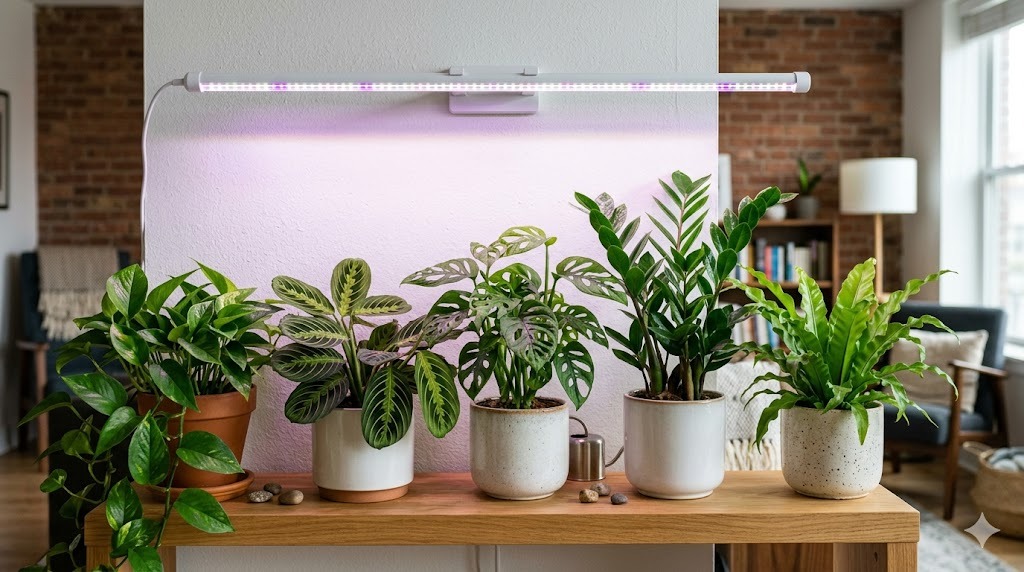
Walk into a grow-light aisle and you’ll see contradictory marketing on every box. “Full spectrum!” “Red and blue for maximum yield!” “5000K daylight bulb perfect for plants!” “PAR rating 850!” The terms are real, but they mean different things, and very few product listings explain how to actually pick one. Most home growers end up with a light that’s fine, an overpriced one, or something that’s almost useless for actual plant growth despite being bright to your eyes.
Plants don’t see light the way humans do. The lumens spec on a regular bulb is meaningless to a plant - it measures human visual brightness. Plants care about specific wavelengths their chlorophyll absorbs, and they care most strongly about red and blue. The middle of the spectrum (green/yellow) bounces off leaves, which is why leaves are green.
This guide untangles the jargon, explains what plants actually use light for, and gives clear recommendations for what to buy depending on what you’re growing.
What “Spectrum” Actually Means
Visible light is a range of wavelengths from roughly 380 nanometres (violet) to 700 nm (deep red). Plants use this light for photosynthesis, but not evenly:
- Blue (400-500 nm) - drives compact, leafy growth. Strong blue = short, bushy, dense plants. Critical for seedlings and leafy greens.
- Green (500-600 nm) - mostly reflected (hence green leaves), but some penetrates deeper into the canopy and is used. Not useless, just less efficient.
- Red (600-700 nm) - drives stem elongation, flowering, and fruiting. Strong red = taller plants, more blooms, more fruit.
- Far-red (700-750 nm) - triggers flowering in some plants, signals “shade” to the plant and can cause stretching.
- UV (under 400 nm) - small amounts trigger plants to produce protective pigments (flavonoids, anthocyanins) - bigger flavour, deeper colour in herbs and lettuce.
- Infrared (over 750 nm) - heat, not photosynthesis.
The two big absorption peaks for chlorophyll are around 450 nm (blue) and 660 nm (red). This is why older “purple” grow lights look pink - they emit mostly blue and red and skip the green.
Full Spectrum vs Red/Blue (Purple) Lights
Red/Blue Purple Lights
Older LED grow lights mix red and blue LEDs in a roughly 5:1 ratio. They look pink-purple, are very efficient (no wasted spectrum), and grow plants well. Downsides:
- Hideous to look at - that purple glow doesn’t fit in a living room.
- Plant problems are hard to spot under coloured light (yellowing leaves all look brownish).
- Slightly less effective than full-spectrum for some flowering plants.
Use case: a grow tent in a closet where aesthetics don’t matter.
Full Spectrum White Lights
Modern LED grow lights produce a “white” light covering all wavelengths from 380-740 nm, often with extra red diodes mixed in. They look like daylight to your eye, plants thrive, and you can see your plants properly.
- Higher up-front cost.
- Slightly less wattage efficiency (some light at green/yellow goes mostly unused).
- The plant-friendly result that fits in a home.
For 95% of houseplant and indoor gardening use, a full-spectrum white LED is the right choice. Not sure whether you even need one? Our light-level checker helps you gauge how bright a given spot really is.
The Specs That Matter (and the Ones That Don’t)
PAR (Photosynthetically Active Radiation)
PAR measures the photons of light in the 400-700 nm range - the actual usable photosynthesis light. Higher PAR = more plant-usable energy.
PPFD (Photosynthetic Photon Flux Density)
PPFD measures PAR at a specific point at a specific distance. Reported in µmol/m²/s. Look for this on serious grow lights:
- Seedlings and microgreens: 100-200 µmol/m²/s
- Leafy greens (lettuce, basil): 200-400 µmol/m²/s
- Houseplants: 100-300 µmol/m²/s
- Flowering / fruiting (tomatoes, peppers): 400-800 µmol/m²/s
- Cannabis (for completeness): 600-1000 µmol/m²/s
If a light’s product page doesn’t mention PPFD, it probably can’t compete on that spec.
DLI (Daily Light Integral)
PPFD over a day. Calculated as PPFD × seconds of light / 1,000,000. Most plants want DLI between 10 (low-light houseplants) and 30 (vegetables, fruiting plants).
Specs That Don’t Matter
- Lumens - measures human visual brightness. Largely irrelevant for plant growth.
- Lux - same as lumens per area. Same issue.
- Watts (only loosely) - modern LEDs vary in efficiency. A 50 W modern LED can outperform a 200 W old-style “plant grow bulb.”
- Kelvin colour temperature (3000K vs 6500K) - describes the colour cast of white light, not the spectrum behind it. A 3000K and 6500K LED can both be excellent or terrible for plants.
What Each Growth Stage Wants
Seedlings
High blue light, moderate red. Compact growth, short stems. A grow light with 4500K-6500K colour temperature, around 200 µmol/m²/s.
Leafy vegetative growth (lettuce, herbs, houseplant foliage)
Balanced blue-heavy spectrum. Same 4500K-6500K range. 200-400 µmol/m²/s.
Flowering and fruiting (tomato, pepper, chilli)
Increase red content. A “bloom” spectrum or 3000K colour temperature works. 400-800 µmol/m²/s.
Houseplants (general decorative)
Just full-spectrum white at moderate intensity. 100-300 µmol/m²/s. They’re not trying to fruit; they’re trying to look healthy.
How Much Light Time?
Most plants want 12-16 hours of light per day under artificial light:
- Seedlings, lettuce, herbs: 14-16 hours.
- Houseplants: 12 hours.
- Flowering plants: depends on species (short-day plants flower with 8-12 hours; long-day plants need 14-16).
- Always give plants 6+ hours of darkness. Continuous light disrupts plant biology and can stunt growth.
A simple timer plug is the best £8 you’ll spend on indoor growing.
Buying Recommendations
Cheapest reliable upgrade for a single houseplant (£15-25): A clip-on white LED grow lamp from a reputable brand. Skip the cheap pink models.
Small herb garden or microgreens tray (£30-60): A 60 cm full-spectrum LED bar above the plants. Sansi, Spider Farmer, MARS HYDRO entry models all work - ideal for the edible crops in our gardening section.
Serious indoor garden / fruiting plants (£100-250): A full-spectrum panel light (Spider Farmer SF1000, MARS HYDRO TS series, Vivosun VS1000) with proper PPFD ratings published.
What to avoid: Old “incandescent plant bulbs” (extremely inefficient), no-brand pink LEDs that don’t publish PPFD, fluorescent tubes (replaced by LEDs across the board).
Common Mistakes
- Putting the light too far from the plant. PPFD drops sharply with distance. Most home grow lights belong 30-60 cm above the plant, not on the ceiling.
- Leaving the light on 24/7. Plants need a night. 12-16 hours on, then off.
- Trusting lumens. A bright-to-your-eye desk lamp does almost nothing for plant growth.
- Mixing wildly different plants under one light. A succulent and a fern need different intensities. Cluster plants by need.
Frequently Asked Questions
Is full-spectrum white better than red/blue purple grow lights?
For home use, almost always yes. The plants grow comparably, you can see them properly, and the light fits in a living space. Red/blue lights are slightly more efficient watt-per-watt and find their niche in commercial grow rooms.
What colour temperature should a grow light be?
For vegetative growth (lettuce, herbs, houseplants) - 4500K to 6500K. For flowering and fruiting - closer to 3000K. Full-spectrum “white” LEDs often blend both into one bulb.
Can I use a regular LED bulb to grow plants?
A bright modern white LED at 5000K or 6500K can grow undemanding houseplants if it’s close enough. It’s far less efficient than a dedicated grow light and won’t grow vegetables well. For pothos on a desk, fine. For tomatoes, no.
How close should a grow light be to plants?
Most home LED grow lights live 30-60 cm above the plant canopy. Too close and you’ll bleach the leaves; too far and PPFD drops too low to matter. Check the manufacturer’s recommended distance.
Do plants need UV light?
A little, yes. Small amounts of UV-A and UV-B trigger plants to produce protective pigments (flavonoids and anthocyanins) - deeper colour, more flavour. Most full-spectrum LEDs include trace UV. Not essential, but it’s why outdoor herbs taste stronger than indoor ones.
🛒 Recommended Gear on Amazon
- Full-spectrum LED grow light - browse current options and reviews on Amazon.
- Plant light meter - browse current options and reviews on Amazon.
- E26 grow light bulbs - browse current options and reviews on Amazon.
As an Amazon Associate, we earn from qualifying purchases - at no extra cost to you. This helps us keep producing free, in-depth guides.