How to Grow Almonds: Early Blossom and Homegrown Nuts on a Warm Wall
A practical guide to growing almonds from a winter planting to a late-summer harvest, including why the early blossom needs frost protection, choosing a self-fertile variety, and guarding against peach leaf curl.
When to sow & harvest
A rough guide for a temperate climate - shift it to your own zone and last-frost date. Greenhouse growing stretches both windows earlier and later.
The almond is a close cousin of the peach, and growing one makes that kinship obvious the moment it flowers. In late winter or very early spring, well before most trees have stirred, the almond breaks into a cloud of beautiful pale pink or white blossom, one of the loveliest sights of the whole gardening year. It is a genuinely rewarding tree to grow for that spring show alone, and in the right spot it will follow the flowers with a crop of your own almonds in late summer.
That early blossom, though, is also the almond's great difficulty in a cool climate. Flowering so far ahead of the season, the delicate blooms are frequently caught and killed by late frosts, and a frosted flower sets no nut. This makes the almond an ambitious, advanced crop rather than an easy one in anywhere but the mildest gardens, and success depends on giving it the warmest, most sheltered position you can find, ideally against a sunny south-facing wall. This guide walks through the whole thing, from planting bare-root in winter and choosing a self-fertile variety, through protecting the blossom and fending off peach leaf curl, to harvesting nuts in late summer or autumn.
Why grow almonds
The first and most reliable reward is the blossom. Even in a garden too cold to crop almonds well, the tree earns its place as a spring ornamental, flowering earlier and more generously than almost anything else and lifting the spirits at the very end of winter. If you never picked a single nut, an almond in full flower against a blue late-winter sky would still be worth growing.
The second reward, in a warm enough spot, is the nuts themselves. Home-grown almonds, harvested and dried, are a real treat and something very few gardeners in cooler regions manage, which is part of the appeal. There is a certain satisfaction in growing a crop most people assume can only come from hot, sunny countries.
And because the almond is so closely related to the peach, growing one teaches you skills that carry straight across to peaches and nectarines: the same early flowering, the same need for warmth and shelter, the same battle with peach leaf curl. If you have grown a wall-trained peach, an almond will feel familiar; if you have not, an almond is a good tree to learn on, with the bonus that its shell protects the crop.
Choosing a variety
The almond you want to eat is Prunus dulcis, the sweet almond, and this is the type sold as an edible or fruiting almond. It is worth being aware that there are also bitter almonds, which are ornamental rather than for casual eating, so buy a named sweet, edible variety from a reputable nursery to be sure of what you are getting. Some almonds are sold mainly as flowering ornamentals and crop poorly, so if nuts are your aim, choose a variety specifically recommended for fruiting.
By far the most useful thing you can do when choosing is to pick a self-fertile variety. Almonds flower so early, at a time when few pollinating insects are about and the weather is often cold and wet, that relying on a second tree for cross-pollination is risky in a cool climate. A self-fertile variety can set nuts with its own pollen, which greatly improves your chances of a crop, and even then, hand-pollinating the flowers with a soft brush on mild days can make the difference in a poor spring. Self-fertile named varieties suited to cooler growing are the ones to seek out.
It also pays to buy an almond grown on a suitable rootstock, which controls the tree's eventual size and can suit it to your soil. For a garden, and especially for training against a wall, a tree on a more dwarfing or moderate rootstock is far easier to manage than a full-sized standard. Ask the nursery which rootstock a tree is on and how large it will grow, and match that to the space and, ideally, the wall you have available.
Planting and starting off
Almonds are planted while dormant, and bare-root trees, sold through the winter, establish well and are the most economical choice. A young, well-formed tree settles more readily than a large one, so there is no advantage in buying an oversized specimen.
The single most important planting decision is the position, and for an almond in a cool climate that usually means training it against a warm, sunny, sheltered wall, most often a south-facing one. A wall stores and radiates heat, offers shelter from cold winds, and gives the early blossom and ripening nuts the extra warmth they need. To plant against a wall, set the tree a little way out from the base, around 20cm or so, because the soil right at the foot of a wall is dry, and lean the young stem in towards the wall so it can be tied to horizontal wires fixed to the brickwork. If you have no suitable wall, choose the warmest, most sheltered sun-trap in the garden and grow the tree as a free-standing bush, but expect cropping to be less reliable.
Dig a good wide hole, plant at the same depth the tree grew before, shown by the soil mark on the stem, firm the soil gently and water in well. Free-standing trees need a stake for the first few years. Whichever way you grow it, keep the base clear of grass and weeds while the tree establishes, and mulch the root area with compost to conserve moisture, especially important at the dry foot of a wall.
Where to grow
Everything about siting an almond comes back to one word: warmth. The almond is a tree of hot, dry, sunny climates, and in a cool garden you are, in effect, trying to recreate a small pocket of that warmth. The warmer, sunnier and more sheltered the position, the better your chances of both good flowering and a ripened crop.
A south-facing wall is close to ideal, providing radiated heat, shelter and the protection of the eaves or a temporary cover against the worst frosts. Failing that, any sun-trap that is protected from cold winds and, crucially, out of frost pockets will give the tree its best shot. Frost pockets, the low-lying spots where cold air pools on still nights, are the almond's enemy, because they are exactly where the early blossom is most likely to be caught. Choose higher, more open ground where cold air drains away, but still sheltered from wind.
Soil should be well-drained and reasonably fertile, and the almond, like the peach, prefers a soil that is not too acidic, doing well on neutral to slightly alkaline ground and tolerating chalk better than many fruit trees. What it will not accept is heavy, cold, wet, waterlogged soil, which encourages disease and poor growth. If your soil is heavy, improving drainage and adding grit and organic matter before planting will help, or consider growing the tree in a large container of free-draining compost that can, if need be, be moved to shelter during the flowering period.
Day-to-day care
In its early years, keep a young almond weed-free at the base, watered in dry spells and, if wall-trained, tied in regularly to its supporting wires as it grows. Watering matters particularly for a wall tree, where the soil stays dry, so do not let it go short in summer.
The defining seasonal task is protecting the blossom from frost, because this, more than anything, decides whether you get a crop. When the flowers are open or opening and frost threatens on a clear, still night, cover the tree overnight with horticultural fleece, or with hessian or old sheets, removing the cover by day so pollinating insects can reach the flowers and the tree can breathe. A wall-trained tree is far easier to cover than a free-standing one, which is another reason walls suit almonds so well. On mild days during flowering, gently dab the open blooms with a soft brush to hand-pollinate them, since the natural pollinators are often scarce so early in the year. This combination of frost protection and hand-pollination is the heart of successful almond growing in a cool climate.
Feeding is modest: an annual spring mulch of compost and, on poorer soil, a light general feed is plenty, avoiding heavy nitrogen. Pruning follows peach practice and is done in spring or summer, never in the dormant winter, because pruning stone fruit in cold, wet weather invites disease to enter the cuts. Almonds fruit on wood made the previous year, so pruning aims to keep a supply of that younger wood coming, while removing dead, damaged and crowded growth. A wall-trained tree is pruned to maintain its trained shape against the wires, tying in new growth and cutting back the rest. Keep all cuts clean and prune in the growing season.
Common problems and pests
The dominant problem, overshadowing all others, is frost damage to the early blossom. An almond can grow perfectly, flower beautifully and still crop nothing at all simply because a cold night caught the open flowers. This is not a disease to be cured but a fact of the tree's early habit, and the defences are the ones already described: a warm, sheltered, frost-free position, and covering the blossom on frosty nights.
The next most important issue is peach leaf curl, the same fungal disease that plagues peaches and nectarines, to which almonds, as close relatives, are also prone. It causes the young leaves to blister, thicken, curl and turn red and puckered in spring, weakening the tree if it recurs year after year. The disease is spread by spores in wet weather in late winter and early spring, so the key defence is to keep the emerging growth dry during that period. On a wall-trained tree this is practical: rig a temporary open-sided shelter of clear polythene over the tree from midwinter until the risk passes in late spring, keeping rain off the buds and young leaves while allowing air to circulate. Clearing away and disposing of any infected leaves also helps reduce the carry-over of spores. It is much harder to protect a large free-standing tree this way, which is yet another argument for wall-training.
Beyond these two, almonds share the general troubles of stone fruit. Aphids may curl and distort the young shoots in spring, birds and squirrels take an interest in the ripening nuts, and a bacterial canker can affect the branches, best guarded against by pruning only in the growing season so the wounds heal quickly. On a healthy, well-sited tree none of these is usually as decisive as frost and leaf curl, which are the two battles that really determine whether almond growing succeeds.
Harvesting
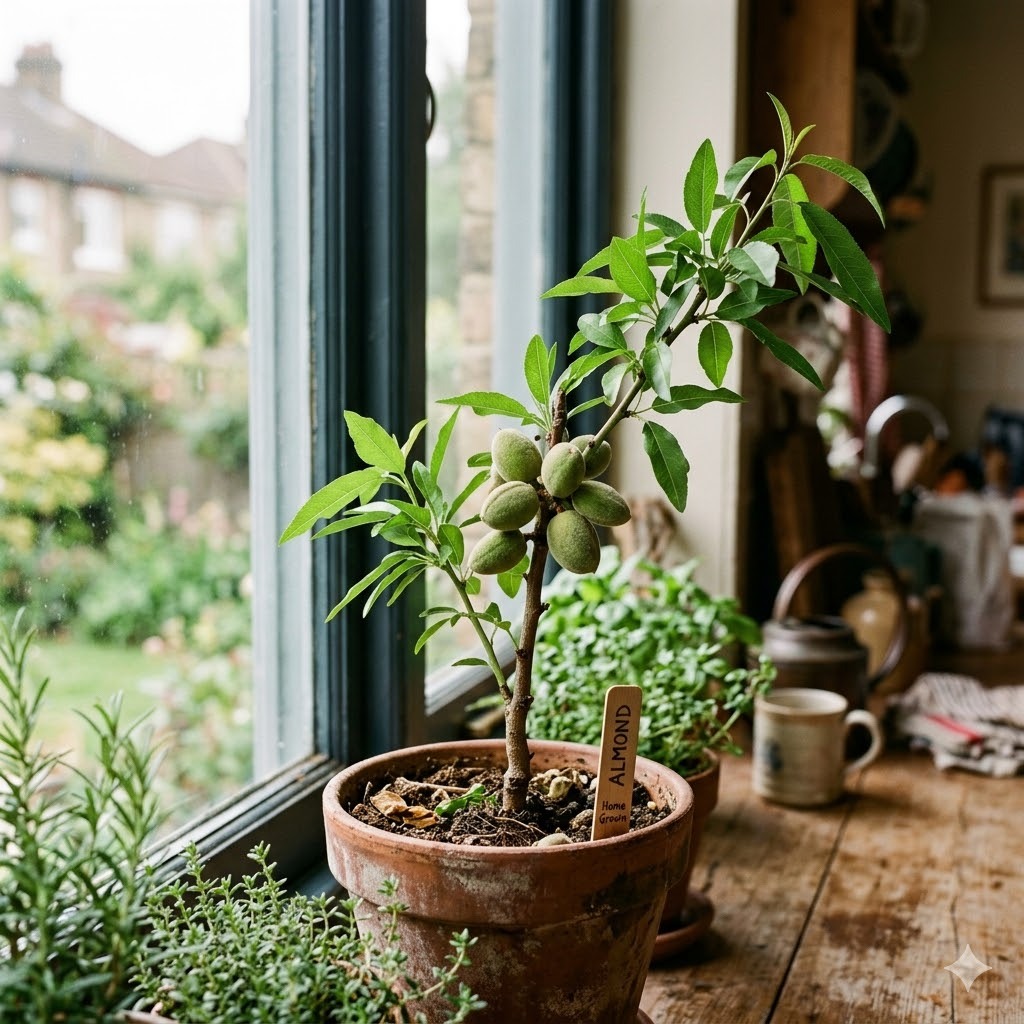
Almonds ripen from late summer into autumn, and the tree tells you when they are ready. The nut develops inside a green, downy, leathery outer hull, rather like a small, hard, inedible peach, and as the nuts ripen this hull dries, splits open and begins to peel back to reveal the familiar pitted shell inside.
Pick the almonds once the hulls have split and dried. You can gather them from the tree at this stage or collect those that have begun to fall. Peel away the split hull from each nut, and you are left with the almond in its shell, just as you would buy it. Do this promptly once ripe, both to beat the birds and squirrels and because nuts left in damp hulls can spoil.
In a cool climate, the honest truth is that not every year will give a full crop, and in a poor summer following a frosty spring you may get very few nuts at all. When the season is kind, though, and the blossom escaped the frost, a well-grown wall almond can hand you a genuinely worthwhile pick of your own nuts, which is a real achievement so far from the tree's Mediterranean home.
Storing and preserving
Freshly picked almonds need drying before they will store, in the same way as walnuts and hazelnuts. Straight off the tree the kernels are moist, and stored damp they will go mouldy.
To cure them, first remove the hulls, then spread the nuts in their shells in a single layer somewhere warm, dry and airy, out of direct sun, and leave them for a week or two, turning occasionally, until the shells are hard and dry and the kernels are crisp rather than soft. A warm shed, spare room or airing cupboard suits the job well.
Once properly dried, almonds in their shells keep for many months in a cool, dry, airy place, ideally in nets, slatted trays or open boxes rather than sealed containers that could trap moisture and cause mould. Check them over from time to time and discard any that feel light or smell rancid. Well-dried nuts stored this way will comfortably see you through the winter.
Shelled almond kernels have a shorter life, as their oils eventually turn, but they freeze very well. Shell the nuts, pack the kernels into bags or tubs and freeze them, and they will keep in good condition for a year or more, ready for baking and cooking. Freezing is the surest way to keep a larger crop over the long term.
Is it worth it?
It depends on what you are after and where you garden. If you want a reliable, easy nut crop, the almond is not it in a cool climate, and this guide has been honest about why: the tree flowers so early that frost frequently destroys the blossom, it needs the warmest, most sheltered spot you can offer, ideally a south wall, and it shares the peach's susceptibility to leaf curl, which takes real effort to keep at bay. It is, fairly, an advanced crop, and in a cold garden some years will give you nothing.
But look at it another way, and the almond becomes one of the most rewarding trees you can grow. Even without a single nut, the early blossom is among the most beautiful sights of the gardening year, so the tree always gives you something. And in a warm, sheltered, well-tended garden, above all trained against a sunny wall with the blossom protected and the leaf curl kept off, it can, in a good year, hand you your own almonds, a crop most people never imagine growing at home. For the gardener who enjoys a challenge, loves the blossom, and has the right warm corner, the almond is a genuinely special thing to grow.