How to Grow Apples in a Small Garden: Big Fruit From a Little Tree on the Right Rootstock
A beginner-friendly guide to growing apples on a patio or in a small garden, using dwarfing rootstocks and trained forms so you do not need an orchard to pick your own.
When to sow & harvest
A rough guide for a temperate climate - shift it to your own zone and last-frost date. Greenhouse growing stretches both windows earlier and later.
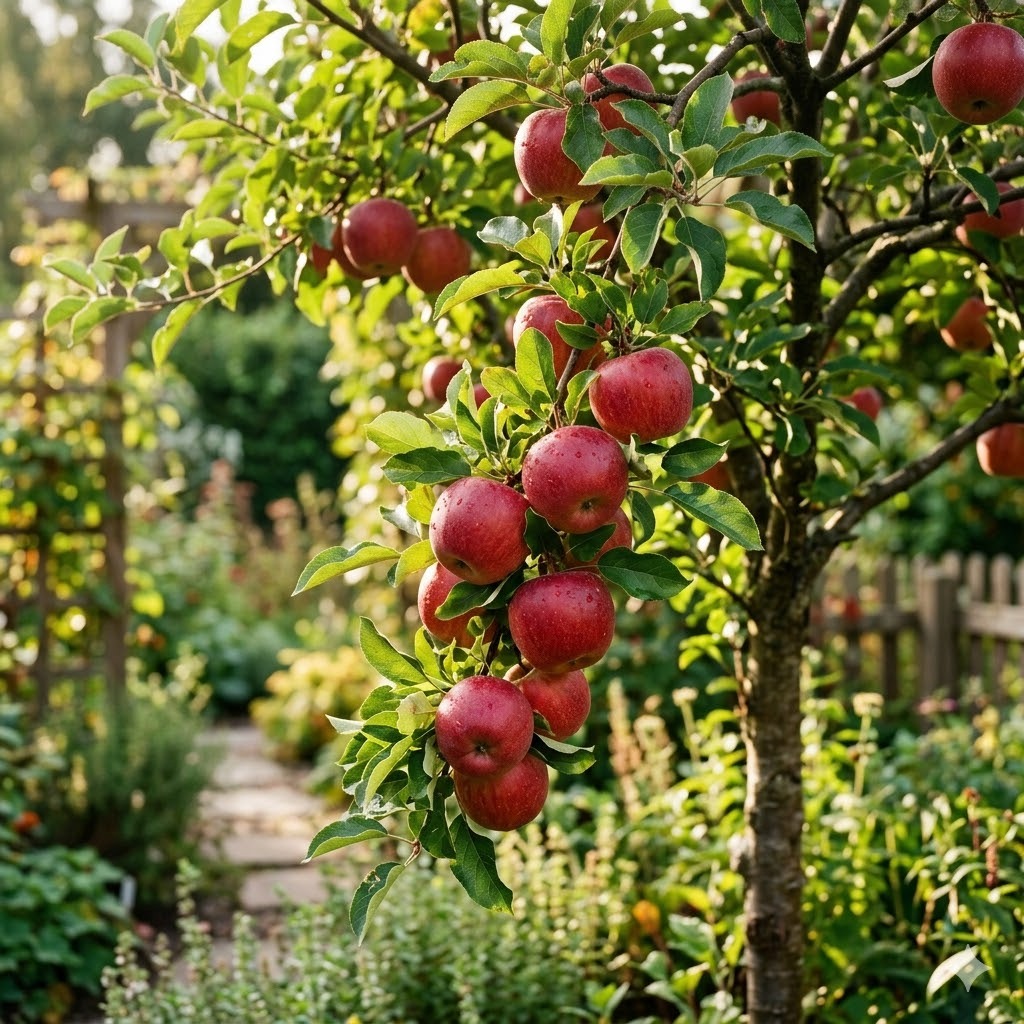
You do not need an orchard to grow apples. The old idea that an apple means a huge spreading tree and a big lawn to put it on is simply out of date. Thanks to dwarfing rootstocks and trained forms, an apple tree can fit against a fence, in a large pot on a patio, or in the corner of the smallest garden, and still hand you a proper crop of fruit each autumn. Of the tree fruits, apples are the most beginner-friendly, and small-garden growing is where they shine.
The two things worth understanding before you buy are the rootstock, which controls how big the tree gets, and pollination, which decides whether it fruits at all. Get those right and the rest is refreshingly straightforward.
Why grow apples
The first reason is variety. Supermarkets sell a handful of apples chosen for looks, storage and shipping, but there are hundreds of varieties out there, many with far better flavour, texture and character than anything on a shelf. Grow your own and you can pick a variety for taste rather than transport - crisp, sharp, aromatic, or old-fashioned and richly flavoured. Once you have tasted a good apple straight off your own tree, the shop ones look dull.
The second reason is how well apples suit small spaces once you drop the orchard idea. A tree on a dwarfing rootstock stays small and easy to reach, and trained forms like cordons and espaliers take up almost no ground at all against a wall or fence. This is genuinely a fruit you can grow on a patio or in a tiny back garden, not a compromise version of one.
The third reason is that apples are forgiving and long-lived. They cope with a range of soils and climates, they are hardy through winter, and a well-chosen tree crops for many years with only modest care. For a beginner wanting real, reliable fruit without a steep learning curve, an apple is close to the perfect starting point.
Choosing a variety
Choosing an apple means making two decisions together: the rootstock and the variety.
The rootstock is the root system the tree is grafted onto, and it controls the tree's final size regardless of the variety on top. For small gardens the dwarfing rootstocks are what you want:
- M27 - very dwarfing, giving a tiny tree ideal for a large pot or a very small space.
- M9 - dwarfing, producing a small tree that fruits young and stays easy to manage.
- M26 - slightly more vigorous, a good semi-dwarf choice for a small garden tree or a trained form on a fence.
The variety on top decides the flavour and season of your fruit, so pick one you actually want to eat, and ideally one suited to your area. But there is a catch beyond taste: most apples need a pollination partner. An apple flower generally needs pollen from a different variety flowering at the same time to set fruit, and varieties are sorted into pollination groups by flowering time - a partner must be in the same or a neighbouring group. In a small garden you have three sensible ways round this:
- Grow two compatible varieties that flower together.
- Choose a self-fertile variety that sets fruit on its own.
- Plant a family tree, which carries two or three compatible varieties grafted onto a single trunk - two apples and a built-in pollination partner in one small plant.
If in doubt, ask the nursery to confirm that your choices pollinate each other, or pick a self-fertile variety for simplicity.
Planting and starting off
Plant apples while they are dormant, from late autumn to early spring, whenever the ground is workable rather than frozen or waterlogged. Bare-root trees planted in this window establish beautifully and are cheaper than pot-grown ones; container-grown trees can go in at other times but need more watering to settle.
Dig a hole wide enough for the roots to spread naturally and plant to the same depth the tree grew at before, keeping the graft union - the visible bulge low on the stem - well above soil level. Burying the graft can let the variety root and escape the dwarfing effect of the rootstock, turning your neat small tree into a big one. Firm the soil gently around the roots and water it in.
Dwarfing rootstocks make small trees, but they also make trees with weaker roots, so a permanent stake is important, especially on the most dwarfing types like M27 and M9. Put it in at planting time and tie the tree to it so wind cannot rock the roots. A tree in a pot needs a large, heavy container, a soil-based compost, and regular watering, since it cannot forage for moisture the way one in the ground can.
Where to grow
Apples want sun and shelter to ripen good fruit. A spot in full sun for most of the day gives the sweetest, best-coloured apples, while a shady position leads to poor, sparse crops. Shelter from strong wind matters too, both to protect the blossom that sets your fruit and to let pollinating insects work the flowers in spring.
Small-garden forms open up all sorts of places. A cordon is a single stem planted at an angle and kept short with pruning, so you can line several up along a fence in the space one normal tree would take. An espalier trains horizontal tiers flat against a wall, both productive and decorative. Both are ideal where ground space is tight but there is a sunny fence or wall going spare. A dwarf bush tree on M27 or M9 suits a large pot on a sunny patio, bringing fruit to a garden with no open soil at all.
Avoid frost pockets - low, cold corners where spring frost can settle and damage the blossom - and avoid deep shade. Given sun, shelter and a bit of room to reach the branches, an apple will crop happily in a surprisingly small footprint.
Day-to-day care
Apples in open ground are fairly self-reliant once established and need watering mainly in their first year or two and during long dry spells while the fruit is swelling. A tree in a pot is the exception and needs regular, attentive watering right through the growing season, because a container dries out fast and drought at fruiting time causes the crop to drop. Feed modestly in spring - a balanced feed or a mulch of well-rotted compost around the base - and avoid overdoing the nitrogen, which brings soft leafy growth at the expense of fruit.
Pruning keeps the tree productive and in bounds, and the approach depends on the form. A bush tree is pruned in winter while dormant, thinning out crowded, crossing and dead wood to keep an open, well-lit centre. Trained cordons and espaliers are pruned mainly in summer, cutting back the new side-shoots to keep the neat shape and encourage fruiting spurs. In both cases the aim is the same: an open, airy framework where light reaches the fruit and air moves freely through the branches.
Thinning the young fruit is the small job that makes a big difference. In early summer, after the tree has set more fruit than it can size up, snip out the smaller and crowded fruitlets so the rest are spaced a hand's width or so apart. This gives you fewer but far larger and better apples, and stops branches breaking under the weight. Do not panic when the tree sheds a load of tiny fruitlets on its own in early summer - the so-called June drop is natural, the tree shedding what it cannot carry, and it does some of the thinning for you.
Common problems and pests
Apples attract a few familiar troubles, none of which need spoil the crop if you keep an eye out. The main ones to know are:
- Codling moth - the classic cause of maggoty apples, where a grub tunnels into the core. Pheromone traps hung in the tree in early summer help catch the males and reduce damage, and clearing fallen fruit removes overwintering grubs.
- Apple scab - a fungal disease showing as dark, scabby blotches on leaves and fruit, worse in wet seasons and on crowded trees. Good airflow through open pruning helps, clearing fallen leaves reduces re-infection, and some varieties are naturally resistant.
- Aphids - clusters of small insects on soft new growth and the undersides of leaves, curling the foliage. Catch them early and they are easily dealt with by squashing, hosing off, or leaving to the ladybirds and other natural predators that soon move in.
Beyond these, birds and wasps take an interest as the fruit ripens, and codling and scab are usually the difference between blemish-free and slightly marked fruit rather than between a crop and none. A home-grown apple with the odd mark is still a far better apple than a flawless shop one, so there is no need to chase perfection.
Harvesting
Apples are ready to pick over a stretch of autumn rather than all at once, and the timing varies by variety - early types are eaten straight off the tree, later ones are picked for storing. The simple test is to cup an apple in your hand and give it a gentle lift and twist; a ripe apple parts easily from the branch with its stalk intact. If you have to tug and wrench, it is not ready yet.
Pick carefully to avoid bruising, because bruised apples do not keep. Lift each fruit gently rather than pulling a handful, and lay them into a basket rather than dropping them. It helps to work from the outside of the tree inwards, and to check the tree over a few times through the season as different apples ripen at different rates.
Handle every apple you mean to store as though it were an egg. The ones destined for the store cupboard should be sound and unbruised, with the stalk still attached; keep any knocked or damaged fruit aside to eat or cook straight away, since a single bruised apple soon spoils its neighbours.
Storing and preserving
Apples are one of the best fruits for storing, and a later-season variety can keep for weeks or even months in the right conditions. Store only perfect, unbruised fruit, keep them somewhere cool, dark and slightly airy such as a shed or garage, and lay them out so they are not touching - a single rotting apple can spoil a whole tray. Check them over regularly and pull out any that are turning.
For the surplus, apples preserve in every direction:
- Apple sauce and puree - cooked down and frozen in portions, a simple way to bank a glut for the freezer.
- Juice - pressed apples make excellent juice, quite unlike the shop version, and it freezes or can be processed to keep.
- Chutneys and preserves - apples add body and sweetness to chutneys, an ideal use for windfalls and less-than-perfect fruit.
- Dried rings - cored, sliced and dried slowly, apples turn into chewy rings that keep for months.
Windfalls and marked fruit that will not store are perfect for all of these, so nothing needs to go to waste even when the crop is more than you can eat fresh.
Is it worth it?
For a small garden, absolutely. Apples are the most beginner-friendly of the tree fruits: forgiving, hardy, long-lived, and - once you understand rootstocks and pollination - genuinely easy to fit into the tightest space. A tree on a dwarfing rootstock or a cordon along a fence gives you real fruit without needing anything like an orchard, and the care it asks for is modest and seasonal rather than constant.
The only real homework is at the buying stage: choose a dwarfing rootstock to suit your space, and sort out pollination with a partner variety, a self-fertile type, or a family tree. Get those two decisions right at the nursery, and you are set up for years of your own apples from a plant that fits on a patio. For a beginner wanting reliable home fruit in a small garden, it is hard to do better.