How to Grow Blackberries: Bigger, Sweeter and Thornless Off Your Own Fence
A beginner's guide to growing cultivated blackberries on wires, from choosing a thornless variety to the tie-in trick that keeps picking easy, plus freezing and jam.
When to sow & harvest
A rough guide for a temperate climate - shift it to your own zone and last-frost date. Greenhouse growing stretches both windows earlier and later.
Everyone knows the wild blackberry, snatched from a scratchy hedgerow in late summer. What fewer people realise is that garden blackberries are a big step up: cultivated varieties crop far more heavily, with larger and sweeter fruit, and the best modern types have no thorns at all. Trained along a fence or a few wires, a thornless blackberry gives you buckets of easy-to-pick fruit for years, with none of the bloodshed of the hedgerow. It is one of the most productive and forgiving fruits a beginner can grow.
Why grow blackberries
The honest reason is that cultivated blackberries are simply better than the wild ones and better value than the shop ones. Hedgerow brambles give small, seedy, often sharp fruit and tear your hands to pieces in the process. A named garden variety gives fat, glossy, genuinely sweet berries in far greater quantity, and if you choose a thornless one you can pick them in comfort. Shop blackberries, meanwhile, are pricey and picked underripe, so home-grown wins easily on both taste and cost.
They are also enormously productive for the space. A single plant, fanned out along a fence or trellis, will cover a good stretch of wall and pour out fruit over several weeks in late summer and autumn. Few plants give so much from one planting, and they crop late in the year when much else is finishing, extending your homegrown season nicely.
And they are tough. Blackberries are vigorous, hardy and hard to kill, which makes them very forgiving of a beginner's mistakes. Plant one well and it will reward you for many years with almost no coaxing.
Choosing a variety
The single best decision you can make is to choose a thornless variety. This one choice transforms blackberry growing from a prickly ordeal into an easy pleasure, because training and picking a thornless plant is genuinely comfortable. There is no flavour penalty for going thornless, so for a home garden there is little reason to grow anything else.
- Loch Ness - a popular thornless variety with upright canes and heavy crops of good, sweet berries. It is well behaved and a reliable choice for a beginner.
- Oregon Thornless - a thornless type with attractive, deeply cut leaves, so it looks handsome trained on a fence as well as cropping well. A good pick where the plant will be on show.
Both are far heavier cropping and sweeter than any wild bramble, and both are easy to keep tidy on wires. Whatever you choose, check the label says thornless, and you will thank yourself every time you go out to pick.
Planting and starting off
Blackberries are usually started from a young potted plant or a bare-rooted plant bought over the dormant season. The best time to plant is from late autumn to early spring, while the plant is dormant, though pot-grown plants can go in at other times if kept well watered.
You typically need only one or two plants, because each is vigorous and will cover a lot of ground. Give each plant plenty of room - a good couple of metres or more of fence to spread along - and plant it at the same depth it was in its pot, or to the old soil mark on a bare-rooted plant. Firm it in and water it well.
Do not expect a full crop in the first year. The plant spends its first season growing the long canes that will carry fruit the following year, so patience early on is repaid with a proper harvest from the second summer onwards.
Where to grow
Blackberries are not fussy, but they crop best in a sunny or lightly shaded spot with reasonable, moisture-holding soil. They tolerate poorer ground and partial shade better than most fruit, which is part of why they are so easy, but more sun means more and sweeter berries.
The key thing to plan for is space and support. Blackberries are vigorous and their canes are long and whippy, so they need something to be tied to and trained along - a fence, a wall with wires, or a run of sturdy posts and horizontal wires. Fanning the canes out along wires is not just tidy, it is what makes the plant manageable and the fruit easy to reach. Do not try to grow a blackberry as a free-standing bush in the middle of a lawn; give it a structure to climb and it becomes a well-behaved, generous crop.
Day-to-day care
Once planted and tied in, blackberries need little from you, but a few habits keep them cropping well and tidy.
Water in dry spells, especially in the first year while the plant is settling in and later while the fruit is swelling, as thirst at that point means smaller, drier berries. A mulch of compost or well-rotted manure round the base in spring holds moisture and feeds the plant, which is usually all the feeding a blackberry needs. They are not hungry plants.
The one skill worth learning is how to train the canes, and it rests on the same principle as summer raspberries: blackberries fruit on canes that grew the year before. That means at any time you have two sets of canes on the plant - this year's new canes, which will fruit next year, and last year's canes, which are fruiting now. The trick that keeps everything sane is to tie in this year's new canes separately from the ones currently fruiting, for instance training the new growth to one side or along a different wire. Keeping the two apart means that after harvest you can easily see which canes have finished and cut them out.
So the yearly cycle is simple: after the plant has finished cropping, cut out the old canes that carried fruit right down to the base, then keep the fresh new canes and tie them neatly onto the wires ready to fruit next year. Because you kept them separate, you will not accidentally cut off next year's crop.
Common problems and pests
Blackberries are remarkably trouble-free, which is a large part of their appeal. The main challenges are less about disease and more about vigour and birds.
Birds enjoy ripe blackberries and will help themselves, so netting the plant as the fruit colours protects your share if birds are a nuisance where you are.
Vigour is the thing to stay on top of. Blackberries grow strongly and, left unmanaged, the canes sprawl and root where their tips touch the ground, quietly making new plants and taking over. Keeping the canes tied in to the wires and cutting out the old ones each year keeps the plant productive and stops it running wild. Prune any stray, rooting cane tips before they establish themselves where you do not want them.
In wet late summers, keep an eye out for grey mould on the ripening fruit, and pick off anything rotting so it does not spread through a cluster. Beyond that, there is very little that seriously troubles a healthy blackberry.
Harvesting
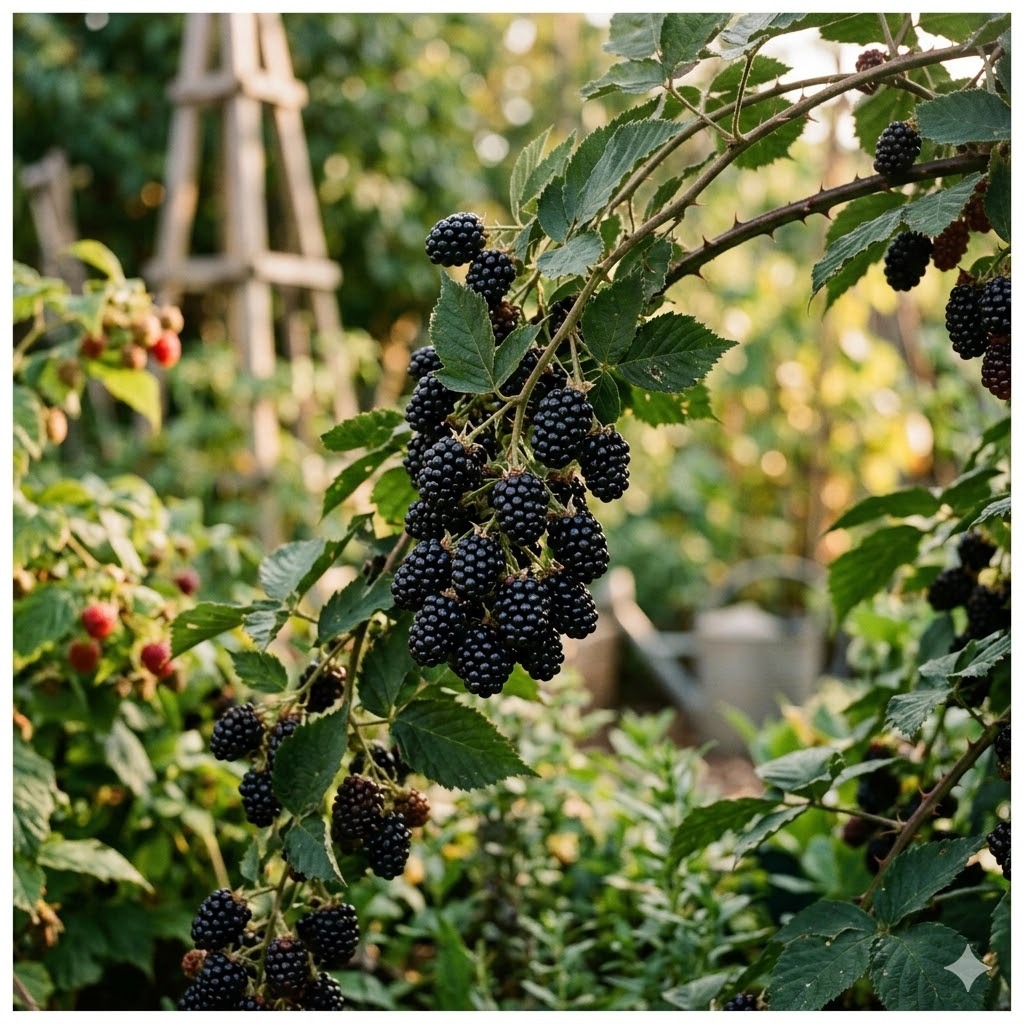
Blackberries are ready when they are fully black, plump and slightly soft, and come away from the plant with only a gentle pull. Unlike raspberries, the little core stays inside the blackberry when you pick it. If a berry is still firm or shows any red, leave it, because it will only be sharp - the sweetest fruit is the fully ripe, softly yielding kind.
Pick over the plant every couple of days through the cropping weeks, as ripe berries do not keep on the plant and will spoil or be taken by birds and wasps if left. Pick into a shallow container so the soft fruit at the bottom does not get crushed, and pick in dry weather where you can, since wet berries deteriorate quickly. On a thornless variety this is a pleasant job rather than a battle, which is exactly the point of choosing one.
Storing and preserving
Fresh blackberries do not keep long. In the fridge they last only a day or two before softening and going mouldy, so use them quickly or preserve them promptly, and do not wash them until you are ready to eat or cook them.
Happily, they preserve very well and a big late-summer crop is easily banked:
- Freezing - blackberries freeze excellently. Spread them on a tray to freeze individually, then bag them up, and you have loose fruit to pull out through winter for crumbles, pies and smoothies. They soften on thawing but hold their flavour, so they are ideal for cooking.
- Jam and jelly - blackberries make rich, dark jam, and blackberry-and-apple is a classic combination that sets well and tastes wonderful. A glut turned into jars carries the taste of late summer right through the year.
You can also stew a surplus down into a simple compote to freeze, ready to spoon over porridge and puddings. Between the freezer and the preserving pan, no blackberry harvest need go to waste.
Is it worth it?
Yes, and especially if you choose a thornless variety. For the price of one or two plants and a bit of fence with some wires, you get a tough, vigorous fruit that crops heavily every late summer for years, with fat, sweet berries far superior to anything from a hedgerow or a shop. The plants shrug off poor conditions, need little feeding and suffer few pests, which makes them very forgiving for a beginner.
The only real work is tying the canes onto the wires and cutting out the old ones once a year, and keeping the plant's natural vigour in check. Do that, pick a thornless type so the job is comfortable, and a blackberry will reward you generously for a very long time. For a productive, low-effort fruit that fills a fence and a freezer, it is hard to beat.