How to Grow Broad Beans: The Hardy First Crop of the Year
A practical guide to growing broad beans from autumn or spring sowing to early summer picking, including the pinching-out trick that beats blackfly and how these plants feed your soil for free.
When to sow & harvest
A rough guide for a temperate climate - shift it to your own zone and last-frost date. Greenhouse growing stretches both windows earlier and later.
Broad beans are one of the easiest and most encouraging crops a new grower can take on. They are tough, they crop early, and they need almost nothing from you along the way. Sow a few in the ground, keep the weeds down, and you will be picking fat green pods while much of the vegetable garden is still finding its feet. For anyone wanting a quick win in their first season, they are hard to beat.
They also happen to be a generous crop in a way that goes beyond the harvest. As legumes, broad beans work with bacteria in the soil to capture nitrogen from the air, so they leave the ground a little richer than they found it. That makes them a smart choice at the start of a rotation, and it is one more reason a row or two earns its place. This guide takes you through the whole thing, from choosing when to sow to what to do with the plants once the last pods are picked.
Why grow broad beans
The first reason is timing. Broad beans are among the earliest fresh vegetables of the year. Sown in autumn or in early spring, they are cropping in late spring and early summer, well ahead of most other beans, which fills a real gap in the growing calendar. Fresh broad beans, popped from their velvety pods and cooked within an hour, are a completely different thing from the frozen ones - sweeter, greener and far more tender.
The second reason is how little trouble they are. Broad beans are properly hardy, shrugging off cold that would flatten most crops, and the autumn-sown plants will sit through frost and even snow without complaint. They ask for no heat, no propagator and no cosseting. You put the seed straight in the ground and let it get on with the job.
The third reason is what they do for the soil. Being a legume, the broad bean fixes its own nitrogen, so it is not competing with you for fertiliser, and if you chop the plants down and leave the roots in the ground at the end, that captured nitrogen stays behind to feed whatever follows. Few crops give back so willingly.
Choosing a variety
Broad beans fall into a few groups, and the main thing that separates them is how hardy they are and how big the beans grow.
Longpod types are the reliable, hardy workhorses. They produce long, narrow pods, each holding a good number of beans, and they are the toughest of the lot. If you want to sow in autumn and have the plants stand through winter, choose a longpod known for hardiness. This is the group most people start with.
Windsor types carry shorter, broader pods with fewer but larger, often sweeter beans, and many growers rate them the best for flavour. They are generally less hardy, so they suit a spring sowing rather than an autumn one.
Dwarf varieties stay compact, often under half a metre, which makes them handy for small beds, exposed sites and containers, where taller plants would need staking against the wind.
If you are sowing in autumn, pick a variety specifically recommended for it. For a spring sowing you have a free hand, so it is worth trying a well-flavoured Windsor type alongside a dependable longpod.
Sowing and starting off
Broad beans are almost always sown straight into the ground where they are to grow, which is part of what makes them so easy. There are two main windows.
An autumn sowing, from around late October into November in milder areas, gives you the earliest possible crop. The plants germinate, make a little growth, and then sit tight through the cold, romping away as soon as the days lengthen. They crop a few weeks ahead of spring-sown plants and often escape the worst of the blackfly. The risk is that a truly savage winter, or heavy wet soil, can kill them off, so it is a gamble that pays best on free-draining ground in a kinder climate.
A spring sowing, from late winter to mid-spring as soon as the soil is workable, is the safer bet and the one most people rely on. You can start the very earliest sowings in pots or root trainers under cover and plant them out once they are up and the weather has softened.
However you sow, plant the seeds around 5cm deep and space them roughly 20cm apart, in double rows about 20cm apart with a wider path between each pair of rows. That double-row arrangement makes it easy to support the plants later. Broad bean seeds are large and easy to handle, which is another point in their favour for anyone gardening with children.
Where to grow
Broad beans are an outdoor crop from start to finish. They want an open, sunny spot and firm, well-drained soil that has not been freshly manured, since too much rich nitrogen pushes leafy growth at the expense of pods - and remember, the plants make their own nitrogen anyway.
The only time cover comes into play is for those earliest spring sowings started in pots under glass or in a cold frame, purely to get young plants going a fortnight or so sooner. Once they are up and hardened off, they go out into the open ground like everything else. There is no need, and no benefit, to growing the crop itself under cover.
A sheltered position helps, because tall varieties in full pod can be top-heavy and prone to being rocked or flattened by wind. If your garden is exposed, either choose a dwarf variety or plan to support the plants well.
Day-to-day care
Broad beans are refreshingly low-maintenance, but a few small jobs make the difference between a scrappy row and a heavy one.
Keep the bed weeded while the plants are young, then let the growing crop shade out most competition. Water in dry spells, and especially once the plants come into flower and start setting pods, as that is when a lack of water will cost you beans.
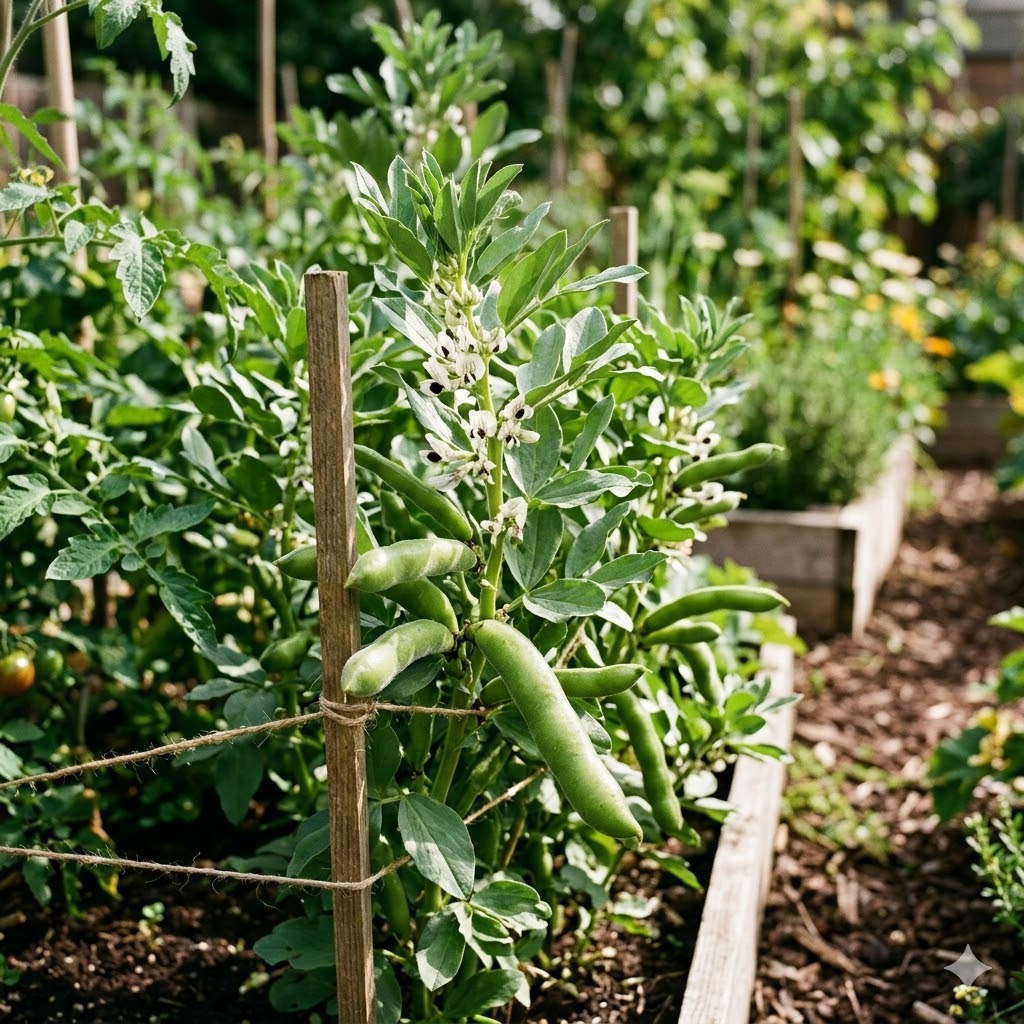
Taller varieties need support. The neat trick is to knock a stake into each corner of your double row and run string around the outside at one or two heights, boxing the plants in so they cannot flop. Do this before they get tall and heavy rather than after.
Then comes the one job that really matters, and it is worth doing at the right moment. As soon as the first pods have set at the base of the plant, pinch out the soft growing tip at the very top of each stem - just nip off the top few centimetres of tender young growth. This does two things. It steers the plant's energy into filling pods rather than making more leaf, and, crucially, it removes the exact tender shoots that blackfly love best, which is your single most effective defence against that pest. The pinched-out tips are edible too, cooked like spinach, so nothing is wasted.
Common problems and pests
The classic broad bean problem is blackfly - blackbean aphid - which cluster in dense black colonies on the soft growing tips and can smother the top of a plant. They arrive as the weather warms, which is one reason autumn-sown crops, being further ahead, often escape the worst of them. Your best move is the one already described: pinch out those tips the moment the first pods set, removing the aphids' favourite feeding ground. If a colony still builds up, a hard jet of water or a squash between finger and thumb will knock it back, and ladybirds and other predators usually arrive to help.
Chocolate spot is a fungal disease that shows as reddish-brown blotches on leaves and stems, worst in damp, still, crowded conditions and on overwintered plants. Good spacing and airflow keep it in check, and mild cases rarely do much harm.
Broad bean rust appears late in the season as small orange-brown pustules on the leaves, but it usually arrives when the crop is nearly done, so it seldom matters much.
Mice can be a nuisance with autumn sowings, digging up and eating the large seeds before they germinate. Starting those sowings in pots under cover sidesteps the problem entirely.
Harvesting
Broad beans give you a choice of harvests, depending on how you like to eat them.
For the classic full-sized beans, wait until the pods have swelled and you can clearly feel the beans inside, but pick before the pods turn leathery and the scar where each bean joins the pod goes from white or green to black, which is the sign they are getting starchy and tough. Pick from the bottom of the plant upwards, as the lowest pods mature first. Hold the stem with one hand and pull the pod down and off with the other, so you do not tear the plant.
If you like them very young and tender, you can pick some pods when they are no longer than your finger and cook them whole, pods and all, like mangetout. And do not forget the pinched-out growing tips earlier in the season, which are a small extra crop in their own right.
Pick regularly once the beans start coming, both because they are at their best young and because keeping a plant picked encourages it to keep producing.
Storing and preserving
Broad beans are best eaten fresh, ideally within a day of picking, when they are at their sweetest. In the fridge, unshelled pods will keep for a few days, though the sugars start turning to starch fairly quickly.
For anything beyond that, freezing is the answer and broad beans freeze extremely well. Pod the beans, blanch them briefly in boiling water, cool them fast in cold water, drain, and freeze in bags. Many people go one step further and slip the tough outer skin off each bean, either before or after freezing, to leave the tender bright green kernel inside - fiddly, but the result is lovely. Frozen this way they keep for many months and are a world away from a bought bag.
You can also leave a few of the last pods on the plant to dry out completely, then shell and store the dried beans in jars. Dried broad beans need long soaking and cooking but make good, hearty additions to soups and stews through winter, and of course they double as next year's seed.
Is it worth it?
Absolutely, and broad beans are one of the crops I would recommend to anyone starting out. They are tough enough to sow in autumn and forget, easy enough to succeed with on the first attempt, and quick enough to reward you early in the year when the garden has little else to offer. The one job that matters - pinching out the tops - is simple, well timed and doubles as pest control.
Add in the fact that they feed the soil rather than draining it, leaving the ground in better heart for the next crop, and the case is easily made. Even the trimmings are edible. For an early, generous, genuinely low-effort crop that improves your soil into the bargain, broad beans are one of the best things you can plant.